
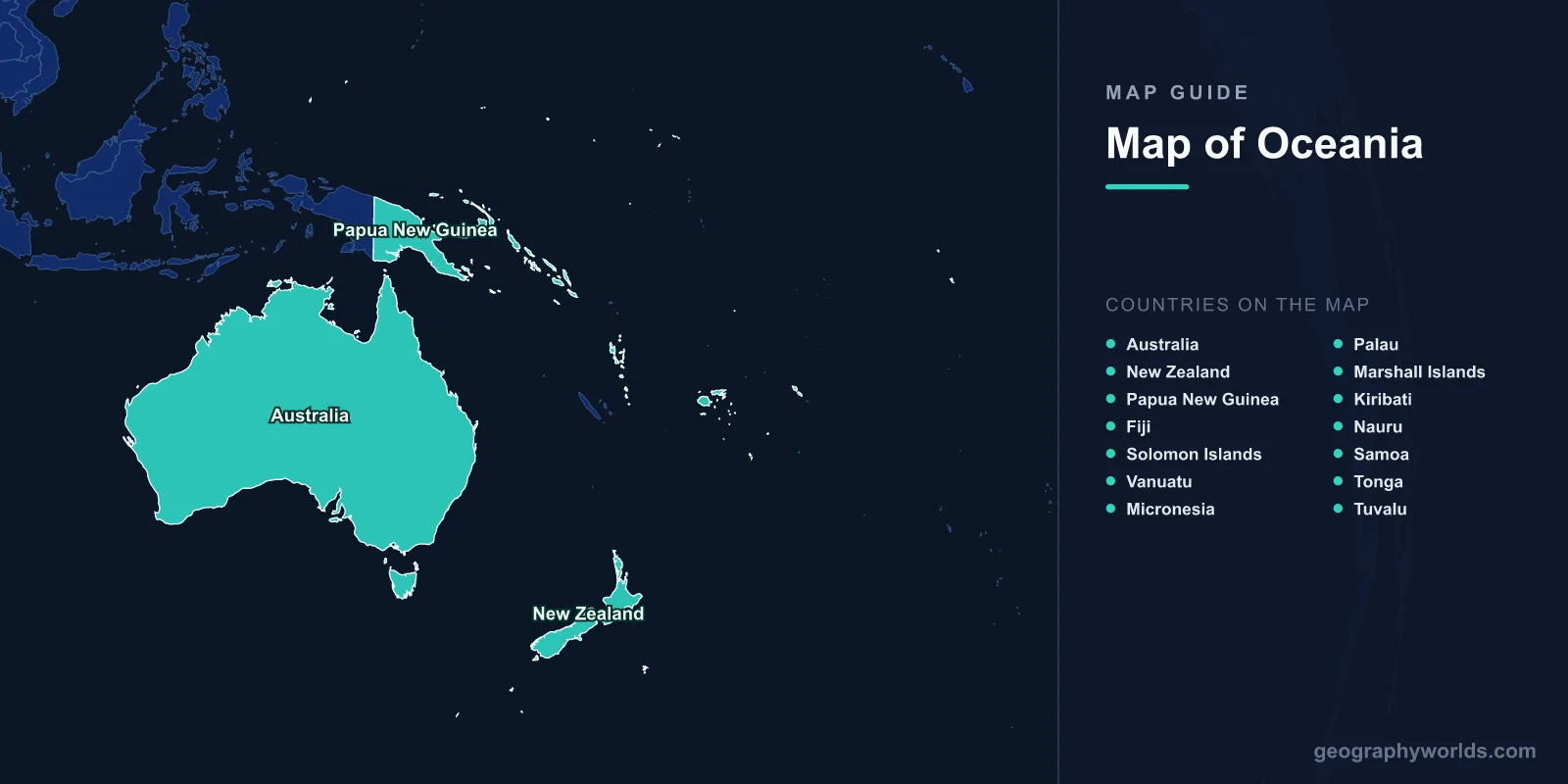
Oceania is a geographic region encompassing 14 independent countries spread across the Pacific Ocean, from Australia in the west to the remote islands of Polynesia in the east. It is traditionally divided into four sub-regions: Australasia (Australia and New Zealand), Melanesia, Micronesia, and Polynesia. While Oceania's total land area is only about 8.5 million square kilometers — dominated by Australia's 7.7 million km² — its maritime zones span roughly one-third of the Earth's surface.
Introduction
Oceania is unique among the world's geographic regions in that it is defined more by ocean than by land. Thousands of islands scattered across the Pacific make up nations that are among the smallest and most isolated on Earth. Yet this region includes Australia, a continent-sized country, and New Zealand, one of the most geographically dramatic nations anywhere. Understanding Oceania's map requires thinking in terms of vast oceanic distances.

Australasia
- Australia: 7.7 million km². Capital: Canberra. The world's smallest continent and sixth-largest country. Six states and two territories, with major cities Sydney, Melbourne, Brisbane, and Perth along the coast.
- New Zealand: 268,021 km². Capital: Wellington. Composed of the North and South Islands, plus smaller islands. Known for dramatic mountains, fjords, and volcanic activity.
Australia dominates Oceania geographically, accounting for over 90% of the region's total land area. Its interior is largely arid outback, while the populated coastal fringe features diverse landscapes from tropical rainforest in Queensland to temperate forests in Tasmania. The Great Barrier Reef off the northeast coast is the world's largest coral reef system.
Melanesia
Melanesia ("Black Islands") lies in the southwestern Pacific, north and east of Australia:
- Papua New Guinea: 462,840 km². Capital: Port Moresby. The largest Pacific Island nation, with over 800 languages spoken.
- Fiji: 18,274 km². Capital: Suva. An archipelago of 333 islands, a major Pacific tourism hub.
- Solomon Islands: 28,896 km². Capital: Honiara. Scene of fierce World War II battles at Guadalcanal.
- Vanuatu: 12,189 km². Capital: Port Vila. An archipelago of 83 islands with active volcanoes.
Melanesia contains the largest and most geographically complex islands in the Pacific. Papua New Guinea alone has mountain peaks exceeding 4,500 meters, extensive tropical rainforest, and one of the highest levels of linguistic diversity on Earth.
Micronesia
Micronesia ("Small Islands") consists of thousands of tiny islands in the western and central Pacific, north of the equator:
- Federated States of Micronesia: 702 km². Capital: Palikir. 607 islands spread across 2.6 million km² of ocean.
- Palau: 459 km². Capital: Ngerulmud. Famous for pristine coral reefs and the Rock Islands.
- Marshall Islands: 181 km². Capital: Majuro. Includes Bikini Atoll, site of US nuclear tests.
- Kiribati: 811 km². Capital: Tarawa. Straddles the equator and the International Date Line, spread across 3.5 million km² of ocean.
- Nauru: 21 km². No official capital. The world's third-smallest country by area.
Polynesia
Polynesia ("Many Islands") is the largest sub-region by ocean area, forming a vast triangle with Hawaii, New Zealand, and Easter Island at its vertices:
- Samoa: 2,842 km². Capital: Apia. The heart of Polynesian culture.
- Tonga: 747 km². Capital: Nuku'alofa. The only Pacific Island nation that was never colonized.
- Tuvalu: 26 km². Capital: Funafuti. The world's fourth-smallest country, gravely threatened by sea-level rise.
Polynesian nations share cultural and linguistic connections across vast ocean distances. The Polynesian navigators were among history's greatest sailors, colonizing islands thousands of kilometers apart using traditional wayfinding techniques based on stars, currents, and bird movements.
Geographic Context
- Total Land Area: ~8.5 million km² (mostly Australia)
- Oceanic Extent: ~100 million km² of Pacific Ocean
- Population: ~45 million (Australia alone: ~26 million)
- Highest Point: Puncak Jaya, Papua, 4,884 m (if including wider Oceania); Mount Kosciuszko, 2,228 m (Australia)
The Pacific Ring of Fire runs through Oceania, producing the volcanic islands of Melanesia, the geothermal activity of New Zealand, and the occasional devastating earthquakes and tsunamis. Many low-lying atoll nations in Micronesia and Polynesia face existential threats from climate change and rising sea levels.
Key Facts
- Oceania has 14 independent countries across four sub-regions.
- Australia accounts for over 90% of Oceania's land area at 7.7 million km².
- Papua New Guinea has over 800 languages, the most linguistically diverse country on Earth.
- Kiribati is the only country spanning all four hemispheres (north, south, east, west).
- Many Pacific Island nations face existential threats from rising sea levels.
Fun Facts
- Tonga is the only Pacific nation that was never formally colonized by a European power.
- The Federated States of Micronesia has just 702 km² of land spread across 2.6 million km² of ocean — a land-to-water ratio of about 1:3,700.
- New Zealand was the last major landmass to be settled by humans, around 1250-1300 AD.
- Nauru, at 21 km², was once the wealthiest country per capita in the world due to phosphate mining.
Final Thoughts
The map of Oceania spans a staggering portion of the globe, from the continental landmass of Australia to the tiniest coral atolls of Micronesia and Polynesia. Its 14 countries represent extraordinary diversity in size, geography, and culture. Understanding Oceania means appreciating both the vastness of the Pacific Ocean and the resilience of island peoples who have navigated and inhabited it for thousands of years.
Test Your Knowledge!
Think you know where things are on the map? Test your skills!
Play Geography Games →