
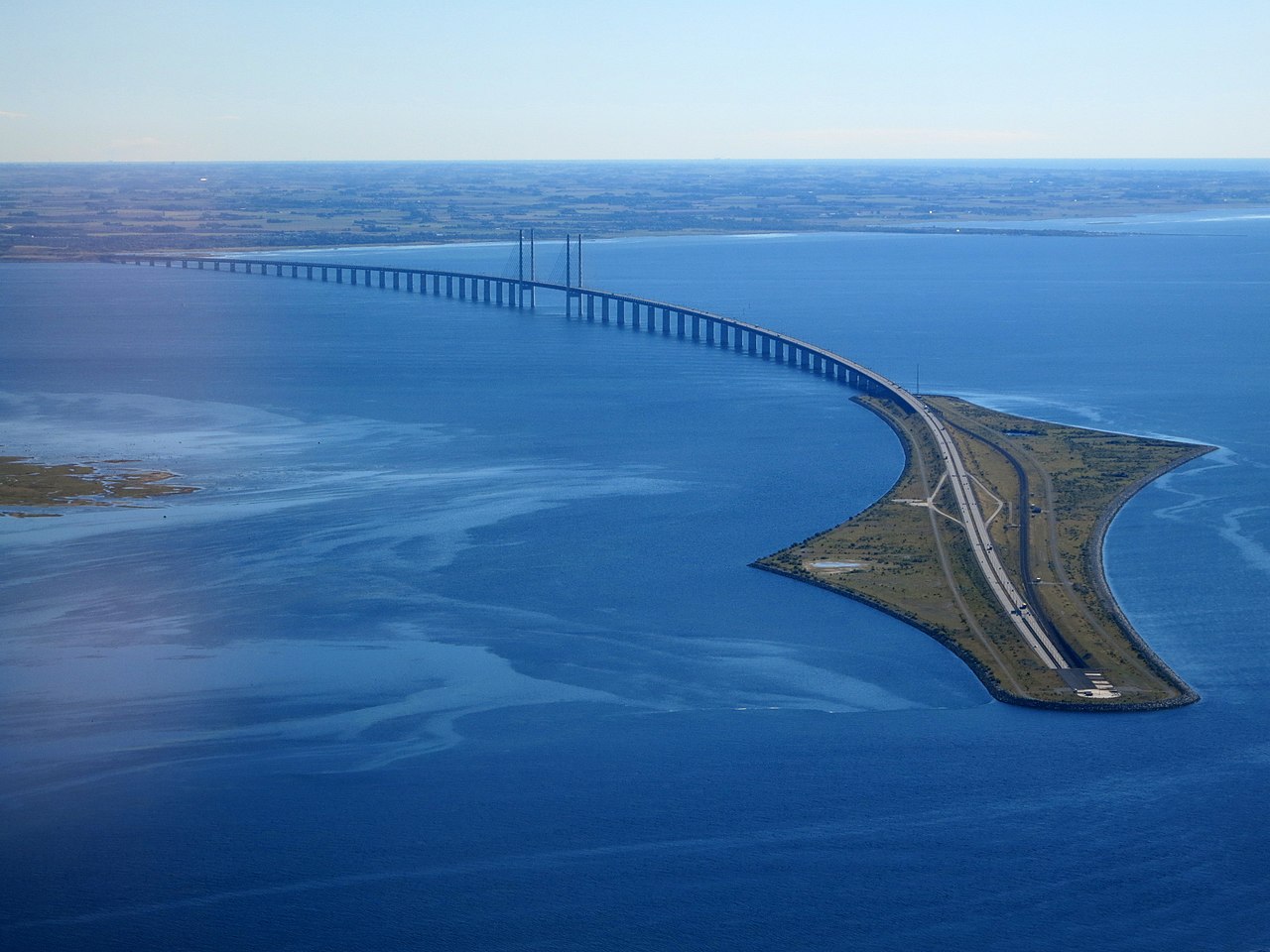
The Øresund Bridge is a combined motorway and railway link connecting Copenhagen, Denmark, to Malmö, Sweden, across the Øresund strait. Opened on July 1, 2000, the crossing consists of a 7,845-meter cable-stayed bridge, a 4,055-meter artificial island called Peberholm, and a 4,050-meter immersed tunnel called the Drogden Tunnel, making the total crossing approximately 16 kilometers.
Introduction
The bridge portion features a 490-meter main span supported by 204-meter-tall pylons, making it the longest combined road and rail bridge in Europe. The Øresund Link, as the entire crossing is formally known, was one of the most ambitious infrastructure projects in European history and has fundamentally transformed the relationship between Denmark and Sweden.
Engineering & Design
- Type: Cable-stayed bridge with immersed tunnel
- Bridge Length: 7,845 meters
- Main Span: 490 meters
- Pylon Height: 204 meters
- Opened: July 1, 2000
The Øresund Bridge carries a four-lane motorway on its upper deck and a twin-track railway on the lower deck. The cable-stayed section features two H-shaped concrete pylons rising 204 meters above sea level, making them the tallest structures in Sweden at the time of construction. The bridge transitions to an artificial island, Peberholm, where it meets the Drogden Tunnel.
The immersed tunnel was chosen for the western portion to avoid disrupting air traffic at Copenhagen Airport and to maintain shipping lanes. Twenty prefabricated concrete tunnel segments, each weighing 55,000 tonnes, were lowered into a trench dredged in the seabed. The transition from bridge to tunnel on the artificial island Peberholm required precise engineering to manage the grade changes between the two structures.
Geographic Setting
- Location: Øresund strait, between Denmark and Sweden
- Connects: Copenhagen to Malmö
- Strait Width: Approximately 16 km at crossing
- Water Depth: Up to 10 meters in the strait
The Øresund strait separates the Danish island of Zealand from the Swedish province of Scania, connecting the Baltic Sea to the North Sea via the Kattegat. The strait is relatively shallow, averaging about 10 meters in depth, which made both bridge and tunnel construction feasible. It is one of the busiest shipping lanes in the world, with over 30,000 vessel passages per year.
The artificial island Peberholm, created from material dredged during construction, has become an unexpected ecological success. Left deliberately undeveloped, it has been colonized by over 500 plant species and serves as a breeding ground for rare birds. The island's name means "Pepper Islet," a playful reference to the nearby natural island of Saltholm ("Salt Islet").
Construction History
- Construction Start: 1995
- Cost: €3.8 billion
- Duration: 5 years
- Workforce: Over 5,000 workers at peak
The idea of a fixed link across the Øresund was discussed for over a century before construction began. Danish and Swedish governments signed a treaty in 1991 committing to the project, which was financed entirely through tolls and private loans without government subsidies. Construction began in 1995 and involved workers from dozens of countries using some of the largest construction vessels ever built.
The project required dredging 7.5 million cubic meters of material from the seabed and moving 1.4 million cubic meters of rock. Environmental concerns were paramount, as the Øresund is a critical waterway for Baltic Sea water circulation. Engineers had to ensure that the bridge piers and tunnel would not significantly alter water flow between the North Sea and the Baltic.
Cultural & Economic Impact
- Daily Traffic: ~20,000 vehicles
- Commuters: Over 15,000 daily cross-border commuters
- Economic Zone: Øresund Region, 3.8 million people
- Pop Culture: Featured in TV series The Bridge (Broen/Bron)
The Øresund Bridge created the Øresund Region, a transnational metropolitan area of approximately 3.8 million people spanning two countries. Daily commuting between Copenhagen and Malmö increased dramatically, with over 15,000 people crossing the bridge daily for work. Property prices in Malmö rose significantly as Swedes and Danes realized they could live in one country and work in the other.
The bridge gained worldwide cultural recognition through the Danish-Swedish television crime series "The Bridge" (Broen/Bron), which used the crossing as both its setting and central metaphor. Economically, the Øresund Region has become one of northern Europe's most dynamic areas, with integrated labor markets, shared university collaborations, and coordinated urban planning across national borders.
Key Facts
- The total Øresund crossing is approximately 16 km, combining bridge, island, and tunnel.
- The cable-stayed bridge portion spans 7,845 meters with a 490-meter main span.
- Over 15,000 people commute across the bridge daily between Denmark and Sweden.
- The artificial island Peberholm has become an important ecological habitat.
- The Øresund Region created by the link has a combined population of 3.8 million.
Fun Facts
- The artificial island Peberholm was named as a humorous counterpart to nearby Saltholm.
- The Drogden Tunnel is made of 20 prefabricated segments each weighing 55,000 tonnes.
- The bridge was featured prominently in the hit Scandinavian TV series "The Bridge" (Broen/Bron).
Final Thoughts
The Øresund Bridge represents one of the most successful cross-border infrastructure projects in history. By physically connecting two nations, it created a vibrant transnational region and demonstrated how ambitious engineering can reshape economic geography, turning a maritime barrier into an integrated metropolitan corridor.
Test Your Knowledge!
Think you know the world's famous bridges? Try our geography quiz games!
Play Geography Games →