
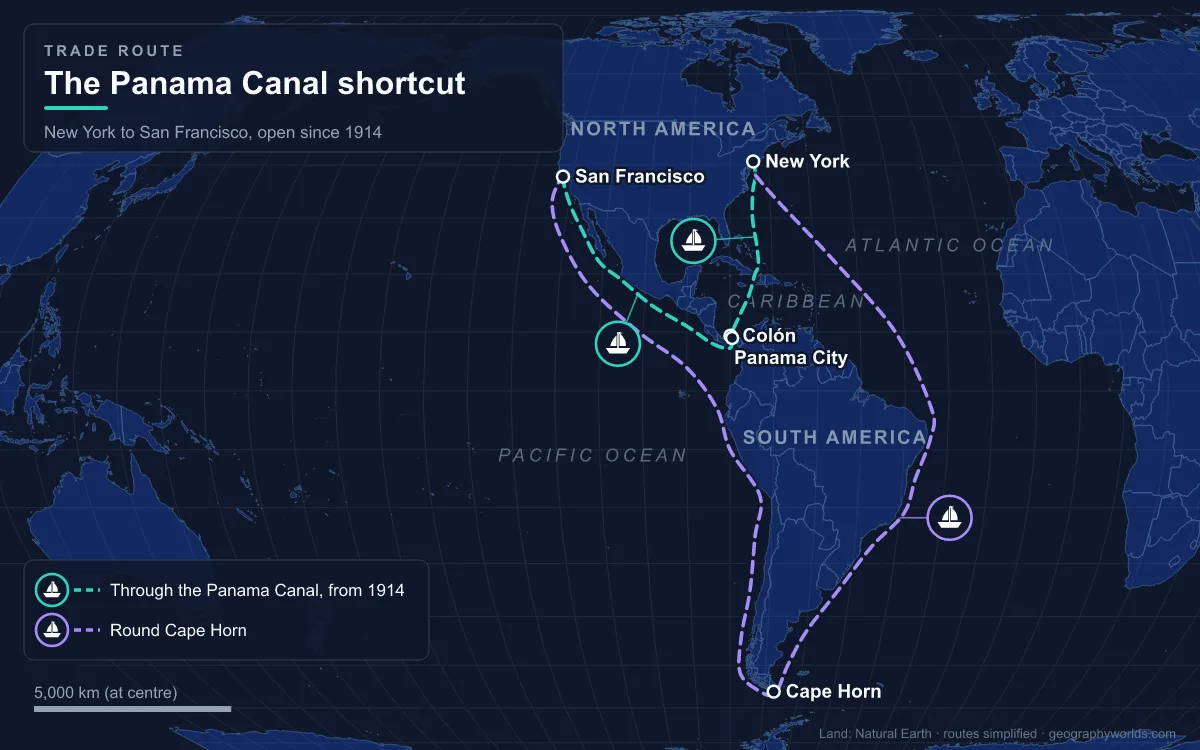
The Panama Canal is an 82-kilometre waterway across the narrowest part of the Isthmus of Panama that connects the Caribbean Sea, and so the Atlantic, with the Pacific Ocean. Instead of cutting to sea level, it uses locks to lift ships about 26 metres to Gatún Lake, an artificial reservoir, carries them through the Culebra Cut across the continental divide, and lowers them again on the far side. Opened on 15 August 1914 after a failed French attempt and ten years of American construction, it spares ships the voyage round Cape Horn and carries more than 5% of world trade. Panama has run it since noon on 31 December 1999 under the Torrijos–Carter Treaties, and since 2016 a third lane of larger Neopanamax locks has handled ships that the original chambers cannot.
Up 26 Metres: the Gatún Locks and Gatún Lake
A ship heading south from the Caribbean enters Limón Bay at Colón, a natural harbour that holds the port of Cristóbal and the Colón Free Trade Zone. Because the isthmus bends, the canal actually runs from north-west to south-east, and the Pacific end lies east of the Atlantic end. After a 3.2 km approach channel the ship reaches the Gatún Locks, a three-step flight 2.0 km long that raises it to the level of Gatún Lake. Inside each chamber, electric locomotives called mulas (mules), running on rails along the lock walls, keep the ship steady side to side and act as brakes, while water flows in by gravity from the lake above through culverts controlled by valves. A chamber can fill in as little as ten minutes.
Gatún Lake is what makes the system work. It was created on 27 June 1913, when the spillway gates of the Gatún Dam were closed across the Chagres River, and at the time it was the largest artificial lake in the world. It covers about 470 km² at roughly 26 m above sea level and carries ships about 33 km across the isthmus. Its forested shores protected the canal for decades, and Barro Colorado Island, the largest island in the lake, was set aside for scientific study when the lake formed and is now run by the Smithsonian Institution. The lake also supplies drinking water for Panama City and Colón, which links the canal’s capacity directly to the country’s water supply.
Through the Continental Divide at the Culebra Cut
From the lake the channel follows the dammed course of the Chagres River and then enters the Culebra Cut, an artificial valley 12.6 km long through the mountain ridge that forms the continental divide. Digging it was the hardest task of the whole project. The French had lowered the summit to 59 m above sea level; the Americans brought it down to 12 m over a much greater width, excavating more than 76 million cubic metres of rock and soil, about 23 million of it extra material from landslides that kept pouring back into the cut.

The work was done with 102 railway-mounted steam shovels, 77 of them from Bucyrus-Erie, loading spoil onto trains. Steam shovels broke through the cut on 20 May 1913, and on 10 October 1913 President Woodrow Wilson sent a telegraph signal from the White House that blew up the Gamboa Dike and flooded the cut. Slides did not stop with the opening: one on 18 September 1915 closed the canal for nearly seven months. Between 1915 and 2000 the cut was called the Gaillard Cut, after Major David du Bose Gaillard, who led its excavation; after the handover Panama restored the old name.
Down to the Pacific at Pedro Miguel and Miraflores
At the southern end of the cut, Panamax ships enter the single-step Pedro Miguel Lock, which drops them 9.4 m. They cross the small artificial Miraflores Lake, 1.8 km long, and then descend 16 m through the two-step Miraflores Locks to sea level at Balboa, beside Panama City. A 13.3 km channel passing under the Bridge of the Americas leads out to the Gulf of Panama. In 2017 ships took an average of 11.38 hours between the outer locks.
For a century the size of these chambers, 33.5 m wide, set the shape of world shipping. A “Panamax” ship is one built to the limits of the Pedro Miguel Locks, the canal’s 12.6 m minimum depth and the clearance under the Bridge of the Americas. A typical Panamax bulk carrier can carry only about 52,500 tons of cargo through the canal, and a Panamax container ship up to 4,400 TEU.
Agua Clara and Cocolí: the Neopanamax Locks of 2016
By 2011 an estimated 37% of the world’s container ships were too large for the old locks. President Martín Torrijos proposed a third set of locks on 24 April 2006, and a national referendum on 22 October that year approved it with 76.8% of the vote. The Panama Canal Authority estimated the cost at $5.25 billion. Work began with a blast at Paraíso Hill on 3 September 2007, and cracks found in a concrete sill at the Cocolí locks in 2015 had to be reinforced, work the authority reported complete in February 2016.

The new locks began commercial operation on 26 June 2016, when the Chinese-owned container ship Cosco Shipping Panama made the first transit. The Agua Clara Locks on the Atlantic side and the Cocolí Locks on the Pacific side are each a three-step flight that climbs straight from sea level to Gatún Lake, with chambers 427 m long, 55 m wide and 18.3 m deep. They use sliding gates, doubled for safety. Each chamber has three water-saving basins beside it, nine to a flight, which allow 60% of the water used in each transit to be reused. The expanded canal can handle about 600 million PC/UMS tons a year.
200 Million Litres a Ship: the 2023–24 Drought Limits
Every ship that passes through the original locks uses about 200 million litres of fresh water from Gatún Lake, flushed out to sea. That makes rainfall the canal’s true capacity limit. The 2015–16 financial year was one of the driest on record, and in 2019 the lake fell to historic lows. During the 2023–24 drought the authority cut daily transits from a normal 36 to 22 in early December 2023, leaving queues of ships at both ends, and allowed 24 a day from January 2024.
Restrictions returned with an El Niño in 2026, cutting transits to 34 a day from 3 September and 32 from 15 September. Scarce slots are auctioned, and in August 2026 South Korea’s SK Gas paid a record $5.3 million for priority passage for the LPG tanker G. Spirit. The authority’s answer is a $1.6 billion reservoir on the Indio River, covering 4,600 hectares and holding about 1.25 billion cubic metres, which should allow up to 15 extra transits a day in the dry season.
The French Attempt and Its 22,000 Dead, 1881–1889
The engineering described above was not the original plan. Ferdinand de Lesseps, fresh from completing the Suez Canal in 1869, set out to build a sea-level canal across Panama, then a province of Colombia, and work began on 1 January 1881, with digging at Culebra from 22 January. By 1888 about 40,000 people were employed, nine-tenths of them Afro-Caribbean workers from the West Indies. The Chagres flooded in the rainy season, slopes collapsed, and yellow fever and malaria killed workers and engineers alike. The company went bankrupt in 1889 after spending about $287 million. An estimated 22,000 men had died, the savings of 800,000 investors were lost, and in the resulting Panama scandal de Lesseps, his son Charles and Gustave Eiffel were among those prosecuted.
Roosevelt, Goethals and the US Canal Zone, 1903–1914
When Colombia’s Senate rejected the Hay–Herrán Treaty in 1903, President Theodore Roosevelt backed Panamanian separatists. US warships blocked Colombian troop movements, Panama declared independence on 3 November 1903, and on 18 November Philippe Bunau-Varilla, acting as Panama’s envoy, signed the Hay–Bunau-Varilla Treaty granting the United States the Canal Zone. The US bought the French assets for $40 million and took over on 4 May 1904.
Chief engineer John Frank Stevens persuaded Roosevelt in 1906 to abandon the sea-level design for the lock-and-lake plan. William C. Gorgas’s mosquito-control campaign nearly eliminated yellow fever and malaria, and Colonel George Washington Goethals, who took over in 1907, finished the work in 1914, two years early, at a cost of almost $500 million. About 5,600 workers still died during the American phase, most of them West Indian labourers, particularly from Barbados; about 350 were American. The cargo ship SS Ancon made the official opening transit on 15 August 1914. In 1921 the Thomson–Urrutia Treaty paid Colombia $25 million, and Colombia recognised Panama’s independence.
From the Torrijos–Carter Treaties to the 1999 Handover
Panamanians condemned the 1903 treaty almost immediately, and US sovereignty over a zone dividing their country remained a grievance for decades. Negotiations began in 1974, and on 7 September 1977 Jimmy Carter and Omar Torrijos signed the Torrijos–Carter Treaties: Panama would gain full control at the end of 1999 in exchange for guaranteeing the canal’s permanent neutrality. After a period of joint administration, the Panama Canal Authority (ACP) took over at noon on 31 December 1999. Fears that service would decline proved unfounded; in its first decade the ACP invested nearly $1 billion in widening and modernising the canal, including widening and straightening the Culebra Cut. In December 2024 US President-elect Donald Trump said the United States should retake the canal, citing tolls and Chinese influence; President José Raúl Mulino rejected both claims and affirmed Panamanian control.
Each stage of a transit is broken down further in our guide to the Panama Canal locks, the landform that made the route possible is explained in what an isthmus is, and the country around the waterway is covered in our geography of Panama.