
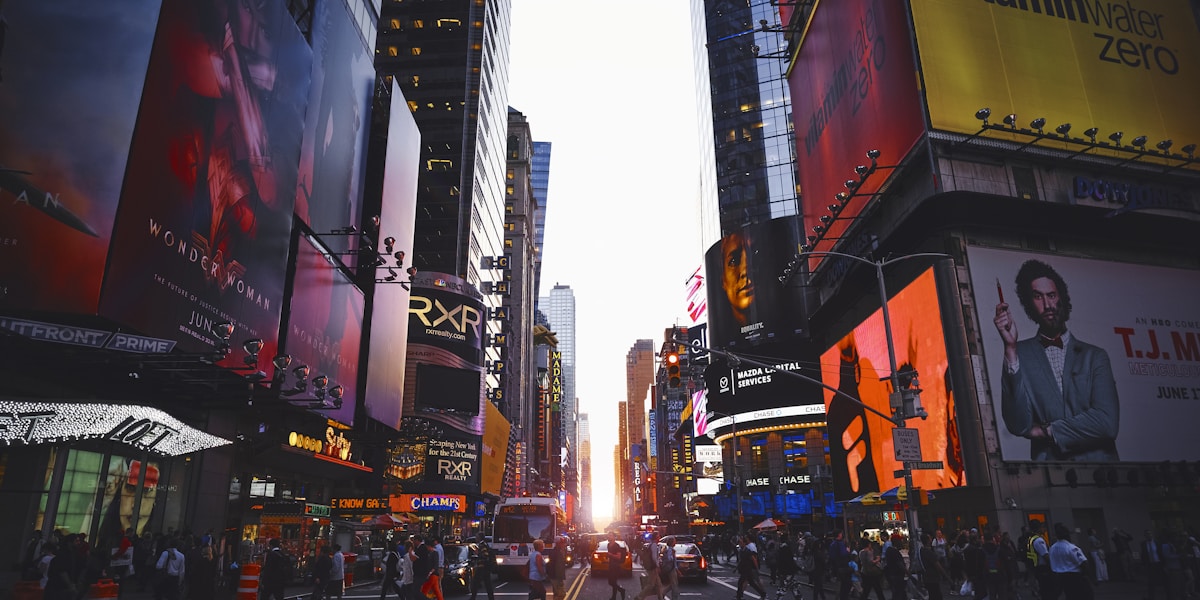
New York City has a population of approximately 8,260,000 people as of 2025, making it the most populous city in the United States by a wide margin. Spread across five boroughs at the mouth of the Hudson River, the city anchors a metropolitan region of roughly 20.1 million residents — one of the largest urban agglomerations on Earth and a global hub of finance, culture, and immigration.
How Many People Live in New York City?
The roughly 8.26 million residents counted in 2025 represent more than double the population of Los Angeles, the second-largest US city. New York has held the title of America's biggest city continuously since the first federal census in 1790, when it counted just 33,000 people. To put its scale in perspective, more people live in New York City than in 38 of the 50 US states, and its population exceeds that of entire countries such as Switzerland, Austria, or Israel.
The wider New York-Newark-Jersey City metropolitan statistical area stretches across parts of New York, New Jersey, Connecticut, and Pennsylvania, holding close to 20.1 million people. That makes the metro region the most populous in the country and one of only a handful worldwide to surpass the 20-million mark.
The Five Boroughs by Population
New York City is divided into five boroughs, each a county in its own right, and the population is far from evenly distributed:
- Brooklyn (Kings County): about 2,590,000 — the most populous borough, having overtaken Manhattan through decades of growth and gentrification.
- Queens (Queens County): roughly 2,270,000 — widely regarded as the most ethnically diverse urban area in the world, where well over 100 languages are spoken.
- Manhattan (New York County): about 1,630,000 residents, though its daytime population swells past 4 million as commuters pour in.
- The Bronx (Bronx County): approximately 1,380,000 — the only borough attached to the US mainland.
- Staten Island (Richmond County): about 490,000 — the most suburban and least populated borough, with a distinct character all its own.
Manhattan's population density of roughly 27,500 people per square kilometre is the highest of any county in the United States, even though it covers just 59 km².
A History of Booms and Declines
New York's population has followed a dramatic arc. Through the 19th and early 20th centuries the city grew explosively, fuelled by successive waves of immigration — first from Ireland and Germany, then from Southern and Eastern Europe, and later by the Great Migration of African Americans from the South. The population peaked at about 7.9 million in 1950 before declining through the 1970s, when fiscal crisis, rising crime, and suburban flight emptied entire neighbourhoods.
A powerful resurgence began in the 1990s. Falling crime, economic recovery, and renewed immigration — now largely from Latin America, Asia, and the Caribbean — pushed numbers to record highs. The 2020 Census counted 8.8 million residents, the most in the city's history. The COVID-19 pandemic then triggered significant outmigration, dropping the count to around 8.1 million before a partial rebound brought it back toward 8.26 million by 2025.
Diversity and Demographics
New York City is one of the most diverse places on the planet. Roughly 36% of residents are foreign-born, and more than 200 languages are spoken across the city. The broad ethnic breakdown is approximately 30% Hispanic or Latino, 29% non-Hispanic White, 22% Black or African American, and 16% Asian, with the remainder multiracial or other backgrounds.
That diversity is woven into the city's geography. Washington Heights is heavily Dominican, Flushing in Queens hosts vast Chinese and Korean communities, Sunset Park in Brooklyn blends Mexican and Chinese populations, and Brighton Beach — nicknamed "Little Odessa" — retains its Russian-speaking character. The largest immigrant communities trace their roots to the Dominican Republic, China, Mexico, Jamaica, Guyana, and Ecuador. The median age sits around 37, slightly younger than the national figure, reflecting the steady inflow of young workers and newcomers.
Why New York's Population Matters Globally
New York's importance reaches far beyond raw headcount. It is the world's leading financial centre, home to Wall Street and the New York Stock Exchange, the headquarters of the United Nations, and one of the planet's great media and cultural capitals. The metropolitan economy generates a gross product of more than $2 trillion — if New York City were an independent country, it would rank among the world's ten largest economies, ahead of nations like Italy and Brazil. Its 24-hour subway, with over 470 stations, moves millions of these residents every single day.
Frequently Asked Questions
What is the population of New York City in 2025?
New York City has an estimated population of about 8.26 million people in 2025, making it the most populous city in the United States. The surrounding metropolitan area holds roughly 20.1 million residents.
Which is the most populous borough of New York City?
Brooklyn is the most populous borough, with around 2,590,000 residents. It overtook Manhattan during the 20th century and continues to grow, followed closely by Queens at about 2,270,000.
Is New York City the largest city in the world?
No. While New York is the largest US city and a leading global metropolis, several cities such as Tokyo, Delhi, and Shanghai have far larger populations. New York's metro area ranks among the world's biggest but is not the most populous.
How dense is New York City?
The city as a whole has a density of roughly 10,550 people per square kilometre, but Manhattan reaches about 27,500 per km² — the highest of any county in the United States. You can test your knowledge of world cities and countries with our interactive geography games.
