
Eritrea is split close to evenly between Christians and Muslims — most estimates put each at roughly half the population — and since a decree in 2002 the state has recognised only four religious bodies: the Eritrean Orthodox Tewahedo Church, Sunni Islam, the Roman Catholic Church and the Evangelical Lutheran Church of Eritrea. Every other group, including Pentecostals, Jehovah's Witnesses, Baha'is and Seventh-day Adventists, was required to apply for registration. None has been approved in more than twenty years.
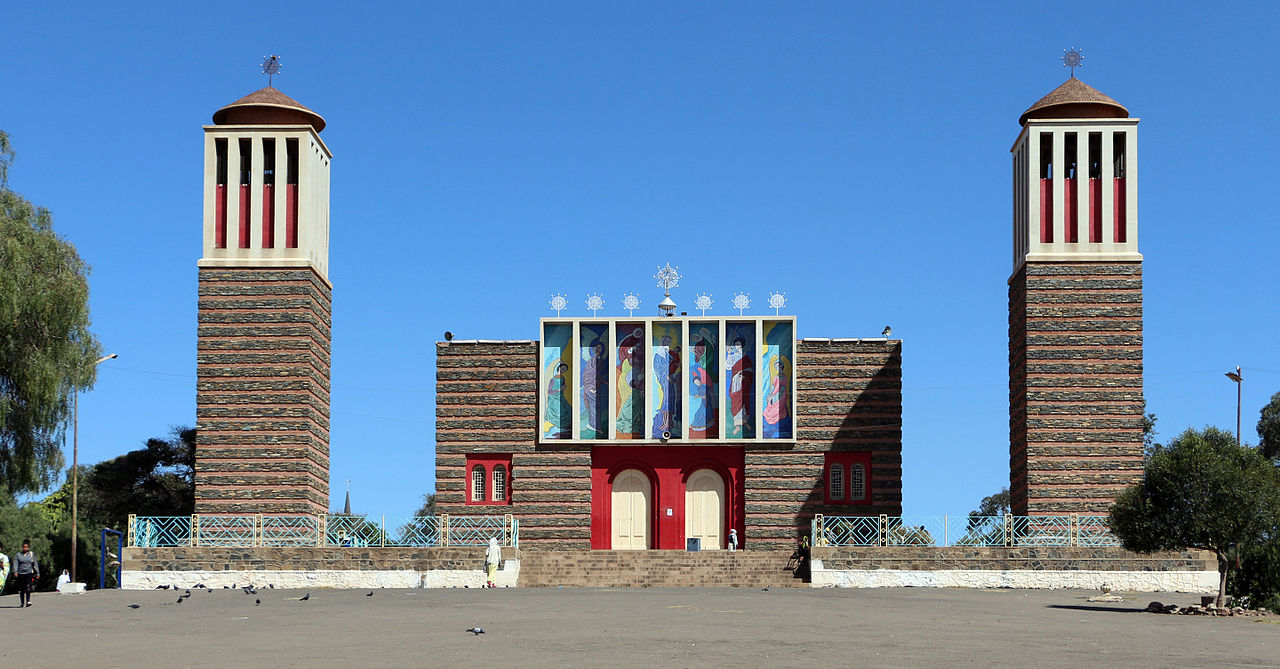
The Divide Runs by Altitude
Eritrea's religious geography is unusually legible. The central highlands around Asmara, where Tigrinya is spoken, are overwhelmingly Christian and have been for more than sixteen centuries. The western lowlands toward Sudan, the eastern coastal plain and the Danakil are predominantly Muslim, and the languages there are Tigre, Afar, Beja, Saho and others.
The split is therefore ethnolinguistic and ecological as much as theological. Highland Christians were settled cultivators; lowland Muslims were more often pastoralists and traders connected to the Red Sea economy. Independence-era politics ran along the same seam, with the Eritrean Liberation Front drawing on Muslim lowlanders and the later Eritrean People's Liberation Front on highlanders, and it is one of the reasons the current government insists so firmly on a single national identity.
A Church Older Than Most of Europe's
Christianity reached the Aksumite kingdom, which straddled present-day Eritrea and Tigray, in the fourth century, when King Ezana converted under the influence of Frumentius, a Syrian traveller who became the first bishop. That places the Christianisation of this region within a few decades of Armenia's and well before most of Europe.
The Eritrean Orthodox Tewahedo Church belongs to Oriental Orthodoxy alongside the Coptic, Ethiopian, Armenian and Syriac churches, and shares the miaphysite position rejected at Chalcedon in 451. Its liturgy is in Ge'ez, a language no longer spoken but retained for worship, and its practices include long fasts, a drum-and-sistrum musical tradition, and the use of a replica ark, the tabot, in every church.
Autocephaly, Granted in 1993 and Contested Since
For most of its history the church here was part of the Ethiopian Orthodox Tewahedo Church. After Eritrea's independence in 1993, the Coptic Pope Shenouda III in Alexandria granted the Eritrean church autocephaly, and its first patriarch was enthroned in 1998.
The new church's independence from Addis Ababa was a national project as much as an ecclesiastical one, and it left the Eritrean hierarchy closely entangled with the state from the outset — a dependence that had consequences within a decade.
Monasteries, and the Ones Women May Not Enter
Eritrean monasticism is ancient and severe. Debre Bizen, founded in 1361 on a mountain above Nefasit, sits at more than 2,400 metres and is reached by a steep climb of several hours. It holds a substantial manuscript library, and like a number of Orthodox monasteries in the region it does not admit women, or in the strictest reading any female animal.
Debre Libanos of Ham, in the Akele Guzai region, claims an origin in the sixth century with one of the Nine Saints, Syrian monks who are credited with consolidating monasticism and translating scripture into Ge'ez. These houses preserved manuscripts, trained clergy and anchored highland religious life through centuries in which no state protected them.
Islam Reached Eritrea Before It Reached Medina
Islamic tradition holds that in around 615, before the migration to Medina, a group of the Prophet's followers facing persecution in Mecca crossed the Red Sea to seek refuge with the Christian king of Aksum, who protected them and refused to hand them back. This episode, the first hijra, is foundational to how Muslims in the Horn describe their relationship with their Christian neighbours.
The Al Sahaba Mosque in Massawa — the Mosque of the Companions — is associated with that group and is claimed as among the oldest mosques anywhere. Islam spread along the coast and into the lowlands from these early contacts and through later Arab and Ottoman commerce, and Massawa functioned for centuries as a Red Sea port with an outward-facing Muslim merchant culture.
Eritrean Islam is Sunni, predominantly Maliki in the lowlands with Shafi'i influence on the coast, and has historically included Sufi elements, particularly the Khatmiyya order whose reach extends from eastern Sudan.
The Decree of 2002
In May 2002 the government required all religious groups to register with the Department of Religious Affairs, submitting membership lists, financial details and information on foreign funding. Four bodies were confirmed. Everyone else was ordered to suspend activity pending approval.
No further approvals followed. The practical effect was to criminalise the worship of a large number of Eritreans overnight, particularly the fast-growing Pentecostal and evangelical churches that had spread in the 1990s. Worship moved into homes, and raids on house churches — at weddings, prayer meetings and study groups — have produced mass arrests repeatedly since.
Detainees have frequently been held without charge and without trial for years, in some cases in shipping containers in the desert, according to consistent reporting by international monitors and by Eritreans abroad. The government's position is that the groups concerned are foreign-funded and a threat to national unity.
The Jehovah's Witnesses Who Lost Their Citizenship
The pattern began before 2002. In 1994, President Isaias Afwerki issued a decree stripping Jehovah's Witnesses of citizenship rights after members declined to vote in the independence referendum and refused military service on grounds of conscience. They lost access to identity documents, government employment, business licences and land.
Three men imprisoned in 1994 for refusing conscription were held for twenty-six years, released only in 2020, without ever being charged or tried. Their detention is among the longest documented cases of imprisonment for conscientious objection anywhere in the world.
A Patriarch Deposed and Held Until His Death
The state's reach extends to the recognised bodies. Abune Antonios, enthroned as the third Patriarch of the Eritrean Orthodox Tewahedo Church in 2004, objected to government interference in church affairs, protested the detention of priests and refused to excommunicate members of a renewal movement.
He was stripped of his authority in 2006, formally deposed in 2007 and held under house arrest. He remained there, with the church's synod operating under a government-approved administrator, until his death in 2022 at the age of 94. Much of the Eritrean Orthodox diaspora continued to recognise him as the legitimate patriarch throughout, and his case became the clearest illustration that recognition by the state does not confer independence from it.
When the State Took the Catholic Clinics
The Catholic Church in Eritrea, which follows the Ge'ez rite and has its own metropolitan archbishop, is small but has historically run schools, clinics and rural health posts.
In 2014 four Eritrean Catholic bishops issued a pastoral letter titled Where Is Your Brother?, an unusually direct criticism of the conditions driving young Eritreans to flee the country, which circulated widely inside and outside Eritrea. In 2019 the government seized more than twenty Catholic-run health facilities, some of them the only medical provision in their districts, under a policy of transferring social services to the state, and subsequently closed Catholic schools.
National Service and the Church Abroad
Eritrea's system of indefinite national conscription is the principal reason large numbers of Eritreans have left, and it intersects with religion directly. Conscientious objection is not recognised. Clergy of the four permitted bodies have at times been called up. Young men and women in service cannot travel for religious study, and detention for evading service is common.
The consequence is a very large diaspora, and Eritrean Orthodox, Catholic, Lutheran and Pentecostal congregations now operate across Europe, North America, Israel and the Gulf. For the banned groups in particular, the diaspora congregation is the only place where their tradition can function openly, and it has become the main source of documentation on what happens at home.
Fasting, Ge'ez and the Shape of the Year
Orthodox Tewahedo practice makes unusual demands. Devout laypeople observe fasts amounting to well over a hundred days a year and the clergy considerably more, abstaining from all animal products — which is why Eritrean cuisine has such a developed repertoire of lentil, chickpea and vegetable dishes.
The calendar follows the Ge'ez reckoning, which runs seven to eight years behind the Gregorian one and places new year in September, so an Eritrean Orthodox parish and its diaspora congregation abroad may be marking different years on the same Sunday. Timkat, the feast of Epiphany, and Meskel, commemorating the finding of the True Cross with a great bonfire, are the high points of the Christian calendar, and Meskel is a public holiday. Eid al-Fitr and Eid al-Adha are likewise national holidays, and Eritrean officials routinely point to the calendar and to high rates of intercommunal coexistence in the cities as evidence of national harmony.
That coexistence appears to be genuine at the level of ordinary life. It exists alongside one of the most restrictive religious regulatory regimes in the world, and the two facts are not in contradiction: the state's hostility is directed at organisational autonomy rather than at any particular creed. Eritrea in the round is covered by our Eritrea country guide; our Horn of Africa guide sets it beside Ethiopia, Djibouti and Somalia, and ten facts about Eritrea covers what is left.
