
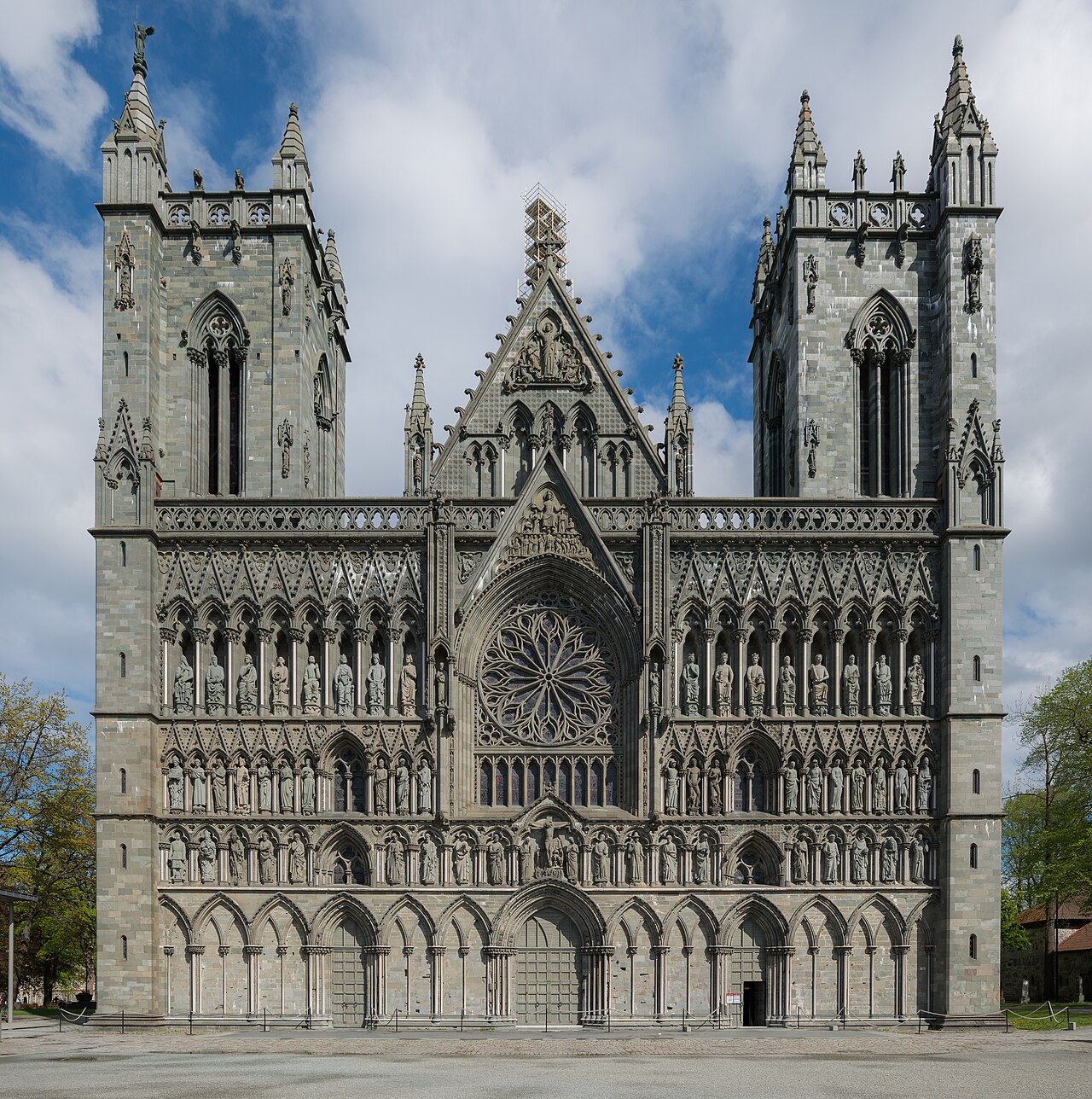
Norway's main religion is Christianity, specifically the Evangelical Lutheran Church of Norway, which a little over 60 per cent of Norwegians belong to. Membership has fallen fast, from more than 85 per cent in 2000, and regular churchgoing is rare. Norway is one of the most secular countries in Europe. Around a fifth of the population belongs to no religious or belief community at all. The largest minorities are Catholics and Muslims, each with a few hundred thousand people, and a secular humanist association of about 100,000 members, one of the largest in the world relative to population.
Those numbers describe a country where most people are church members without being churchgoers. How it got there is a story of kings, a thousand-year-old saint, a Reformation imposed from Copenhagen, and a constitution that once barred Jews and Jesuits from the kingdom.
Conversion by Kings
Before Christianity, Norwegians followed the Norse religion of the Viking Age, worshipping gods such as Odin, Thor and Freyr at local sanctuaries and feasts. In the far north, the Sámi had their own religion, centred on shamans called noaidi, sacred places in the landscape and ritual drums.
Christianity came from the top. Håkon the Good, raised as a Christian at the English court, tried and failed to convert his subjects in the 950s. Several Viking-Age kings who had been baptised abroad tried to impose it. Olav Tryggvason, who ruled from about 995 to 1000, forced conversion on coastal districts by threat and violence. The decisive figure was Olav Haraldsson, who ruled from 1015 to 1028. At an assembly on the island of Moster in about 1024 he issued Norway's first Christian church law. Driven out by rivals, he returned with an army and was killed at the Battle of Stiklestad on 29 July 1030. Within a year he was being venerated as a saint. St Olav became the country's patron, and his feast day, Olsok, is still marked on 29 July.
Nidaros and the Pilgrims
Olav's grave in Trondheim, then called Nidaros, became the most important pilgrimage site in northern Europe. Nidaros Cathedral was built over it from about 1070, and Trondheim became the seat of an archbishop in 1152, with authority over churches as far away as Iceland, Greenland, Orkney and the Isle of Man. The cathedral, Scandinavia's largest medieval building, is still where Norwegian monarchs are consecrated. It was damaged by fires many times over the centuries, and its restoration, begun in 1869, was not declared complete until 2001. The pilgrim routes to it, known today as St Olav's Ways, were revived in the 1990s, and the main path from Oslo to Trondheim runs about 640 km.
The other lasting monuments of medieval faith are the stave churches, built of vertical timber posts with carved dragon heads on their gables. There were once many hundreds across Norway, and 28 survive. The oldest, Urnes, on the Sognefjord, dates from the twelfth century and has been a UNESCO World Heritage Site since 1979. Heddal, in Telemark, is the largest.
The Reformation From Copenhagen
Norway did not choose Protestantism. In 1537 King Christian III of Denmark, which then ruled Norway, imposed the Lutheran Reformation across his kingdoms. The last Catholic archbishop, Olav Engelbrektsson, fled to the Netherlands, and Norway lost its own church leadership and much of its remaining independence. The king became head of the church. For almost five centuries after that, Lutheranism was the official religion, taught in schools and enforced by law.
The law was strict. The Conventicle Act of 1741 banned religious meetings held without a priest. The lay preacher Hans Nielsen Hauge travelled Norway from 1796 preaching personal faith and hard work, and was jailed for years under that act. His movement nevertheless shaped Norwegian Christianity into something sober, personal and suspicious of the elite, and it helped build a class of farmer-entrepreneurs. The act was repealed in 1842. In the north, Lutheran missionaries in the early eighteenth century, led by Thomas von Westen, suppressed Sámi religion and confiscated and burned many of its drums. Later, many Sámi and northern Norwegians joined Laestadianism, a strict revival movement that remains strong in the region.
A Constitution That Barred Jews and Jesuits
Norway's constitution of 1814 was one of the most liberal of its time, but its second article kept the Lutheran state religion and added that Jews and Jesuits "are still excluded from the kingdom". Monastic orders were barred too. The Jewish clause was removed in 1851 after a long campaign by the poet Henrik Wergeland. The ban on monastic orders ended in 1897, and the ban on Jesuits survived until 1956.
Norway's Jewish community remained small. In the Second World War, under German occupation, 773 Jews were deported from Norway, most of them on the ship Donau from Oslo in November 1942. Only a few dozen survived. Today the community numbers around 1,500 registered members, and the Holocaust Centre in Oslo is housed in the wartime home of the collaborator Vidkun Quisling.
From State Church to People's Church
The formal link between church and state was dismantled in two steps. A constitutional amendment in 2012 removed the clause making the Evangelical Lutheran religion the official religion of the state, and gave the Church of Norway the power to appoint its own bishops. Then, on 1 January 2017, the church became an independent legal body, and its clergy stopped being civil servants. The constitution still describes it as Norway's folkekirke, or people's church, and requires the state to support it.
That support goes to everyone. Under Norwegian law, every registered religious or life-stance community receives public funding in proportion to its membership, calculated from what the Church of Norway receives per member. Mosques, Catholic parishes, Hindu temples and the Norwegian Humanist Association are all funded the same way, which is one reason that association, Human-Etisk Forbund, has grown to about 100,000 members.
Belonging Without Believing
Most Norwegians still use the church for life's milestones even if they rarely attend. Baptisms, weddings and especially funerals remain largely church affairs, and at Christmas services are full. Confirmation at 15 is still a widespread rite of passage, although a large minority choose the humanist civil confirmation instead, which has been offered since 1951. After the terrorist attacks of 22 July 2011, which killed 77 people, it was to Oslo Cathedral that the country turned for its collective mourning, with a sea of roses laid outside.
Belief is another matter. Surveys regularly find that only a minority of Norwegians say they believe in God, and far fewer attend church in a normal month. Membership has fallen steadily as people formally resign, and as fewer children are baptised. The same pattern appears across Scandinavia, as our overview of religion in Sweden shows.
A Christian Calendar in a Secular Country
Even Norwegians who never go to church live by a Christian calendar. Norway keeps more religious public holidays than most of Europe: Maundy Thursday, Good Friday, Easter Monday, Ascension Day and Whit Monday are all days off, alongside Christmas and Boxing Day. A holiday-peace law restricts shop opening on Sundays and religious holidays, so most stores close, a rule that has survived repeated attempts to relax it. On 17 May, Constitution Day, many towns begin the celebrations with a church service before the children's parades, and on Christmas Eve churches are fuller than at any other time of year, even among families who otherwise never attend.
The Return of the Sámi Drum
The Sámi relationship with Christianity is still being worked through. The Church of Norway has formally apologised for its role in the suppression of Sámi culture, and it now has a Sámi church council and services in Sámi languages. One symbolic moment came in 2023, when a Sámi ritual drum confiscated in 1691 from a man named Bendix Andersen, who was tried for witchcraft, was returned from the National Museum of Denmark to a Sámi cultural centre in Snåsa. For more than three hundred years it had been held in Copenhagen. Its return marked the recognition that the pre-Christian religion of the north was a faith in its own right, not superstition.
The Growing Minorities
Immigration has made Norway far more religiously varied than it was a generation ago. The Catholic Church is the largest minority denomination. Its numbers have grown through migration from Poland, Lithuania and the Philippines, and it now counts a few hundred thousand people, although many are not formally registered. Islam arrived mainly with labour migrants from Pakistan in the late 1960s and 1970s, and later with refugees from Somalia, Iraq, Afghanistan and Syria. Registered members of Muslim communities now number around 180,000. Oslo's skyline includes mosques, a Sikh gurdwara and Hindu temples alongside its churches. Buddhists, Hindus and a small number who follow a revived Norse religion, Forn Sed, make up the rest.
The picture today is of a country that remains culturally Lutheran, in its calendar, its architecture and its public rituals, while its private beliefs have become largely secular. The churches of the fjord villages still anchor the landscape, as our guide to Norway shows.