
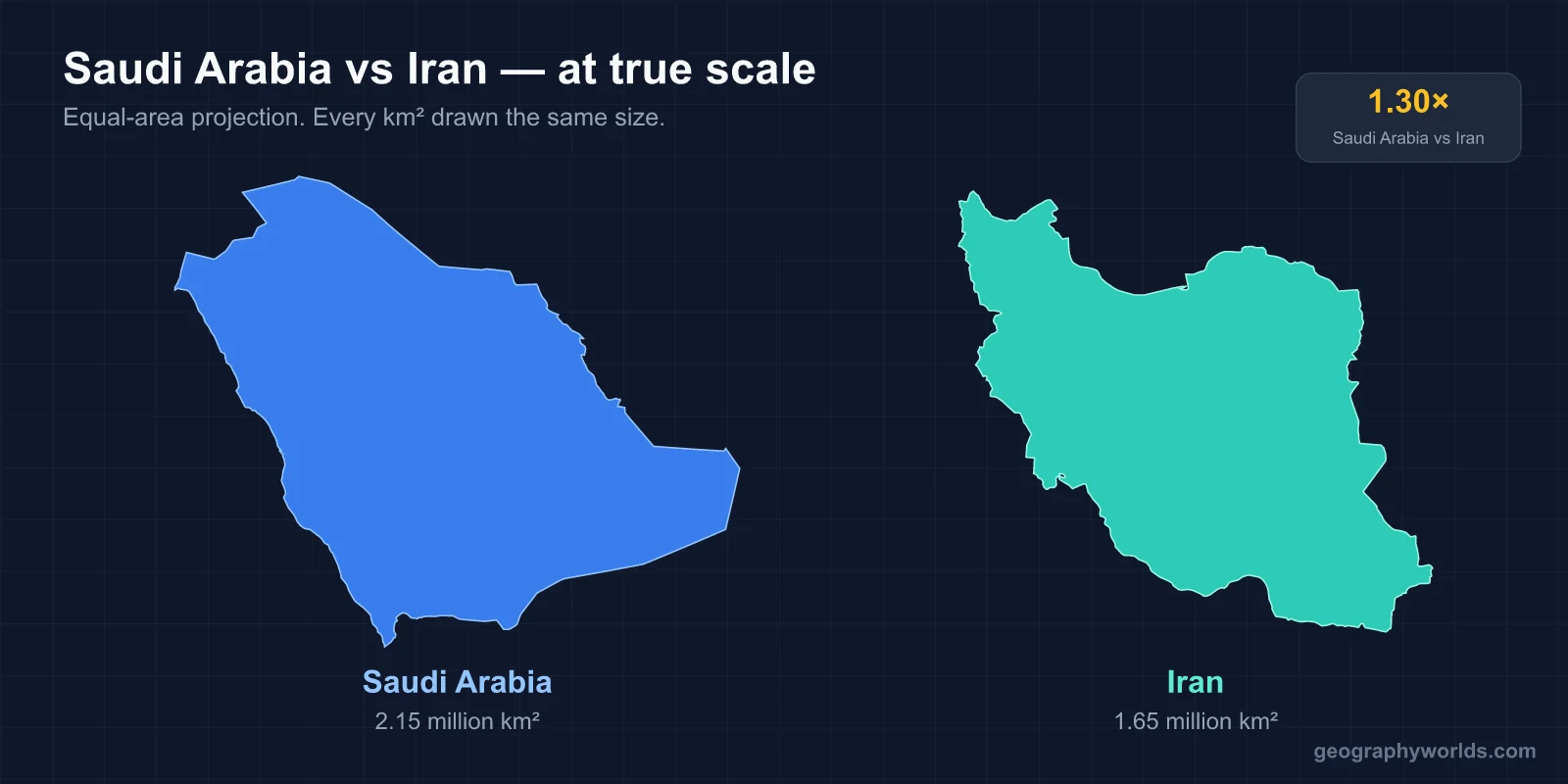
Saudi Arabia is the larger country at about 2.15 million km² against Iran's 1.65 million, but Iran has substantially more people — roughly 90 million to Saudi Arabia's 35 million. They face each other across the Persian Gulf, which is around 250 km wide at its broadest and narrows to the Strait of Hormuz, and almost every difference between them runs back to terrain and water.
Sand against stone
Saudi Arabia is overwhelmingly desert, and its southern quarter is the Rub' al Khali — the Empty Quarter — the largest continuous sand desert on Earth, effectively uninhabited. The country has no permanent rivers or lakes at all, which is a distinction shared by very few states of any size. Its western edge rises in the Hejaz and Asir mountains, and the south-west corner near the Yemeni border catches enough monsoon moisture to support terraced agriculture, but that is a small exception.
Iran is a mountain and plateau country. Its interior sits high, ringed by the Zagros and Alborz ranges, with Damavand reaching about 5,610 metres — a dormant volcano and the highest peak in the Middle East. Iran has genuine seasons, real snowfall, and ski resorts within an hour of Tehran.
The practical consequence is agricultural. Iran can farm a meaningful share of its land and grows a wide range of crops; Saudi Arabia cannot, and imports the large majority of its food.
Water, and two different shortages
Both are water-scarce, but the scarcity has different shapes.
Saudi Arabia depends on desalination to an extraordinary degree — it is among the world's largest producers of desalinated water, and its cities would be uninhabitable without it. It also spent decades pumping fossil groundwater to grow wheat in the desert, a programme abandoned once the depletion became undeniable; the country now imports grain instead.
Iran's problem is over-extraction of renewable but limited resources. Aquifer depletion, dam building and diversion have caused rivers and lakes to shrink dramatically — Lake Urmia in the north-west, once one of the largest saltwater lakes in the world, lost most of its area, and water shortages have triggered protests in several provinces.
Both have also turned to large-scale solar as a partial answer, since desalination and pumping are energy-intensive and both have abundant sunlight — though Iran's build-out has been constrained by the same sanctions that limit everything else.
Neither country can solve its water problem with money alone, though Saudi Arabia has more money to throw at it.
Oil, gas and the shape of two economies
Both are hydrocarbon states, and both are trying to become something else, but from different positions.
Saudi Arabia holds among the largest proven oil reserves in the world, and Ghawar is the largest conventional oilfield ever found. Saudi Aramco is the world's most valuable oil company, and the state's Vision 2030 programme is an explicit attempt to diversify — tourism, entertainment, logistics and the enormous Neom development on the Red Sea coast.
Iran has comparable oil reserves and vastly more natural gas, holding a share of the South Pars field it splits with Qatar. But decades of sanctions have restricted its access to investment, technology and banking, so it has been unable to develop or export at anything like its potential, and its economy has been forced into a degree of domestic self-sufficiency Saudi Arabia has never needed.
The result is that the country with the smaller population and the less varied land is by far the richer per head.
Two very different visitor economies
Saudi Arabia's tourism has historically been religious almost exclusively — the Hajj and the year-round Umrah bring millions to Mecca and Medina, and the logistics of moving that many people through two cities in a short window is a national infrastructure programme in itself. Leisure tourist visas were only introduced in 2019.
Iran has a far older and broader heritage tourism base — Persepolis, Isfahan's Naqsh-e Jahan square, Yazd's windcatchers, Shiraz — with more UNESCO World Heritage sites than most countries in the region. What it lacks is access: sanctions, banking restrictions and travel advisories have kept visitor numbers far below what the sites would otherwise attract.
Two theocratic claims, two different systems
Both states derive legitimacy from Islam, and the difference in how is the core of the rivalry.
Saudi Arabia is the custodian of the two holiest mosques, at Mecca and Medina, and the Hajj brings millions of pilgrims annually — a religious responsibility that confers enormous standing across the Sunni world. Its state is a hereditary absolute monarchy under the Al Saud, historically allied with a conservative religious establishment.
Iran is the leading Shia power and, since 1979, an Islamic republic in which an elected president and parliament operate beneath a clerical Supreme Leader — a system with no precedent in Shia political tradition before Khomeini articulated it.
So one is a monarchy legitimised by religious custodianship, the other a republic legitimised by clerical rule. The Sunni–Shia divide maps onto that, and their rivalry has been fought largely through proxies across the region rather than directly, with a Chinese-brokered restoration of diplomatic relations in 2023.
The chokepoint they both depend on
The Strait of Hormuz, between Iran and Oman, is about 33 km wide at its narrowest, and a very large share of the world's seaborne oil passes through it.
Iran's coast forms its entire northern shore, which gives Tehran a standing capacity to threaten traffic through it — a threat repeatedly invoked during periods of tension. Saudi Arabia's exposure is why it built the East–West pipeline across the peninsula to Yanbu on the Red Sea: a route to market that avoids the strait entirely.
That single piece of geography does more to structure Gulf security than any other, and it is the reason both countries' internal politics have global price consequences.
A young country and an ageing one
Demographically the two are moving apart.
Iran's fertility fell dramatically from the late 1980s onward — one of the fastest recorded declines anywhere — and its population is now ageing, with a median age around 33. The government has reversed policy and is actively encouraging births.
Saudi Arabia's population is younger, with a median age around 30 and a large cohort entering the workforce, which is precisely the pressure Vision 2030 is meant to answer: the state cannot employ everyone directly, and the private sector has historically relied on foreign labour. Roughly a third of the people in the kingdom are foreign nationals.
Four coastlines between them
Both countries have two coasts, and in both cases the second one changes their options.
Saudi Arabia fronts the Persian Gulf in the east and the Red Sea in the west. That western coast is what makes the East–West pipeline useful, gives Jeddah its role as the port of entry for Hajj pilgrims, and is where the Neom development and the Red Sea tourism projects are being built. It also puts the kingdom on the Bab el-Mandeb approach to Suez.
Iran fronts the Gulf and the Gulf of Oman in the south, and the Caspian Sea in the north. The Caspian coast is a different country climatically — humid, forested, high-rainfall, with rice paddies and tea plantations that look nothing like the rest of Iran, because the Alborz mountains trap moisture against the shore.
So Saudi Arabia's second coast extends its strategic reach, while Iran's gives it a green province and a stake in a landlocked sea shared with Russia, Kazakhstan, Turkmenistan and Azerbaijan.
What the two look like from orbit at night
Night-lights imagery is an unusually good summary of both countries' settlement patterns.
Saudi Arabia shows a bright cluster around Riyadh in the centre, a dense strip along the Gulf coast where the oil and the Shia population are, another along the Red Sea around Jeddah and Mecca, and near-total darkness across the Empty Quarter — a void the size of France.
Iran shows a ring: Tehran enormous at the foot of the Alborz, then a chain of cities around the rim of the plateau — Tabriz, Mashhad, Isfahan, Shiraz — with the two central deserts dark in the middle. The pattern maps the mountains almost exactly, because the mountains are where the water is.
Both images make the same point in different ways: in this region, population follows water rather than land, and neither country has much of the former.
Persians and Arabs
The two are not the same people and do not speak related languages, which outsiders frequently miss.
Saudi Arabia is Arab and Arabic-speaking, and Arabic is a Semitic language. Iran is majority Persian and Persian is Indo-European — a distant relative of English, and no relation to Arabic at all, despite being written in a modified Arabic script since the Islamic conquest.
Iran is also considerably more diverse internally: Azerbaijanis are a very large minority, along with Kurds, Arabs, Baloch, Lurs and Turkmen. Saudi Arabia is more homogeneous in language, though it has a significant Shia population concentrated in the Eastern Province — which is also where the oil is, a coincidence with obvious political consequences. Our Saudi Arabia and Iran guides cover each separately.
