
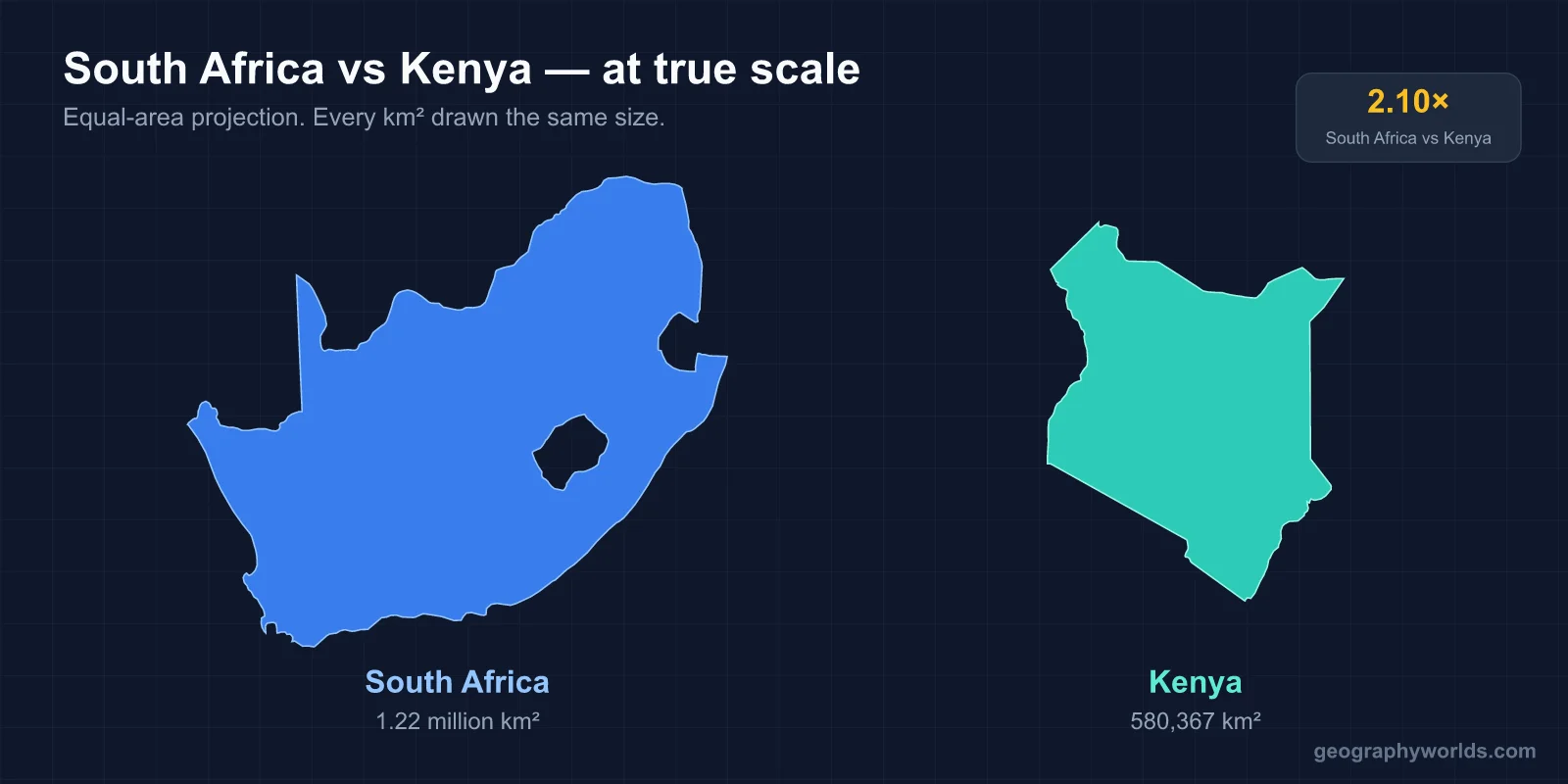
South Africa is the bigger, more populous and richer country; Kenya is the higher one. South Africa covers 1,221,037 km², a little more than twice Kenya’s 580,367 km². Its 2022 census counted 62.0 million people, against 47.6 million in Kenya’s 2019 census and an estimated 54.2 million Kenyans in 2026. On IMF estimates for 2026, South Africa’s GDP per person is about US$7,500, close to three times Kenya’s US$2,600. Kenya wins on altitude: Mount Kenya rises to 5,199 m, more than 1,700 m above South Africa’s highest point. Kenya’s capital is Nairobi and its official languages are Swahili and English; South Africa divides its capital functions between Pretoria, Cape Town and Bloemfontein and recognises twelve official languages. The questions people ask most often about the pair are answered one by one below.
Is South Africa Bigger Than Kenya?
Yes, by about 640,000 km². South Africa, at 1,221,037 km², ranks 24th in the world by area; Kenya, at 580,367 km², ranks 48th. Put another way, Kenya would fit into South Africa twice with room to spare. Both countries have long coasts on the Indian Ocean, but South Africa’s also wraps round the tip of the continent onto the Atlantic, giving it about 2,800 km of coastline from the Namibian border to Mozambique.
The shapes and settings differ as much as the sizes. South Africa occupies the southern end of Africa, bordered by Namibia, Botswana, Zimbabwe, Mozambique and Eswatini, and it completely surrounds Lesotho. Kenya sits on the east coast almost exactly on the equator, bordered by Somalia, Ethiopia, South Sudan, Uganda and Tanzania, with a shore on Lake Victoria in the west and Lake Turkana, the world’s largest permanent desert lake, in the dry north.
Does South Africa or Kenya Have More People, and Which Is Growing Faster?
South Africa has more people today, with 62,027,503 counted in October 2022. Kenya counted 47,564,296 in August 2019, and the Kenya National Bureau of Statistics estimates about 54.2 million for 2026. Density tells the opposite story: South Africa has about 51 people per km², Kenya about 82, so the smaller country is the more crowded one.
Kenya is growing much faster. Its population rose from 15.3 million in 1979 to 47.6 million in 2019, a factor of about three in 40 years, with average growth of more than 3 per cent a year between 1979 and 2009. If that pace continues even at a reduced rate, Kenya’s population will close much of the gap with South Africa within a generation.
The largest cities are close in size. The City of Johannesburg counted 4.8 million residents in 2022, with about 15.1 million across its metropolitan region; Nairobi has about 5.6 million people in the city and close to 16 million in its wider metropolitan area on 2026 estimates. Nairobi is both capital and largest city. Johannesburg is not one of South Africa’s three capitals, although it is home to the Constitutional Court.
Which Is Richer, South Africa at US$7,503 or Kenya at US$2,600 a Head?
South Africa, clearly. The IMF estimates South Africa’s 2026 GDP at about US$480 billion and Kenya’s at about US$141 billion, so the South African economy is roughly three and a half times larger. Per person the ratio is about 2.9 to 1. Adjusted for local prices the gap narrows: about US$16,700 per person in South Africa against about US$7,900 in Kenya.
The two economies rest on different foundations. South Africa’s was built on minerals: diamonds near the Orange River from 1867 and the Witwatersrand gold field from 1886, followed by the world’s largest outputs of platinum, chromium and manganese. It is the most industrialised economy in Africa, but its unemployment rate has stayed above 30 per cent and its Gini index of 63.0 is among the highest in the world. Kenya’s economy grew from farming, above all tea and horticultural produce, its chief exports, along with coffee, and more recently from services. M-Pesa, the mobile-phone money service launched by Safaricom and Vodafone in 2007, turned Kenya into a pioneer of mobile banking and has since spread to Tanzania, Mozambique and other countries. On the Human Development Index for 2023, South Africa scores 0.741 and Kenya 0.628.
Which Is Higher: Mount Kenya at 5,199 m or Mafadi at 3,446 m?
Kenya, by a wide margin. Mount Kenya, about 150 km north-northeast of Nairobi and only 16.5 km south of the equator, is the second-highest mountain in Africa after Kilimanjaro. Its three main summits are Batian at 5,199 m, Nelion at 5,188 m and Point Lenana at 4,985 m. It is an old volcano that formed about 3 million years after the East African Rift opened and once stood around 7,000 m before glaciers wore it down; about 11 small glaciers survive but are shrinking fast and may be gone by 2050.

South Africa’s highest point is Mafadi, 3,446 m, on the crest of the Drakensberg on the Lesotho border. Even that is not the top of the escarpment: Thabana Ntlenyana, across the border in Lesotho, reaches 3,482 m. South Africa’s height is spread out rather than concentrated. Its interior is a high plateau, and where the eastern edge of that plateau, the Great Escarpment, meets Lesotho it stands between 2,000 m and 3,482 m above sea level. Kenya has its own high plateau too; Nairobi sits at about 1,795 m, which is why its evenings can drop to around 9 °C in June and July despite lying just south of the equator.
Which Has Stronger Seasons, Johannesburg or Nairobi?
South Africa, because it lies well south of the tropics while Kenya straddles the equator. Nairobi’s days change little through the year: the warmest and sunniest stretch runs from December to March with daytime temperatures in the high twenties Celsius, and the year is divided less by temperature than by wet and dry seasons. Kenya does share the Southern Hemisphere’s rhythm in a small way, with its coolest months in June to August, but the swing in average temperature across most of the country is only about 4 °C. Heat in Kenya depends mainly on height and distance from the sea: the coast at Mombasa, Lamu and Malindi is tropical, with higher rainfall and temperatures than inland, while the interior grows more arid the further it lies from the sea.
South Africa has real winters. Johannesburg, on the Highveld, averages daytime highs of about 26 °C in January and around 16 °C in June, with most of its rain falling in late-afternoon storms between October and April. Cape Town has the reverse pattern, a Mediterranean climate with dry summers and wet winters, when cold fronts from the Atlantic bring rain between May and August. Across the whole country, average annual rainfall is only about 464 mm, roughly half the global average, and it declines from the wet east toward the semi-desert of the west.
Which Has More Official Languages, South Africa or Kenya?
South Africa, with twelve against Kenya’s two. Kenya’s official languages are Swahili and English. Swahili, a Bantu language native to the East African coast with tens of millions of first- and second-language speakers across the region, works as a common tongue between Kenya’s many ethnic groups, of which the Kikuyu, about 8.1 million people in 2019, are the largest.
South Africa’s 1996 constitution recognised eleven spoken languages, and South African Sign Language was added as the twelfth in 2023, signed into law on 19 July. In the 2022 census Zulu was the most common first language, at 24.4 per cent, followed by Xhosa and Afrikaans; English, the main language of government, is the first language of fewer than one South African in ten.
Which Has the Bigger Safari Parks, Kruger or the Maasai Mara?
South Africa’s flagship park is far larger. Kruger National Park covers 19,623 km² in Limpopo and Mpumalanga provinces, stretching 360 km north to south along the Mozambique border. It grew from a reserve first protected by the South African Republic in 1898 and became the country’s first national park in 1926.

Kenya’s best-known reserve is smaller but belongs to a bigger system. The Maasai Mara National Reserve in Narok County, reduced to 1,510 km² in 1984, is contiguous with Tanzania’s Serengeti, a protected region of about 30,000 km². Together they host the Great Migration, the mass movement of grazing herds that brings the Mara its peak wildlife season. Kenya adds landscapes South Africa does not have at all: the floor of the Great Rift Valley, part of the eastern branch of the East African Rift, with its chain of lakes, and the glaciers of Mount Kenya.
Which Became Independent First?
It depends on what counts. South Africa became a self-governing dominion as the Union of South Africa on 31 May 1910 and a republic on 31 May 1961, but from 1948 to 1994 apartheid excluded most of its people from power, and the first elections open to all races were held in 1994. Kenya was a British colony until 12 December 1963, after a state of emergency from October 1952 to December 1959 during the Mau Mau uprising, and became a republic a year later. For how each government is organised today, see our guides to Pretoria, Nairobi and the geography of Kenya.