
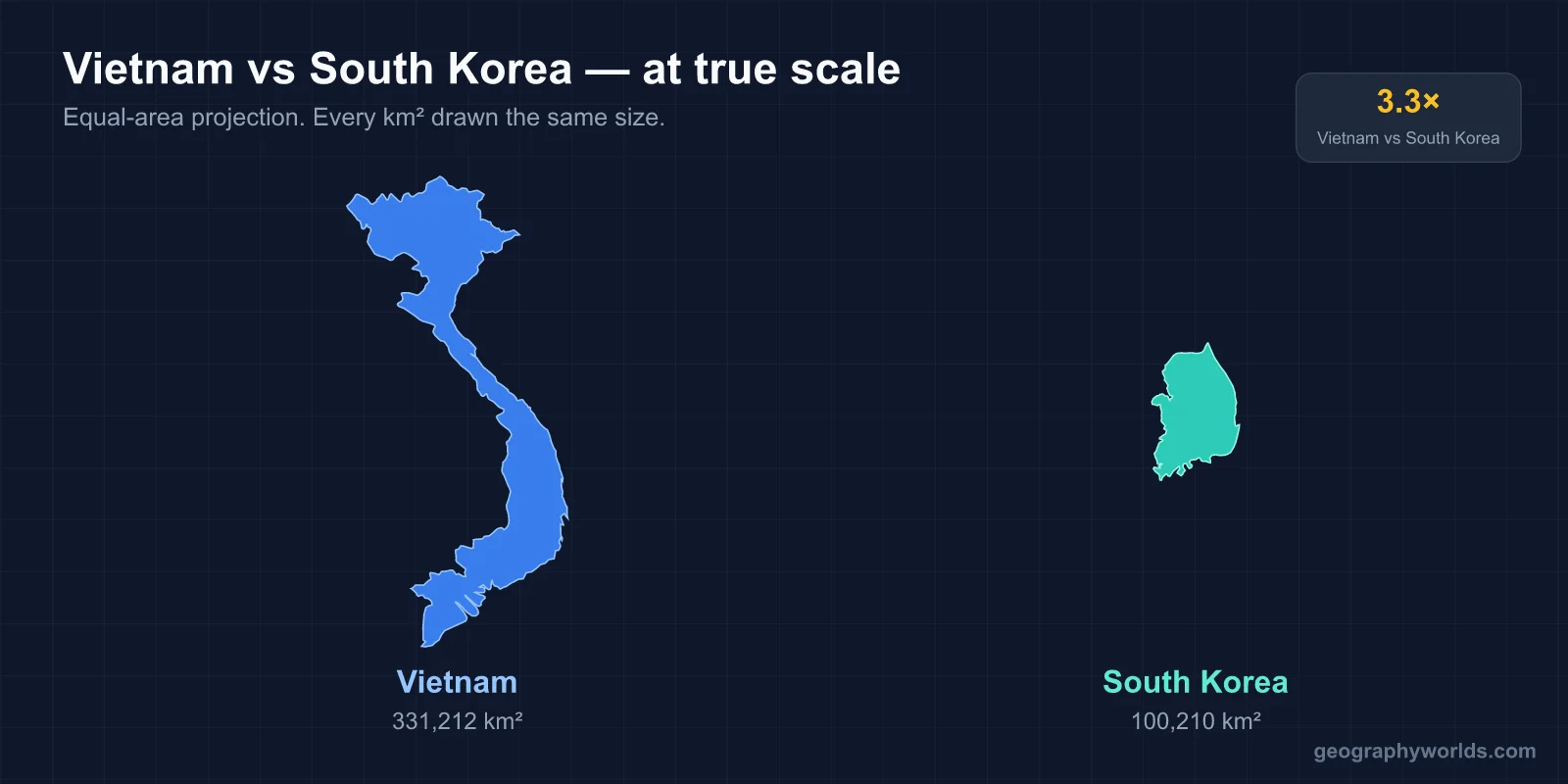
Vietnam is the larger country at about 331,000 km² with roughly 100 million people; South Korea covers about 100,000 km² with around 52 million. Both were partitioned along a parallel during the Cold War and fought a war over it. Vietnam was reunified by force in 1975; Korea never was — and the divergence since is one of the sharpest natural experiments in modern development.
Two partitions, two endings
Korea was divided at the 38th parallel in 1945 by American and Soviet agreement, and the war of 1950–53 ended in an armistice rather than a peace treaty. The Demilitarized Zone that resulted is about 4 km wide and 250 km long, and — because it has been almost entirely off-limits to people for seventy years — has become an accidental nature reserve holding species scarce elsewhere on the peninsula.
Vietnam was divided at the 17th parallel in 1954 after the French defeat at Dien Bien Phu, on the understanding that elections would follow. They did not, and the war that followed ended with northern forces taking Saigon in 1975 and the country reunified under one government.
So one partition became permanent and one did not. South Korea remains technically at war with a nuclear-armed neighbour and maintains conscription; Vietnam has no such frontier problem, and its principal strategic anxiety is maritime — competing claims with China in the South China Sea.
Long and thin against short and mountainous
Vietnam's shape is its defining feature: roughly 1,650 km from north to south, narrowing to under 50 km across at its waist. The country is often described as two rice baskets on a carrying pole — the Red River delta in the north around Hanoi, the Mekong delta in the south around Ho Chi Minh City, joined by a narrow mountainous middle.
South Korea is compact, occupying the southern half of a peninsula, and about 70 per cent mountainous. Its ranges are old and eroded rather than high — Hallasan on Jeju island, a volcano, is the highest point at 1,947 metres — and its usable flat land is concentrated in the west and south, which is where almost everyone lives.
Neither country has much spare land, and both have built upward and outward from a small usable base — which is why land prices in Seoul and Ho Chi Minh City have both risen far faster than incomes for much of the past two decades.
Both are consequently dense, and both concentrate population extraordinarily: the Seoul Capital Area holds around half of South Korea's entire population, one of the highest capital concentrations of any sizeable country.
What each does with its coastline
Vietnam has roughly 3,260 km of coast and uses it heavily: aquaculture, particularly shrimp and pangasius, is a major export sector, and the country is among the world's largest seafood exporters.
South Korea's coastline is more indented and shorter, but it hosts something Vietnam does not — the world's largest shipbuilding industry. Korean yards at Ulsan, Geoje and Busan have led global shipbuilding for years, competing with China and Japan for the largest share of new orders, and container ships, LNG carriers and offshore platforms are among the country's most valuable exports.
Rice, and where it grows
Both are rice cultures, but Vietnam is a rice exporter on a global scale and South Korea is not.
The Mekong delta alone produces the majority of Vietnam's rice, and the country is consistently among the top three exporters worldwide. That delta is also among the most threatened agricultural regions anywhere — barely above sea level, subsiding from groundwater extraction, starved of sediment by upstream dams, and increasingly reached by saltwater intrusion in the dry season.
South Korea's rice is grown for domestic consumption and heavily protected. Its agricultural sector is small as a share of the economy, its farmers are old, and food self-sufficiency has been declining for decades.
The development gap, and how it closed for one
In 1960 South Korea was poorer per head than many African countries. Its transformation over the following four decades — the Miracle on the Han River — took it to high-income status via state-directed industrial policy, export orientation and the chaebol, family-controlled conglomerates like Samsung, Hyundai and LG that still dominate the economy.
Vietnam started later. The Đổi Mới reforms of 1986 opened a centrally planned economy to markets and foreign investment, and growth since has been rapid and sustained. Vietnam is now a major manufacturing destination in its own right, in significant part because it sits one rung below China on cost — and, notably, much of that investment is Korean. Samsung alone manufactures a very large share of its phones in Vietnam and is among the country's biggest exporters.
So the relationship is not merely a comparison: South Korea is one of the largest foreign investors in Vietnam, and the development ladder each climbed is the same one, a few decades apart.
Confucian inheritance, different states
Both societies were shaped by Chinese civilisation and share a Confucian inheritance visible in attitudes to education, family hierarchy and examinations — Vietnam ran a Confucian civil-service examination system for centuries, as Korea did.
Both also abandoned Chinese characters for their own scripts, but at different times and with different results. Korea's hangul, devised in the fifteenth century under King Sejong, is an alphabet designed on phonological principles and is now used almost exclusively. Vietnamese switched to quốc ngữ, a Latin-based script developed by Portuguese and French missionaries, which became standard under French colonial rule.
Politically they diverged completely. Vietnam is a one-party socialist republic. South Korea was under authoritarian and military rule into the 1980s and democratised through mass protest, becoming a competitive democracy with a free press and a habit of prosecuting former presidents.
Typhoons, monsoons and what the weather does
Both sit in the path of Pacific typhoons, and both have monsoon-influenced climates, but the range differs.
Vietnam spans from tropical in the south — Ho Chi Minh City has wet and dry seasons and little temperature variation — to subtropical in the north, where Hanoi has a genuinely cool winter. Central Vietnam takes the worst of the typhoon season, with severe flooding most years.
South Korea has four sharply marked seasons: cold, dry winters driven by Siberian air, and hot, humid summers with a concentrated rainy season, the jangma. Snow is normal in winter; in southern Vietnam it is unknown.
Two diasporas, both consequential
Both countries have large populations abroad, formed in very different circumstances.
The Vietnamese diaspora was created substantially by departure after 1975 — the boat people and subsequent resettlement programmes — and is concentrated in the United States, Australia, France and Canada. Remittances back to Vietnam are a significant share of GDP, and the relationship between the overseas community and the government in Hanoi remains politically sensitive.
The Korean diaspora is older and more varied: labour migration to Japan and Manchuria under colonial rule, post-war emigration to the United States, and a large ethnic Korean population in China's Yanbian region. South Korea has also been, unusually, a major source country for international adoption for decades — a history the government has more recently begun to examine critically.
Soft power, and who exports culture
South Korea has achieved something very few middle-sized countries manage: its popular culture is consumed globally. The Korean Wave — Hallyu — covers music, television drama and film, and it has been deliberately supported by state cultural policy since the late 1990s. The commercial effects run well beyond entertainment into cosmetics, food and tourism.
Vietnam has no equivalent, and its international image is still shaped disproportionately by the war and by tourism. Its cultural exports that have travelled — phở, bánh mì, the coffee industry that has made it the world's second-largest producer after Brazil — are culinary rather than media.
Vietnam's film and music industries are growing domestically and its tourism marketing has improved sharply, but neither yet travels the way Korean output does — and the gap is a reminder that soft power is built deliberately over decades rather than arriving with growth.
That asymmetry matters economically. Korean soft power translates directly into demand for Korean goods; Vietnam's growth has come from manufacturing for other people's brands, which is a lower-margin position it is explicitly trying to move beyond.
Two demographic futures
The starkest present difference is demographic. South Korea has the lowest fertility rate of any country in the world, well below one child per woman, and its population has begun to fall. The implications — for pensions, conscription, rural depopulation and the concentration of everything in Seoul — dominate its domestic politics.
Vietnam's fertility is near replacement and its population is still young, giving it a demographic dividend that South Korea spent decades ago. That window is finite, and Vietnamese policymakers are explicit about wanting to reach high income before it closes — the trap South Korea escaped and many middle-income countries have not. Our South Korea and Vietnam guides go further into each.
