
Introduction
Sweden 🇸🇪 and Finland 🇫🇮 face each other across the Gulf of Bothnia at the top of the Baltic, two Nordic nations with a shared border, a long intertwined history, and a reputation for forests, lakes, and long winter nights. They sit close together on the map, but their languages and a few key details set them apart.
This side-by-side comparison walks through how Sweden and Finland measure up in area, population, capitals, language, and landscape — handy for anyone studying the Nordic region or weighing up a trip north.
Size & Geography
| Feature | Sweden 🇸🇪 | Finland 🇫🇮 |
|---|---|---|
| Area | 450,295 km² | 338,424 km² |
| Continent | Europe | Europe |
| Region | Northern Europe | Northern Europe |
| Land Borders | Norway, Finland | Sweden, Norway, Russia |
| Landscape | mostly flat or gently rolling; mountains in west | mostly low, flat to rolling plains with lakes |
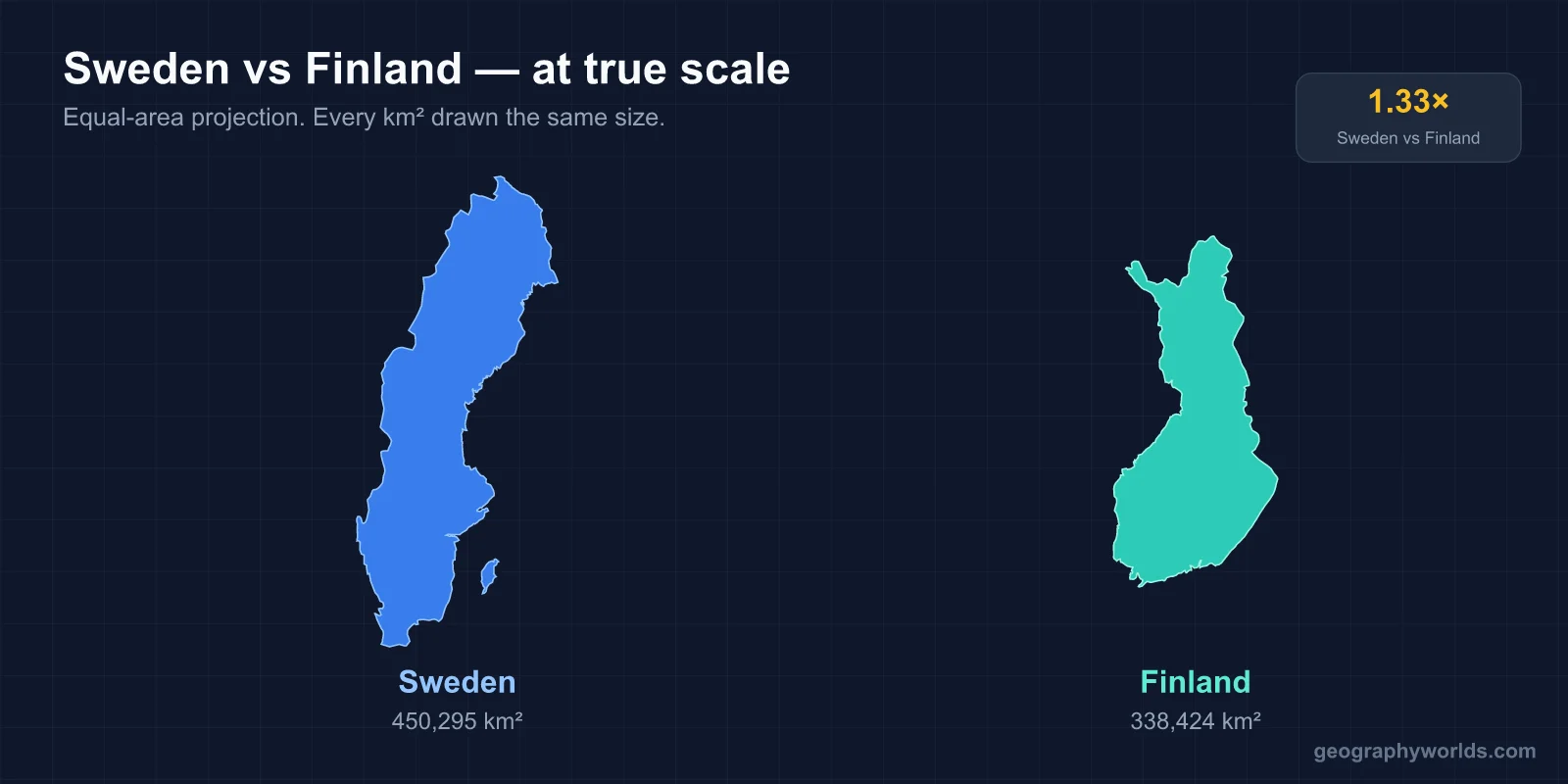
The two are fairly evenly matched in size, with Sweden's 450,295 km² coming in about 1.3 times Finland's 338,424 km². Both are largely low and gently rolling, but Sweden rises to mountains along its western flank, where it meets Norway, while Finland is flatter still and famously stippled with lakes. Their borders also differ in a way that has mattered historically: Finland shares a long eastern frontier with Russia in addition to Sweden and Norway, while Sweden borders only Norway and Finland.
Population & Demographics
| Metric | Sweden 🇸🇪 | Finland 🇫🇮 |
|---|---|---|
| Population | 10.7 million | 5.6 million |
| Population Density | 23.8 per km² | 16.6 per km² |
Sweden's 10.7 million residents are about 1.9 times Finland's 5.6 million, so Sweden is the more populous neighbor by a fair margin. It is also the slightly denser of the two, at 23.8 people per km² against Finland's 16.6 — a gap of about 7.2 people per km². Either way, both countries are sparsely settled by European standards, with much of their land given over to forest, lake, and the thinly populated far north.
Capital Cities
Stockholm is the capital of Sweden, spread across a cluster of islands where Lake Mälaren meets the Baltic, while Helsinki is the capital of Finland, sitting on a peninsula on the southern coast. Both are Northern European capitals on the Baltic, and ferries have long linked the two cities directly across the sea.
Language, Currency & Culture
| Aspect | Sweden 🇸🇪 | Finland 🇫🇮 |
|---|---|---|
| Languages | Swedish (official) | Finnish and Swedish (both official) |
| Currency | Swedish Krona (SEK) | Euro (EUR) |
Language reveals the deeper difference between these neighbors. Swedish is the official language of Sweden and, notably, one of two official languages in Finland, a legacy of the centuries when Finland was part of the Swedish realm. Finnish, the other official language of Finland, belongs to a different language family entirely and is unrelated to Swedish. Money sets them apart too: Finland adopted the Euro (EUR), while Sweden has kept its own Swedish Krona (SEK).
Climate & Natural Features
| Aspect | Sweden 🇸🇪 | Finland 🇫🇮 |
|---|---|---|
| Climate | temperate in south; subarctic in north | cold temperate; harsh winters, mild summers |
| Key Features | Swedish Lapland, Stockholm Archipelago, forests and lakes | 188,000 lakes, Finnish Lapland, forests, midnight sun |
| Economy | automotive, telecommunications, pharmaceuticals, forestry | technology (Nokia), forestry, metals, engineering |
Both countries reach far enough north to share long, dark winters and the summer midnight sun, but their climates are described a little differently: Sweden ranges from temperate in the south to subarctic in the north, while Finland is cold temperate throughout, with harsh winters and mild summers. Their natural signatures overlap in spirit — endless forests and water everywhere. Sweden is known for Swedish Lapland, the Stockholm Archipelago, and its forests and lakes, while Finland is so dotted with water that it counts some 188,000 lakes, alongside Finnish Lapland and its own midnight-sun north. Forestry underpins both economies; Sweden adds automotive, telecommunications, and pharmaceuticals, while Finland leans on technology, metals, and engineering.
What Makes Each Country Unique
Sweden is internationally renowned for IKEA, Spotify, the Nobel Prize, Viking heritage, and stunning Northern Lights. Sweden invented the three-point seatbelt, the pacemaker, and dynamite — and awards the Nobel Prize for global achievements.
Finland is best known for Santa Claus Village in Lapland, saunas, the Northern Lights, Nokia, and world-class education. Finland has over 3 million saunas for a population of 5.5 million people — roughly one sauna for every two residents.
Key Differences at a Glance
- Area: Sweden (450,295 km²) vs Finland (338,424 km²) — Sweden is 1.3x larger
- Population: Sweden (10.7 million) vs Finland (5.6 million) — Sweden is 1.9x more populous
- Capitals: Stockholm vs Helsinki
- Currency: Swedish Krona (SEK) vs Euro (EUR)
- Continents: Europe vs Europe
- Density: Sweden is more densely populated (difference of ~7.2 people per km²)
- Languages: Swedish (official) vs Finnish and Swedish (both official)
Verdict
Sweden and Finland are close cousins among the Nordic nations, alike in their forests, lakes, and far-northern light yet distinct in the details. Sweden is the larger and more populous of the two, by roughly 1.3 times in area and 1.9 times in people, and edges Finland on density as well, though both remain among Europe's emptiest countries.
Their landscapes echo each other — Sweden with Lapland and the Stockholm Archipelago, Finland with its 188,000 lakes and its own Lapland — but the languages mark the real divide, with Swedish spanning both countries and Finnish standing alone. The split currencies, krona versus euro, are another reminder that geographic neighbors can still choose different paths.
Looking at them together is a clean way to understand the Nordic region: similar enough to feel like a family, different enough that each keeps its own character. Comparing the two brings those shared roots and quiet contrasts into focus.
Test Your Knowledge!
Think you know your countries? Try our interactive geography quiz!
Play Geography Games →