
Introduction
Switzerland 🇨🇭 and Austria 🇦🇹 sit next to each other in the heart of the Alps, share a language, and both trade heavily on their mountain scenery. Yet a closer look reveals two countries that took very different paths: one a multilingual confederation famous for neutrality and banking, the other a former imperial center known for music and skiing.
This side-by-side comparison lays out the key facts and figures, from land area and population to capitals, climate, and economy, so you can see exactly where these neighbors line up and where they part ways.
Size & Geography
| Feature | Switzerland 🇨🇭 | Austria 🇦🇹 |
|---|---|---|
| Area | 41,284 km² | 83,871 km² |
| Continent | Europe | Europe |
| Region | Western Europe | Western Europe |
| Land Borders | Germany, France, Italy, Austria, Liechtenstein | Germany, Czech Republic, Slovakia, Hungary, Slovenia, Italy, Switzerland, Liechtenstein |
| Landscape | Alps in south, Swiss Plateau in center, Jura in northwest | mostly mountainous (Alps); flat along Danube River |
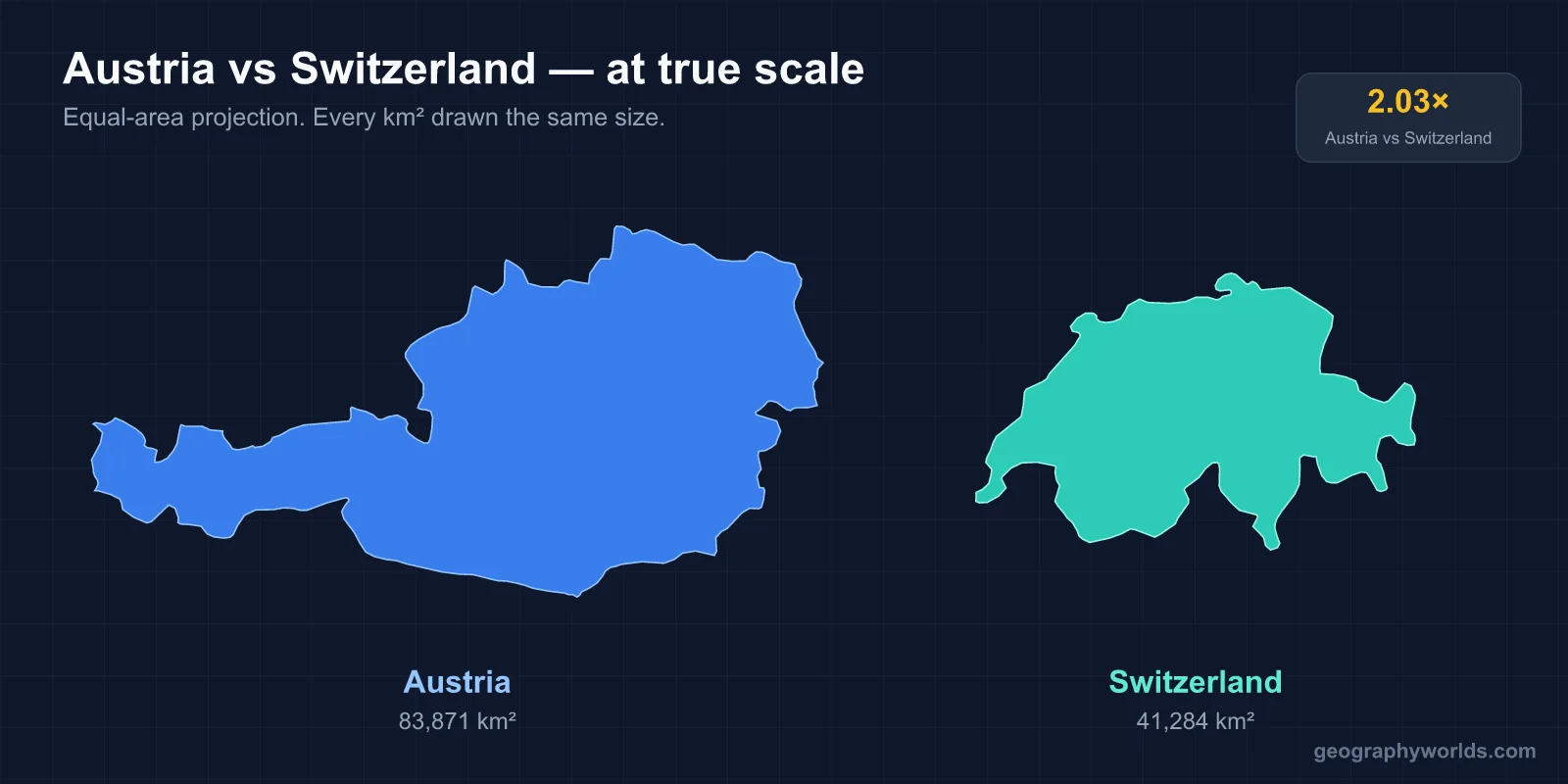
Austria is the bigger country by a wide margin, covering 83,871 km² to Switzerland's 41,284 km² — roughly twice the area. The two also notably differ in how mountains shape them. Switzerland packs the Alps into its south, leaves room for the populous Swiss Plateau across its center, and adds the Jura range in the northwest. Austria is mostly mountainous as well, but its terrain opens out into flat, fertile land along the Danube River, which gives the country a clear lowland corridor that Switzerland lacks.
Their border lists tell the same story. Switzerland touches five neighbors, while Austria touches eight, reflecting its position as a crossroads between Central, Eastern, and Southern Europe. The one country they share a border with, fittingly, is each other.
Population & Demographics
| Metric | Switzerland 🇨🇭 | Austria 🇦🇹 |
|---|---|---|
| Population | 9.0 million | 9.1 million |
| Population Density | 218.2 per km² | 108.6 per km² |
Here the two countries are almost twins: Switzerland is home to about 9.0 million people and Austria to roughly 9.1 million, a difference small enough to be negligible. The interesting contrast is density, not headcount. Because Austria fits nearly the same population into double the land, it averages 108.6 people per km². Switzerland, squeezing a similar number into half the space, comes in at 218.2 per km² — about twice as crowded, a gap of roughly 109.6 people per km².
Capital Cities
Switzerland's capital is Bern, a deliberately modest choice for a country wary of concentrating power. Austria's capital is Vienna, the former seat of the Habsburg Empire and still one of Europe's grandest cities. Both lie within Western Europe, but they reflect each nation's character: Bern is a quiet federal compromise, while Vienna carries the weight of an imperial past.
Language, Currency & Culture
| Aspect | Switzerland 🇨🇭 | Austria 🇦🇹 |
|---|---|---|
| Languages | German, French, Italian, Romansh (all official) | German (official) |
| Currency | Swiss Franc (CHF) | Euro (EUR) |
Language is where the neighbors diverge most sharply. Austria has a single official language, German. Switzerland recognizes four — German, French, Italian, and Romansh — a reflection of how the country was assembled from communities that never had to give up their own tongue. Money tells a similar tale of independence: Austria adopted the Euro as a member of the eurozone, while Switzerland kept its own Swiss Franc, a currency long prized for stability.
Climate & Natural Features
| Aspect | Switzerland 🇨🇭 | Austria 🇦🇹 |
|---|---|---|
| Climate | continental to Mediterranean; varies with altitude | temperate continental; cold winters, moderate summers |
| Key Features | Matterhorn, Lake Geneva, Jungfrau, Swiss Alps | Austrian Alps, Danube Valley, Wachau, Grossglockner |
| Economy | banking, pharmaceuticals, watchmaking, tourism | tourism, manufacturing, services, forestry |
Switzerland's climate ranges from continental to Mediterranean and shifts dramatically with altitude, so a single short drive can take you from vineyard warmth to glacier cold. Its landmark roll call is hard to beat: the Matterhorn, Lake Geneva, the Jungfrau, and the broader Swiss Alps. Austria leans more uniformly temperate continental, with cold winters and moderate summers, and its standout sights cluster around the high country and the river valley — the Austrian Alps, the Danube Valley, the vineyard-lined Wachau, and the Grossglockner, the country's highest peak.
Economically, both lean on tourism, but their strengths sit elsewhere. Switzerland built its wealth on banking, pharmaceuticals, and watchmaking — high-value, precision industries. Austria's economy rests more on manufacturing, services, and forestry, a broader industrial base supported by its extensive woodlands and lowland resources.
What Makes Each Country Unique
Switzerland is internationally renowned for the Alps, luxury watches, chocolate, banking secrecy, and political neutrality. Switzerland has four official languages and has not been involved in an international armed conflict since 1815, making it one of the longest-standing neutral nations.
Austria is best known for classical music (Mozart, Strauss), Alpine skiing, the Sound of Music, and Viennese coffeehouse culture. Austria has produced more classical music composers per capita than any other nation — Mozart, Haydn, Schubert, and Strauss all called it home.
Key Differences at a Glance
- Area: Switzerland (41,284 km²) vs Austria (83,871 km²) — Austria is 2.0x larger
- Population: Switzerland (9.0 million) vs Austria (9.1 million) — Austria is 1.0x more populous
- Capitals: Bern vs Vienna
- Currency: Swiss Franc (CHF) vs Euro (EUR)
- Continents: Europe vs Europe
- Density: Switzerland is more densely populated (difference of ~109.6 people per km²)
- Languages: Switzerland has four official languages vs Austria's single official German
Verdict
For two Alpine neighbors that share a border and a language, Switzerland and Austria are surprisingly different countries. Austria is the larger of the two, roughly twice the area at 83,871 km² against Switzerland's 41,284 km², and it edges ahead on population as well with 9.1 million people to Switzerland's 9.0 million. But because that population is spread over far more land, Austria feels far less crowded, while Switzerland's 218.2 people per km² make it one of the denser countries in the region.
Beyond the numbers, each carved out its own identity. Switzerland is the multilingual, neutral nation of banks, watches, and peaks like the Matterhorn, keeping its own franc and its distance from European politics. Austria is the cultural heir to an empire, anchored by Vienna and the Danube, fluent in a single German tongue, and woven into the eurozone. Same mountains, very different countries — which is exactly what makes the pair so interesting to compare.
Test Your Knowledge!
Think you know your countries? Try our interactive geography quiz!
Play Geography Games →