
The tallest waterfall in Asia is Kadamaian Falls, a cascade of about 700 m (2,300 ft) on the southern flank of Mount Kinabalu in Sabah, Malaysian Borneo, according to Wikipedia's list of waterfalls by height and the fall's own article. Next come Taiwan's Jiao Lung Waterfall, a seasonal plunge of about 600 m, and India's Vajrai Waterfall, quoted at 560 m, though that figure is disputed. Japan's Hannoki Falls (497 m), which flows only during the spring snowmelt, and Siberia's Talnikovy Waterfall, measured at 482 m in 1990, complete the top five. There is no standard way to measure a waterfall, and many of these heights are estimates, so the ranking below is best read region by region: Borneo holds the record, Taiwan, Japan and Siberia have seasonal giants, and India has the largest cluster of tall falls on the continent.
Asia against the world: 700 metres beside Angel Falls' 979
Asia does not hold the world record. Angel Falls in Venezuela is usually credited with it: 979 m in total, including an uninterrupted plunge of 807 m off the edge of Auyán-tepui in Canaima National Park, a UNESCO World Heritage Site. Even that title is not quite settled, because Tugela Falls in South Africa, officially 948 m, was re-measured at 983 m by a Czech expedition in 2016. Most of the world's tallest falls are in Venezuela, Peru, Norway, Hawaii and New Zealand, where high plateaus and glacier-cut valleys end in sheer walls. Asia's nearest answer to Angel Falls' main drop is Taiwan's Jiao Lung Waterfall, a sheer plunge of about 600 m; most of its other tall falls are multi-stage cascades, which is one reason their heights vary so much between sources.
Kadamaian, at roughly 700 m, is listed level with Haloku Falls in Hawaii and Chamberlain Falls in New Zealand. Below it, Asia's ranking drops into the 300 to 600 m range, and the continent's most visited falls, such as Huangguoshu in China, are famous for width and volume rather than height. The table gives ten of the tallest Asian falls that have their own Wikipedia articles with a recorded height. Just outside it are Siberia's Kinzelyuk Waterfall (328 m), South Korea's Towangseong Waterfall (320 m), Meghalaya's Nohsngithiang Falls (315 m) and Goa's Dudhsagar Falls (310 m).
| Rank | Waterfall | Height | Location |
|---|---|---|---|
| 1 | Kadamaian Falls | about 700 m | Mount Kinabalu, Sabah, Malaysia |
| 2 | Jiao Lung Waterfall (seasonal) | about 600 m | Alishan Township, Chiayi County, Taiwan |
| 3 | Vajrai Waterfall | 560 m quoted (disputed) | Satara district, Maharashtra, India |
| 4 | Hannoki Falls (seasonal) | 497 m | Tateyama, Toyama, Japan |
| 5 | Talnikovy Waterfall (seasonal) | 482 m measured; 600–700 m claimed | Putorana Plateau, Siberia, Russia |
| 6 | Kunchikal Falls | 455 m | Shimoga district, Karnataka, India |
| 7 | Barehipani Falls | 399 m | Simlipal National Park, Odisha, India |
| 8 | Shōmyō Falls | 350 m | Tateyama, Toyama, Japan |
| 9 | Nohkalikai Falls | 340 m | Sohra, Meghalaya, India |
| 10 | Langshiang Falls | about 337 m (unconfirmed) | West Khasi Hills, Meghalaya, India |
Borneo's Kadamaian Falls, Asia's leader on Mount Kinabalu
Kadamaian Falls tumbles about 700 m down the southern side of Mount Kinabalu, which at 4,095 m is the highest mountain in Malaysia and in Maritime Southeast Asia. It is a cascade rather than a single plunge, and it is Malaysia's longest waterfall. It can be seen from the Tamparuli–Ranau road but is hard to reach on foot. The mountain sits in Kinabalu Park, Malaysia's first UNESCO World Heritage Site, inscribed in December 2000, and a recent botanical survey estimated that 5,000 to 6,000 plant species grow on the mountain itself.
Thi Lo Su, Sipiso-piso and Khone Phapheng: the rest of Southeast Asia
Elsewhere in Southeast Asia, the tall falls are shorter and the famous ones are wide. Thailand's Thi Lo Su Waterfall, in the Umphang Wildlife Sanctuary of Tak Province, is said to be about 250 m high and nearly 450 m wide, though it has apparently never been surveyed. In Indonesia, Sipiso-piso drops about 120 m from a cave in the wall of the Lake Toba caldera in North Sumatra, with 651 steps leading down to its base. On the Mekong in southern Laos, the Khone Phapheng Falls are never more than about 21 m high, but they spread across 10,783 m of channels and islands, making them the widest waterfall in the world and the reason the Mekong cannot be navigated all the way into China. The rapids run for 9.7 km through Si Phan Don, the "4,000 islands", with an average discharge of nearly 11,000 cubic metres per second and a recorded peak above 49,000.
Japan's Hannoki and Shōmyō falls at Tateyama
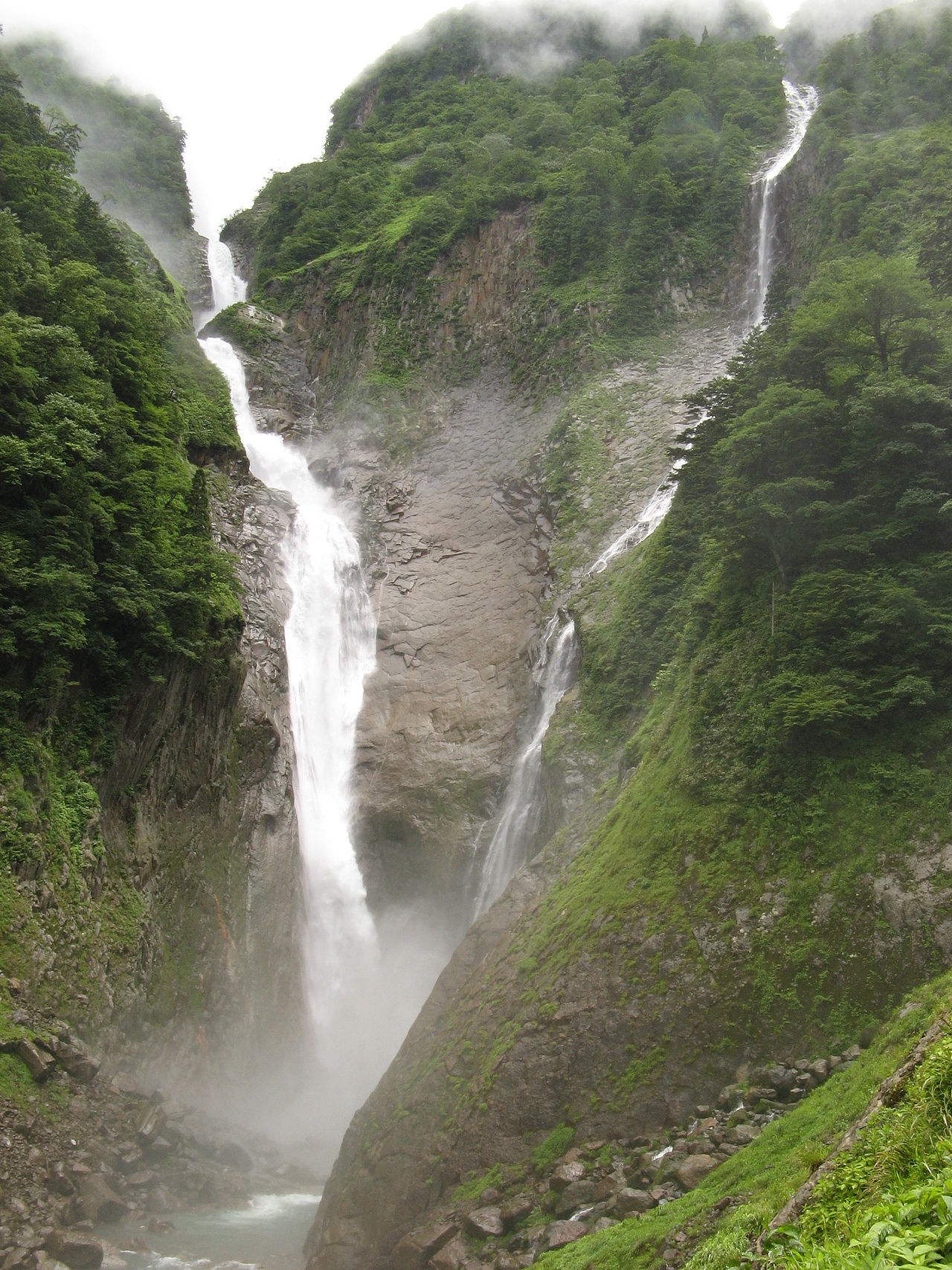
Japan's two tallest falls stand side by side in the same gorge in the town of Tateyama, Toyama Prefecture. Hannoki Falls is the taller at 497 m, but it has water only from April to July, while snow on the Midagahara plateau above is melting. For that reason its neighbour, Shōmyō Falls, is usually treated as Japan's highest. Shōmyō drops 350 m in four stages of 70, 58, 96 and 126 m, and carries its greatest volume in early to mid-summer. In late spring the two run side by side as twin falls that almost face each other.
Japan's best-known waterfall is a different kind of record. Nachi Falls in Wakayama Prefecture has a single uninterrupted drop of 133 m, the tallest single uninterrupted drop in Japan, and two rocks at its top are revered as the guardian kami of the falls.
Jiao Lung, Huangguoshu and Ban Gioc–Detian: East Asia from Taiwan to the Kurils
Taiwan's Jiao Lung Waterfall, on a cliff of Mount Da Ta in Alishan Township, Chiayi County, is the island's tallest measured fall, a sheer plunge of about 600 m. It is mostly seasonal: its stream drops 1,300 m in a 4 km run, so after a typhoon it is in full flow, but within days or even hours its volume falls away, and the same floods wash out the crossings to the nearby hamlet of Fengshan. South Korea's longest, Towangseong Waterfall in Seoraksan, totals 320 m in three sections of 150, 80 and 90 m.
China's largest waterfall, Huangguoshu in Guizhou Province, is only 77.8 m high but 101 m wide; its main fall, 67 m high and 83.3 m wide, is described as the biggest waterfall in Asia. On the China–Vietnam border, Ban Gioc–Detian Falls drops about 30 m over two main falls on the Quây Sơn River, 272 km north of Hanoi. Over thousands of years the falls have eroded their crest and moved upstream; most of the year they appear as two separate falls, but in summer floods they can merge into one.
Further north, on Iturup in the Kuril Islands, Ilya Muromets Waterfall falls about 141 m from the eastern slope of the Demon Volcano straight into the Pacific. Iturup is administered by Russia and claimed by Japan, which knows the fall as Rakkibetsu, and it can be reached only by boat.
Siberia's Talnikovy Waterfall on the Putorana Plateau
North Asia's leader lies in Russia's Putorana Mountains, the north-western part of the Central Siberian Plateau. The Talnikovy Waterfall pours a small brook off the flat summit of Mount Trapetsia into the Talnikova River, inside the Putorana Nature Reserve near Lake Dyupkun. The first instrumental measurement was made in 1990 by an eight-member expedition led by Boris Babizki and including the writer Petro Kravchuk, who published its result of 482 m in his book Nature's Records, while some sources claim the whole cascade is 600 to 700 m. The brook is frozen for 10 to 11 months a year, and the fall does not even appear every year; in some years the stream is not seen at all, and Russian geographers have disputed whether it still exists. Russia's third-tallest, Kinzelyuk Waterfall in the Eastern Sayan mountains, was estimated at 328 m by a team led by Kravchuk in 1989.
Vajrai, Kunchikal, Barehipani and Nohkalikai: India's tallest cluster
India has more tall falls in the top ten than any other country, most of them on the Western Ghats or the Meghalaya plateau. Vajrai Waterfall, on the Urmodi River about 27 km from Satara in Maharashtra, is given as 560 m over three tiers and heads Wikipedia's list of Indian falls by height, but a note on that list argues that the drop from its source at the Kas reservoir to the Urmodi project below cannot exceed about 500 m. Kunchikal Falls on the Varahi River in Karnataka is 455 m high according to the World Waterfall Database, but since the Mani Dam and an underground power station were built upstream, it is visible only in the July to September rainy season. The falls are in a restricted area and visitors need a gate pass. Barehipani Falls in Odisha's Simlipal National Park drops 399 m in two tiers on the Budhabalanga River, with a single drop of 259 m.
Nohkalikai Falls, 340 m, is the tallest plunge waterfall in India. It falls off a small plateau near Sohra, formerly Cherrapunji, one of the wettest places on Earth, into a pool of unusual green water, and weakens in the December to February dry season. Its Khasi name refers to a local legend of a woman, Ka Likai, who threw herself from the edge of the plateau in grief after the death of her infant daughter.

Dudhsagar, Jog and Bambarakanda: the Western Ghats and Sri Lanka
Further south, Dudhsagar Falls, "Sea of Milk", drops 310 m in four tiers in Goa's Bhagwan Mahaveer Sanctuary, with the Belagavi–Vasco da Gama railway line passing the falls. Jog Falls on the Sharavati River in Karnataka plunges about 253 m in four streams known as Raja, Rani, Roarer and Rocket; it ranks 36th in the world among free-falling waterfalls, according to the World Waterfall Database. Sri Lanka's tallest, Bambarakanda Falls in Badulla District, is 263 m high on the Kuda Oya, a tributary of the Walawe River. West Asia has nothing comparable: Turkey's tallest, Tortum Waterfall, drops about 48 m, 100 km north of Erzurum, and since the Tortum Dam was completed in 1960 it runs only briefly in May and June.
For the world record holder that Kadamaian trails by almost 300 m, see our guide to Angel Falls; the border falls between China and Vietnam get a fuller treatment in Ban Gioc Falls, and the countries where all these cascades add up to the biggest totals are ranked in countries with the most waterfalls.