
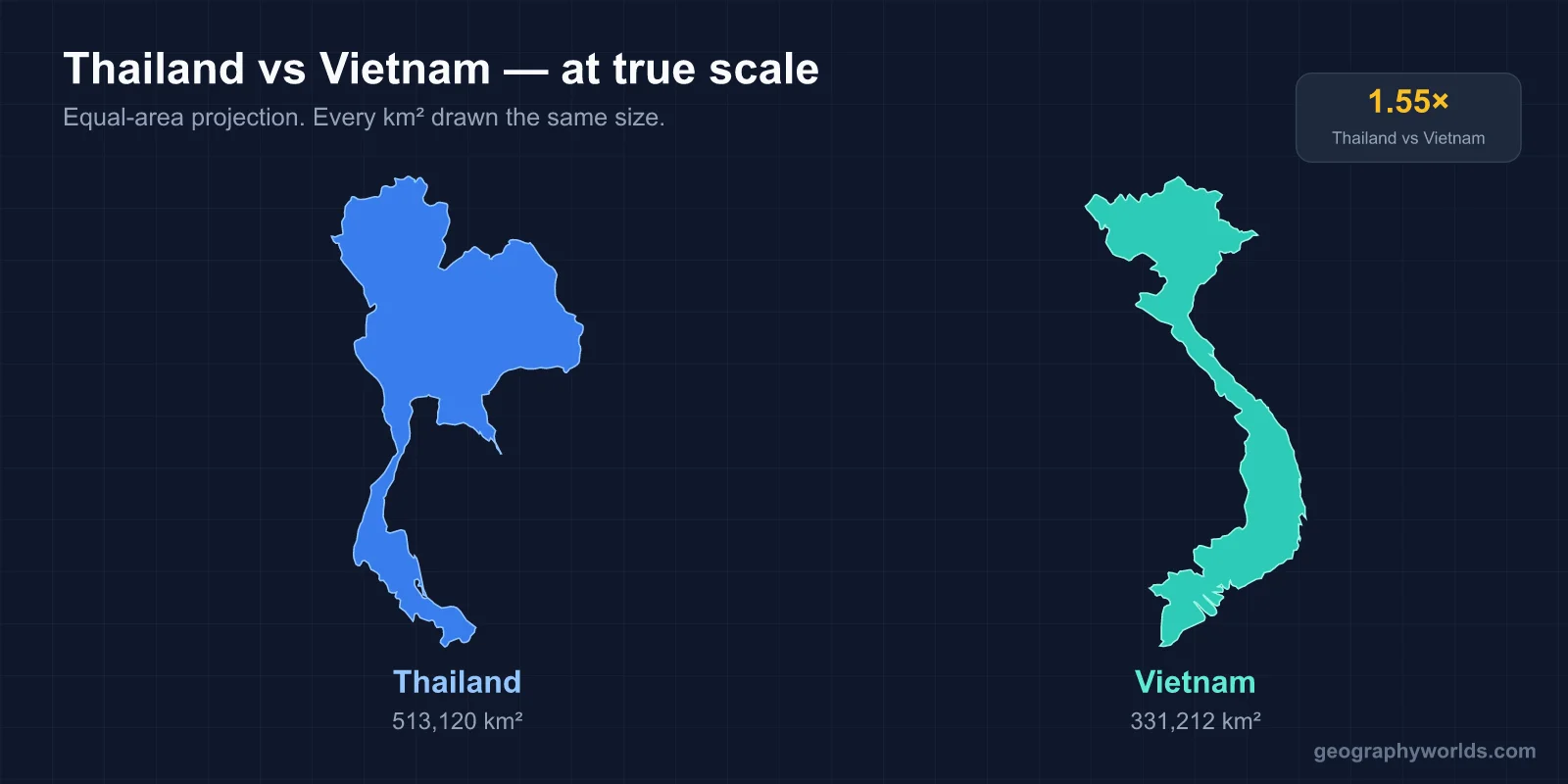
Thailand is the bigger country and the richer one; Vietnam has far more people. Thailand covers about 513,120 km², roughly 55% more than Vietnam’s 331,345 km², but Vietnam had an estimated 102.3 million inhabitants in 2025 against Thailand’s roughly 66 million in 2024. On IMF estimates for 2026, Thailand’s GDP per capita is about US$8,100 and Vietnam’s about US$5,100. Thailand is a constitutional monarchy governed from Bangkok, where the official language is Thai; Vietnam is a one-party socialist republic governed from Hanoi, where the language is Vietnamese. The two do not share a border (Laos and Cambodia sit between them), yet their histories have run in parallel for a thousand years, and the points where those histories split explain most of the differences you see today.
Ayutthaya and Đại Việt: Two Kingdoms Before 1800
Both countries trace their statehood to breaks with a larger neighbour. In Vietnam, the decisive moment came in late 938, when Ngô Quyền defeated the fleet of the Chinese Southern Han state at the Bạch Đằng River near Hạ Long Bay, ending roughly a thousand years of intermittent Chinese rule over the Red River Delta. Vietnamese dynasties that followed kept Chinese models of government, Confucian examinations and Mahayana Buddhism, and they pushed south for centuries, absorbing the kingdom of Champa and eventually the Khmer lands of the Mekong Delta.
The Thai story began further inland. Tai-speaking peoples moved into the Chao Phraya basin between the 8th and 10th centuries, and in 1238 a local chief rebelled against the Khmer and founded Sukhothai, which Thai historians treat as the start of their national history. The Ayutthaya Kingdom, founded in 1350, replaced the Khmer Empire as the dominant power in the region and adopted Theravada rather than Mahayana Buddhism. Portuguese envoys reached Ayutthaya in 1511, and the city thrived on trade until Burmese forces destroyed it in 1767.

By the early 19th century both states had rebuilt around new dynasties and new capitals. Rama I founded the Chakri dynasty and moved the Siamese capital to Bangkok in 1782. Twenty years later the Nguyễn dynasty unified Vietnam in 1802, and in 1804 Emperor Gia Long began the walled Imperial City at Huế. The two courts then fought directly, mainly over Cambodia, which lay between them: the Siamese–Vietnamese wars of 1833–1834 and 1840–1845 were contests for suzerainty over the Khmer kingdom. Cambodia, with Laos, still separates them on the map.
1855 to 1893: Siam Bends While the Nguyễn Break
The 19th century is where the timelines part. Siam chose accommodation. On 18 April 1855 King Mongkut signed the Bowring Treaty with Britain, the first of several unequal treaties, which opened the kingdom to free trade and extraterritorial rights for foreigners. The concessions were costly, but they gave London a commercial stake in an independent Siam, and Mongkut’s son Chulalongkorn (Rama V) used the breathing room to centralise the state along European lines.
Vietnam resisted and lost. France and Spain attacked Tourane (Da Nang) in 1858, the Treaty of Saigon in 1862 surrendered three southern provinces, and by 1867 all of Lower Cochinchina was a French colony. In 1883 the Nguyễn court at Huế accepted a protectorate; by 1884 the whole country was under French control, split into the colony of Cochinchina and the protectorates of Annam and Tonkin. In 1887 all three were folded into French Indochina, governed first from Saigon and, from 1902, from Hanoi.

French expansion then reached Siam itself. In the Franco-Siamese crisis of 1893, French gunboats sailed up the Chao Phraya to blockade Bangkok, and Siam ceded most of what is now Laos, the territory east of the Mekong. In the Anglo-Siamese Treaty of 10 March 1909, Siam gave up its claims to Kedah, Kelantan, Perlis and Terengganu to Britain, fixing the modern Thai–Malaysian border. Siam lost land on every side, but it kept its throne, its capital and its administration. It was the only country in Southeast Asia never colonised by a European power, and that single fact separates Thai and Vietnamese experience for the next century.
1932 and 1945: A Revolution in Bangkok, a Declaration in Hanoi
Both countries changed their political systems in the interwar and wartime years, and the difference between the two changes is instructive. In Siam, the bloodless revolution of 24 June 1932 by the Khana Ratsadon (People’s Party) forced King Prajadhipok to accept a constitution. The monarchy survived, and on 24 June 1939 the country was officially renamed Thailand. During the Second World War the military government of Plaek Phibunsongkhram allied with Japan, but the underground Free Thai Movement allowed Thailand to escape treatment as a defeated nation.
Vietnam’s break came through revolution rather than reform. Japan took full control of Indochina in March 1945; the famine of 1944–1945 killed up to two million people. After Japan’s surrender, the communist-led Việt Minh seized Hanoi and Huế in August 1945, the last emperor, Bảo Đại, abdicated, and on 2 September 1945 Hồ Chí Minh declared independence. France returned, and the First Indochina War ended only with the French defeat at Điện Biên Phủ in 1954. The Geneva Accords of 21 July 1954 split the country at roughly the 17th parallel. So while Thailand entered the Cold War as a monarchy with its borders intact, Vietnam entered it as two rival states.
1964 to 1975: Thai Air Bases and a Divided Vietnam
The Vietnam War tied the two histories together more tightly than at any point since the wars over Cambodia. Thailand, under Field Marshal Thanom Kittikachorn, became a close United States ally and a member of SEATO. From 1964 it let the US Air Force use Thai air and naval bases, and at the war’s height almost 50,000 American personnel were stationed in Thailand, mostly airmen. Thailand also sent its own troops: the Queen’s Cobras regiment arrived at Bien Hoa in 1967, followed by the Black Panthers division in 1968. About 40,000 Thai soldiers served in South Vietnam, making Thailand the third-largest provider of ground forces after the United States and South Korea; 351 were killed in action.
The war ended with the fall of Saigon on 30 April 1975, and on 2 July 1976 North and South were merged as the Socialist Republic of Vietnam. The two neighbours then faced off again over the same ground as in the 1830s. In 1978 Vietnam invaded Cambodia and removed the Khmer Rouge from power, occupying Phnom Penh, which put Vietnamese troops on Thailand’s eastern frontier. A Western trade embargo, the Cambodian occupation and a border war with China in 1979 crippled Vietnam’s economy into the mid-1980s.
ASEAN in 1967 and Đổi Mới in 1986: How the Economies Diverged
The economic gap between the two countries opened during the Cold War, when they took opposite sides. On 8 August 1967, Thailand hosted the signing of the ASEAN Declaration at Saranrom Palace in Bangkok, one of five founding members of a bloc formed partly to contain communism. Integrated with Western and Japanese investment, Thailand industrialised through the 1970s and 1980s, building a car industry and an export base. That model also exposed it: the 1997 Asian financial crisis began in Thailand and ended with an International Monetary Fund bailout.
Vietnam started from a planned economy. At the Sixth National Congress of the Communist Party in December 1986, reformers launched Đổi Mới (“Renovation”), which allowed private farms and factories, deregulation and foreign investment while the state kept control of strategic industries. Relations with the United States were upgraded to embassy level in August 1995; on 28 July 1995 Vietnam joined ASEAN as its seventh member, 28 years after Thailand helped found it; and on 11 January 2007 it became the 150th member of the World Trade Organization.
The result is two economies of similar total size built on different foundations. Thailand’s nominal GDP is estimated at about US$580 billion for 2026 and Vietnam’s at about US$527 billion, so a country with 36 million more people is close to matching Thailand’s output. Thailand leans on manufacturing, agriculture and tourism: before the pandemic it was the world’s eighth-most visited country, receiving 39.8 million international tourists in 2019, and estimates of tourism’s direct contribution to GDP have ranged from about 9% to almost 18%. Vietnam’s growth has come from export manufacturing and agriculture. Both are among the world’s largest rice exporters, Thailand from the Chao Phraya plain and the Khorat Plateau, Vietnam from the Red River and Mekong deltas.
What the Two Maps Look Like in the 2020s
Geography has shaped how each history played out. Thailand is compact: a central plain drained by the Chao Phraya, the Khorat Plateau of Isan in the northeast bounded by the Mekong, highlands in the north where Doi Inthanon rises to 2,565 m (8,415 ft), and the narrow Kra Isthmus running south towards Malaysia. It is organised into 76 provinces, and Bangkok dominates as both capital and largest city. Vietnam is a long S-shape with a coastline of 3,444 km; at its narrowest, in Quảng Bình province, it is about 50 km wide. Its peak, Fansipan, reaches 3,143 m (10,312 ft) on the border of Lào Cai and Lai Châu provinces and is the highest mountain on the Indochinese Peninsula. The shape has produced two poles, Hanoi in the Red River Delta and Ho Chi Minh City near the Mekong Delta at opposite ends of the country.
Twenty Thai Constitutions Against One Vietnamese Party
The political endpoints are as different as the starting points were similar. Thailand has had 20 constitutions and charters since 1932 and coups in 2006 and 2014; it operates under the 2017 constitution, with the armed forces keeping considerable influence. Vietnam has been governed by the Communist Party since reunification and, since 1986, has combined one-party rule with a market economy. Religion follows the old dynastic split: Thailand remains overwhelmingly Theravada Buddhist, while Vietnam’s religious life mixes Mahayana Buddhism, folk religion and a substantial Catholic minority. Ethnically, the Kinh make up about 85% of Vietnam’s people, alongside 53 other officially recognised groups.
Put the two timelines side by side and the pattern is clear. Both states formed by breaking from larger empires, both rebuilt under new dynasties within twenty years of each other, and both competed over Cambodia. The fork came in the 1850s to 1880s, when Siam negotiated and Vietnam was conquered; everything after, from monarchy against revolution to a 1967 head start in ASEAN against a 1986 restart through Đổi Mới, follows from it. For a closer look at the two capitals where these decisions were made, see our guides to Bangkok and Hanoi, or follow the river that links the two countries’ farmland in our guide to the Mekong.