
Tucked into the high eastern Pyrenees between France and Spain, Andorra is a country you could drive across in under an hour, yet it packs in ski slopes, medieval churches, and a constitutional setup unlike anywhere else on Earth. With around 84,000 people and a capital, Andorra la Vella, sitting higher than any other in Europe, this tiny principality has quietly outlasted empires and revolutions. Here are ten facts that show why Andorra is far more remarkable than its size suggests.
1. It Is Ruled by Two Princes — One of Them French, One a Spanish Bishop
Andorra is the world's only co-principality, a head-of-state arrangement that has survived since 1278. Power is formally shared between two co-princes: the Bishop of Urgell, a Catholic cleric based in Spain, and the President of France. Neither lives in Andorra, and neither is chosen by Andorrans, yet both remain ceremonial heads of state today.
The system began as a peace deal between feuding feudal lords and proved so durable that it survived the French Revolution and Napoleon, who reportedly preserved Andorra as a "museum piece" of feudalism. The French co-prince inherited the role from the medieval Counts of Foix, which is why a modern republican president still holds a centuries-old aristocratic title.
2. Europe's Highest Capital City
Andorra la Vella sits at roughly 1,023 metres (about 3,356 feet) above sea level, making it the highest capital city in Europe. The name literally means "Andorra the Old," and the compact city is wedged into a narrow valley where two mountain rivers meet, framed by peaks on nearly every side.
Despite the thin mountain air, the capital is the country's commercial heart, famous for duty-free shopping along its main street, Meritxell Avenue. You can learn more about the nation's geography and cities in our country guide. The city's small old quarter, the Barri Antic, preserves stone lanes and the 12th-century Casa de la Vall, long home to Andorra's parliament.
3. There Are No Airports and No Trains
Andorra has no commercial airport and not a single kilometre of railway. The only way to arrive is by road, winding up through mountain passes from France or Spain, or by helicopter. The nearest airports and train stations sit across the border, and shuttle buses ferry visitors up into the principality.
This isolation is partly geography and partly choice: the steep Pyrenean terrain leaves little flat land for runways or rail lines. For centuries the mountains kept Andorra cut off and self-reliant, and even today the lack of rail and air links gives the country an unusually quiet, tucked-away feel for somewhere that draws millions of visitors each year.
4. Catalan Is the Only Official Language
Andorra is the only country in the world where Catalan is the sole official language. While Catalan is also spoken across Catalonia, Valencia, and the Balearic Islands in Spain, in those regions it shares official status with Spanish. In Andorra it stands alone, a point of real national pride.
In practice the country is deeply multilingual. Spanish, French, and Portuguese are all widely heard, reflecting the large foreign-born population. Many Andorrans switch effortlessly between languages in daily life. The dominance of Catalan also ties Andorra culturally to its neighbouring Pyrenean regions, sharing folklore, music, and cuisine with the wider Catalan-speaking world.
5. The Population Is Mostly Foreign-Born
One of Andorra's most surprising statistics is that a majority of residents are not Andorran citizens. Spanish, Portuguese, and French nationals together make up a huge share of the population, drawn by jobs in tourism, retail, and construction. Andorran citizenship is famously hard to obtain, often requiring many years of residence.
The result is a cosmopolitan little society where you might hear four languages on a single street. Andorrans themselves are a minority in their own country, yet the national identity remains strong, anchored in the Catalan language, mountain traditions, and a fierce attachment to the principality's long history of independence.
6. Andorrans Live Among the Longest in the World
Andorra consistently ranks near the top of global life expectancy tables, with averages frequently cited around 83 years or higher. Clean mountain air, an active outdoor lifestyle, a Mediterranean-influenced diet, and a well-funded healthcare system all contribute to these long lifespans.
The combination of low pollution, plentiful fresh food, and a culture of hiking and skiing in the surrounding peaks creates conditions that researchers link to healthy ageing. For such a small nation, topping the longevity charts alongside places like Japan and Switzerland is a quietly impressive achievement, and a reflection of the high standard of living Andorrans enjoy.
7. Tourism and Tax-Free Shopping Drive the Economy
Andorra has no traditional industry to speak of, yet it is wealthy. Its economy rests on tourism, which brings in millions of visitors, and on its status as a low-tax shopping haven. For decades Andorra had no income tax at all, and prices on electronics, alcohol, tobacco, and perfume remain notably cheaper than in France or Spain.
Skiing fuels the winter economy, while summer brings hikers and shoppers. The principality only introduced a modest income tax in 2015 as part of efforts to shed its reputation as a tax shelter and align with European financial standards. Banking and finance round out an economy that thrives despite the country's tiny size and rugged terrain.
8. A UNESCO-Listed Valley Covers a Tenth of the Country
The Madriu-Perafita-Claror Valley is a glacial landscape of open pastures, dramatic cliffs, and stone shepherds' huts that has been a UNESCO World Heritage Site since 2004. It covers roughly a tenth of Andorra's entire territory and is accessible only on foot, offering a window into centuries of mountain farming life.
The valley preserves an unbroken tradition of summer pastures, irrigation channels, and pathways shaped by Andorrans over a thousand years. It is the country's only World Heritage Site and a striking reminder that, despite the glitzy ski resorts and shopping streets, much of Andorra remains wild, remote, and almost untouched.
9. Skiing Is a National Obsession
With the Pyrenees on its doorstep, Andorra has become one of southern Europe's premier ski destinations. The two main resorts, Grandvalira and Vallnord (now Pal Arinsal and Ordino Arcalís), together offer hundreds of kilometres of slopes that attract skiers from across France, Spain, and beyond every winter.
Grandvalira is one of the largest ski areas in the Pyrenees, and the sport is central to both the economy and the national psyche. Andorra has hosted World Cup alpine skiing events, and for a country with no railways or airport, its winter-sports infrastructure is remarkably world-class. In summer the same slopes transform into mountain-biking and hiking trails.
10. The National Flag Tells the Co-Principality Story
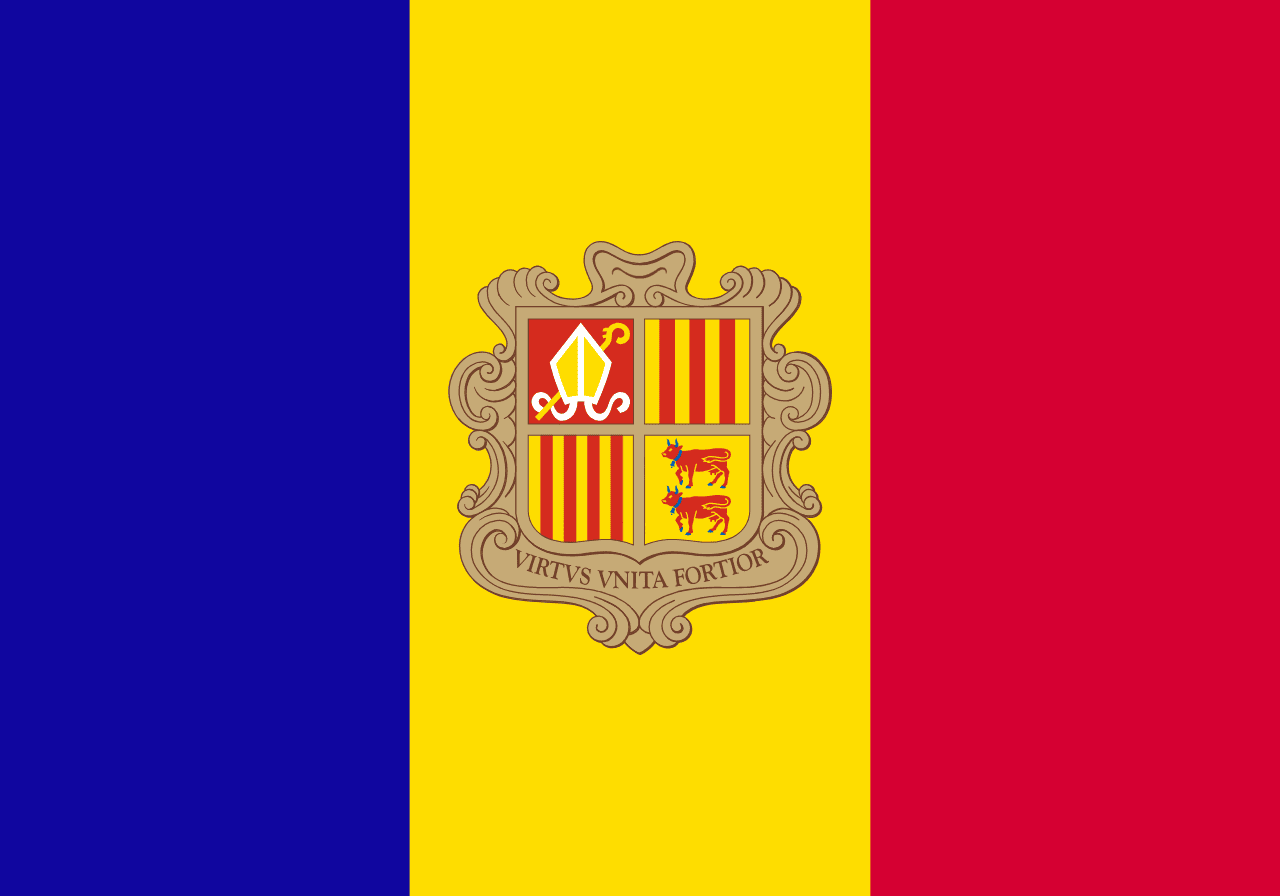
Andorra's tricolour of blue, yellow, and red is no random design. The colours nod to its two protectors, France and Spain, while the central coat of arms captures the country's unique shared rule. The shield features the mitre and crozier of the Bishop of Urgell alongside symbols of the French co-prince's lineage.
Beneath the arms runs the motto Virtus Unita Fortior, Latin for "united virtue is stronger." You can explore the symbolism in detail in our guide to the Andorran flag. Few national flags pack so much history, diplomacy, and identity into a single banner as Andorra's does.
Frequently Asked Questions
What is the capital of Andorra?
The capital is Andorra la Vella, which means "Andorra the Old." Sitting at around 1,023 metres above sea level, it is the highest capital city in Europe and serves as the country's main commercial, governmental, and shopping hub.
What is Andorra famous for?
Andorra is best known for its ski resorts in the Pyrenees, its duty-free shopping, and its unusual status as a co-principality jointly headed by the President of France and the Bishop of Urgell. It is also famous for being one of the world's smallest and oldest sovereign states.
Does Andorra really have no army or airport?
Correct. Andorra has no standing army and relies on France and Spain for defence, a tradition reaching back centuries. It also has no airport and no railway, so the only way in is by road through the surrounding mountains.
Conclusion
Andorra proves that a country measured in tens of thousands of people, rather than millions, can still hold a wealth of surprises. From its medieval shared monarchy and Europe's loftiest capital to its UNESCO valley, record longevity, and world-class ski slopes, this Pyrenean principality rewards anyone willing to look closer. The next time someone dismisses Andorra as just a dot on the map, you will know there is far more to this mountain nation than meets the eye.
