
Scattered like a handful of jewels across the turquoise sea between Florida and Cuba, The Bahamas is far more than a postcard of white sand and palm trees. This archipelago of hundreds of islands has shaped pirate legends, scientific discoveries, and a vibrant Afro-Caribbean culture all its own. Here are ten facts that reveal why The Bahamas is one of the most fascinating nations in the Western Hemisphere.
1. It's an Archipelago of Around 700 Islands and 2,400 Cays
The Bahamas is not a single island but a sprawling chain of roughly 700 islands and more than 2,000 smaller islets known as cays, stretching across some 470,000 square miles of ocean. Yet only about 30 of these islands are inhabited. The major populated islands include New Providence, Grand Bahama, Abaco, Eleuthera, and Andros. This dispersal of land across vast water means that boats and small planes are essential to daily life. For a deeper dive into the country's geography, see our country guide. The sheer scale of empty ocean and uninhabited islands gives The Bahamas an air of frontier wilderness despite its modern tourism economy.
2. The Capital, Nassau, Holds Most of the Population
Nassau, the capital, sits on the relatively small island of New Providence, and yet it is home to the majority of the nation's roughly 405,000 residents. The city blends pastel colonial architecture, bustling Bay Street shopping, and the colourful Parliament Square painted in distinctive pink and white. Nassau grew up around its sheltered harbour, which made it a magnet for traders, privateers, and eventually cruise ships. Today it is the political, commercial, and cultural heart of the country, anchoring banking, government, and the lion's share of tourism arrivals. The contrast between busy Nassau and the sleepy, sparsely populated "Family Islands" defines the rhythm of Bahamian life.
3. The Land Is Astonishingly Flat
If you are searching for mountains, look elsewhere. The Bahamas is one of the flattest countries on Earth, built almost entirely from limestone laid down by ancient coral and marine sediment. Its highest natural point, Mount Alvernia (also called Como Hill) on Cat Island, rises a mere 63 metres above sea level. There are no rivers of any size, and freshwater collects in underground lenses and limestone caves. This low elevation makes the islands beautiful but also vulnerable to hurricanes and rising seas. The flat terrain is part of why the surrounding waters are so shallow and luminous, producing the famous bands of jade and aquamarine.
4. It Was Christopher Columbus's First Landfall in the Americas
In October 1492, Columbus made his first New World landing on a Bahamian island the local Lucayan people called Guanahani, which he renamed San Salvador. The peaceful Lucayans who greeted him were Taino-related Arawaks, and within a few decades they were tragically wiped out by enslavement and disease. The islands later became a notorious haven for pirates. Nassau in the early 1700s was effectively a "Republic of Pirates" where figures like Blackbeard and "Calico Jack" Rackham operated. This layered history of indigenous peoples, conquest, and buccaneers gives The Bahamas a past far richer than its serene beaches suggest.
5. English Is Official, but Bahamian Dialect Has Its Own Flavour
English is the official language, a legacy of British colonial rule that lasted until independence in 1973. In everyday speech, however, Bahamians use a lively creole-influenced dialect sometimes called "Bahamianese," full of distinctive vocabulary, dropped consonants, and musical rhythm. Phrases like "conchy joe" (a Bahamian of European descent) and expressions blending African, British, and Caribbean roots colour daily conversation. There is also a notable Haitian Creole-speaking community, reflecting migration from nearby Haiti. The way Bahamians shift between formal English and warm island vernacular is itself a marker of national identity and belonging.
6. Junkanoo Is the Heartbeat of Bahamian Culture
The most electrifying expression of Bahamian identity is Junkanoo, a riotous street parade of costumed dancers, goatskin drums, cowbells, brass, and whistles. Held in the small hours of Boxing Day (December 26) and New Year's Day, Junkanoo traces its origins to enslaved Africans who were given brief holidays and turned them into joyful celebration. Today rival groups spend months crafting elaborate costumes of crepe paper and cardboard, competing for prizes as crowds line Bay Street in Nassau. The word and tradition link The Bahamas to a broader Caribbean heritage, but the Bahamian version, with its driving "rake and scrape" sound, is uniquely its own.
7. Tourism and Banking Drive One of the Region's Strongest Economies
The Bahamas has one of the highest per-capita incomes in the Caribbean, powered overwhelmingly by tourism, which accounts for a huge share of jobs and GDP. Millions of visitors arrive each year, many on cruise ships that dock in Nassau and at the private islands cruise lines maintain across the archipelago. The second pillar is offshore financial services. With no income tax, the country became a major international banking and corporate registry centre. The Bahamian dollar is pegged one-to-one with the US dollar, and American currency circulates freely, making the islands feel economically intertwined with their giant neighbour to the north.
8. Conch Is the National Obsession on the Plate
No food defines The Bahamas like conch (pronounced "konk"), the large sea snail whose firm white meat appears in nearly every form imaginable. There is conch salad, diced raw and "cooked" in lime and citrus like a ceviche; cracked conch, battered and fried; conch fritters; and steaming conch chowder. Other beloved dishes include rock lobster (crawfish), peas and rice, and guava duff, a rolled dessert of guava and dough served with a buttery sauce. Sky Juice, a potent mix of gin, coconut water, and sweetened milk, is the unofficial national cocktail. Bahamian cuisine is the sea served up with island spice.
9. The Waters Hide Swimming Pigs and the World's Deepest Blue Hole
Bahamian nature delivers genuine surprises. On Big Major Cay in the Exumas, a colony of feral pigs has become a global sensation, paddling out to greet tourist boats in the shallows, the famous "swimming pigs." Beneath the surface lies Dean's Blue Hole off Long Island, one of the deepest known underwater sinkholes on the planet, plunging around 200 metres and beloved by world-record free divers. The surrounding reefs and mangroves shelter West Indian flamingos (the national bird), endangered rock iguanas, and the world's third-largest barrier reef system, making the country a paradise for divers and naturalists alike.
10. Its Flag Tells the Story of Sun, Sea, and People
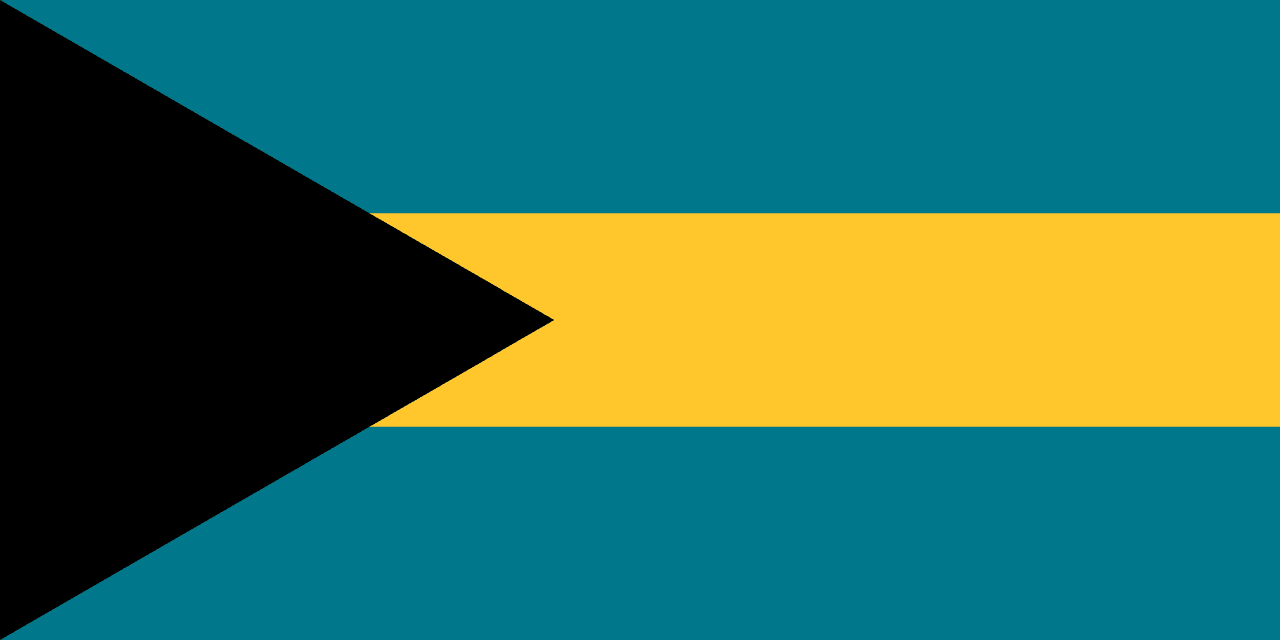
Adopted at independence in 1973, the Bahamian flag features two horizontal aquamarine bands separated by a gold stripe, with a black triangle pointing from the hoist. The aquamarine represents the surrounding sea, the gold symbolizes the sun and the islands' natural resources like sand, and the black triangle stands for the strength, unity, and determination of the Bahamian people pointing toward those resources. You can read more about its design and meaning in our piece on the Bahamian flag. It is a banner that, fittingly, distils the entire national landscape into three simple colours.
Frequently Asked Questions
What is the capital of The Bahamas?
The capital is Nassau, located on the island of New Providence. It is the country's largest city and home to most of its population, serving as the centre of government, banking, and tourism, with its historic harbour and pastel colonial buildings.
What is The Bahamas most famous for?
The Bahamas is famous for its dazzling turquoise waters, white-sand beaches, and coral reefs, as well as the energetic Junkanoo festival, conch cuisine, offshore banking, and quirky attractions like the swimming pigs of the Exumas and Dean's Blue Hole.
Did Columbus really land in The Bahamas first?
Yes. Most historians agree that Christopher Columbus made his first landfall in the Americas in October 1492 on a Bahamian island the Lucayan people called Guanahani, which he renamed San Salvador, marking the start of European contact with the New World.
Conclusion
From its 700 islands and pirate-soaked harbours to swimming pigs, blue holes, and the thunder of Junkanoo drums, The Bahamas packs astonishing variety into a flat ribbon of limestone in the sea. It is a nation where history, nature, and culture meet at the water's edge, proving that the most memorable places are not always the largest. Keep exploring, and the islands will keep surprising you.