
They call it "Africa in miniature," and for good reason: within a single country you can climb an active volcano, trek through equatorial rainforest, cross sun-baked savanna, and lounge on volcanic black-sand beaches. Cameroon packs nearly every African landscape, ecosystem, and cultural tradition into one nation of roughly 30 million people. Here are ten genuinely fascinating facts that go far beyond the textbook.
1. It Is Literally Nicknamed "Africa in Miniature"
Cameroon earned the affectionate label "Afrique en miniature" because it contains almost every climate and landscape found across the entire continent. In the far north lie the semi-arid Sahel plains around Lake Chad; the center rolls into grassy plateaus; the south erupts into dense Congo Basin rainforest; and the west rises into volcanic highlands. Beaches, deserts, mountains, jungles, and savanna all coexist within roughly 475,000 square kilometers. Few countries on Earth offer such ecological compression. This diversity is no accident of marketing but a result of Cameroon straddling the geographic transition between West and Central Africa, where the Gulf of Guinea coast meets the heart of the continent. To dig deeper into the country's regions, see our country guide.
2. Mount Cameroon Is West Africa's Highest Active Volcano
Towering over the coastal town of Buea, Mount Cameroon reaches about 4,040 meters, making it the tallest peak in West and Central Africa and one of the continent's few active volcanoes. Locals call it Mongo ma Ndemi, "Mountain of Greatness." It has erupted multiple times in recent decades, most notably in 1999 and 2000, sending lava toward the sea. Every year runners tackle the brutal "Race of Hope," sprinting from Buea to the summit and back, a punishing climb through banana plantations, cloud forest, and barren volcanic rock. The mountain's fertile slopes also feed some of Cameroon's richest agriculture, a striking reminder that the same volcano that threatens can also sustain.
3. Two Capitals of Power: Yaoundé and Douala
Yaoundé is the official political capital, perched among seven hills in the cool central highlands and home to the government, embassies, and the presidency. But the country's true economic engine is Douala, the sprawling port city on the Wouri River estuary. Douala is Cameroon's largest city, busiest commercial hub, and gateway for trade across Central Africa, handling cargo bound for landlocked Chad and the Central African Republic. The two cities embody Cameroon's split personality: Yaoundé the orderly seat of government, Douala the hot, humid, frenetic marketplace. Together they anchor a nation whose urban population continues to swell as people leave rural areas seeking opportunity.
4. A Country with Two Colonial Languages
Cameroon is officially bilingual, with both French and English as national languages, a legacy of being divided between France and Britain after Germany lost its colony following World War I. Roughly 80 percent of the country is Francophone, while two western regions are Anglophone. This linguistic divide runs deep, shaping education, law, and identity, and has fueled real political tension in recent years. Beyond the two European languages, Cameroon is astonishingly multilingual, with more than 250 indigenous languages spoken across its territory. Many Cameroonians also speak Camfranglais, a vibrant urban slang blending French, English, Pidgin, and local tongues that thrives among young people in cities.
5. Over 250 Ethnic Groups Share One Nation
Cameroon's population is a mosaic of around 250 distinct ethnic groups, from the Bamileke and Bamoun of the western highlands to the Fulani herders of the north, the Beti-Pahuin of the center and south, and the forest-dwelling Baka communities. The Bamoun kingdom even developed its own original script in the early twentieth century under Sultan Njoya, a rare indigenous writing system created from scratch. This human diversity gives Cameroon one of the richest cultural fabrics in Africa, where a single market might echo with a dozen languages and where traditional kingdoms and chieftaincies still hold real influence alongside the modern state.
6. The Indomitable Lions Put African Football on the Map
Cameroon's national football team, the Indomitable Lions, are among the most celebrated in African history. At the 1990 World Cup in Italy they stunned the world by beating defending champions Argentina in the opening match and reaching the quarter-finals, the furthest an African team had ever advanced at the time. The unforgettable image of 38-year-old Roger Milla dancing at the corner flag became a global sensation. Cameroon has won the Africa Cup of Nations five times and produced legends like Samuel Eto'o, one of the greatest strikers the continent has ever seen. Football here is more than sport; it is national pride distilled into ninety minutes.
7. Ndolé and a Cuisine Built on the Land
Cameroonian food is hearty, communal, and deeply regional. The unofficial national dish is ndolé, a rich stew of bitterleaf greens cooked with ground peanuts, fish or beef, and spices, typically served with fried plantains or boiled cassava. Across the country you'll find fufu made from pounded cassava or corn, spicy grilled fish, poulet DG (a celebratory chicken-and-plantain dish whose name means "Director General chicken"), and roadside skewers of soya. Palm wine and locally brewed beer wash it all down. Meals are rarely solitary affairs; sharing from communal bowls reflects the strong social bonds that hold Cameroonian communities together.
8. Home to Forest Elephants, Gorillas, and Living Crater Lakes
Cameroon shelters extraordinary wildlife. Its southern rainforests are home to western lowland gorillas, chimpanzees, and forest elephants, while northern parks like Waza protect lions, giraffes, and elephants on the savanna. The country is also a hotspot for the critically endangered Cross River gorilla, one of the rarest great apes alive. Cameroon's volcanic crater lakes are scientific marvels too: in 1986, Lake Nyos released a massive cloud of carbon dioxide that suffocated more than 1,700 people in nearby villages, a rare natural disaster known as a "limnic eruption" that scientists now monitor and degas to prevent a repeat.
9. A Cocoa and Oil Economy at the Crossroads
Cameroon has one of Central Africa's larger and more diversified economies. Agriculture employs much of the population, and the country ranks among the world's leading producers of cocoa, alongside coffee, cotton, bananas, and rubber. Crude oil exports provide significant revenue, while timber from its vast forests and a growing services sector round out the mix. Cameroon's relative stability and natural wealth have made it a regional anchor, though challenges around infrastructure and inequality remain. The port of Douala and pipelines from neighboring Chad underline its role as a commercial lifeline for landlocked Central African neighbors.
10. The Flag's Colors Carry a Hidden Meaning
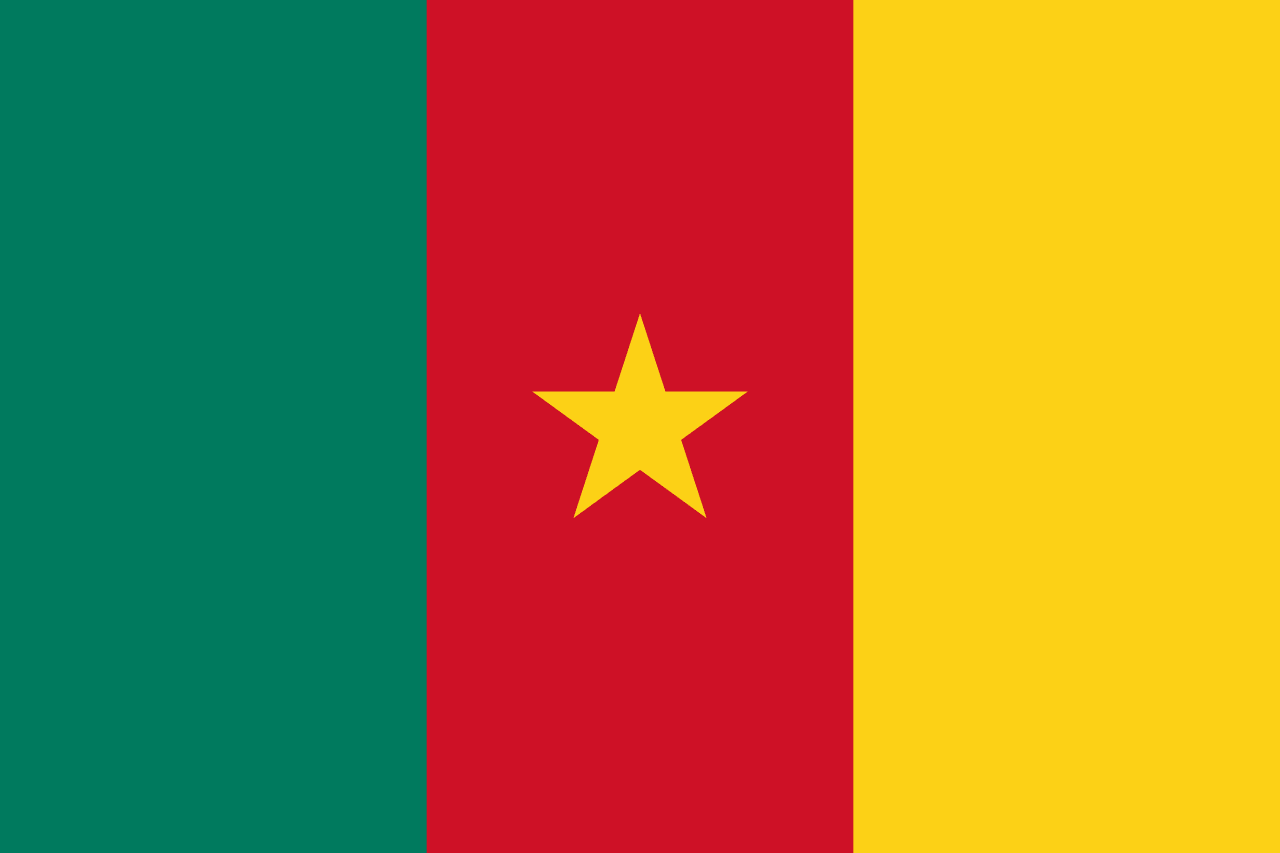
Cameroon's national flag features three vertical bands of green, red, and yellow with a single gold star in the center, the Pan-African colors shared across the continent. Green symbolizes the lush forests of the south, yellow represents the savannas and sunshine of the north, and red stands for unity and independence. The central star is sometimes called the "star of unity," a nod to the reunification of the formerly French and British territories into one nation. It's a compact visual summary of the very thing that defines Cameroon: many lands, many peoples, one country.
Frequently Asked Questions
What is the capital of Cameroon?
The official capital is Yaoundé, located in the central highlands and home to the government and presidency. However, Douala, the coastal port city, is the largest city and the country's economic and commercial center.
What is Cameroon famous for?
Cameroon is famous for being "Africa in miniature" thanks to its incredible range of landscapes, for the active volcano Mount Cameroon, for its powerhouse football team the Indomitable Lions, and for being one of the world's top cocoa producers. It is also known for its remarkable ethnic and linguistic diversity.
Why does Cameroon speak both French and English?
After Germany lost its colony of Kamerun in World War I, the territory was divided between France and Britain. When the regions reunified, both languages became official, leaving Cameroon one of the few countries in Africa with French and English as co-equal national languages.
Conclusion
Cameroon truly lives up to its nickname. From the volcanic heights of Mount Cameroon to the rainforests sheltering rare gorillas, from the dancing celebrations of the Indomitable Lions to a table laden with ndolé, this is a country of staggering variety packed into one welcoming nation. These ten facts only begin to capture its richness, so let your curiosity lead you onward and keep exploring this fascinating corner of Central Africa.