
Sitting almost exactly in the geographic center of the African continent, the Central African Republic is a landlocked nation of vast forests, sweeping savannas, and one of the most spectacular concentrations of large mammals left anywhere on Earth. It is a country defined by water, wildlife, and the resilience of its people, yet it remains one of the least-visited places on the planet. Here are ten fascinating facts that reveal why the C.A.R. deserves a closer look.
1. It Lies at the Dead Center of Africa
The Central African Republic is one of only two landlocked countries that share the title of being near the continent's geographic heart. Surrounded by six neighbors, Chad, Sudan, South Sudan, the Democratic Republic of the Congo, the Republic of the Congo, and Cameroon, it has no coastline and no port of its own. This central position once made it a crossroads for trade and migration, but it also left the country isolated from the sea, with goods historically traveling thousands of kilometers by river and road. Its terrain rises from rainforest in the south to a broad, rolling plateau in the center, the watershed that separates the Congo and Chad river basins. You can learn more in our country guide.
2. The Capital Sits on the Mighty Ubangi River
Bangui, the capital and largest city, hugs the banks of the Ubangi River, a major tributary of the Congo. The river forms part of the country's southern border with the Democratic Republic of the Congo, and Bangui grew up around a French river post established in 1889. The city's name comes from a local word meaning "the rapids," referring to the stretch of fast water nearby. Today Bangui is home to government ministries, the national university, and bustling riverside markets where dugout canoes still ferry goods and people. Despite decades of upheaval, it remains the cultural and economic engine of the nation, and most of the country's limited infrastructure radiates outward from it.
3. Around 5.7 Million People Call It Home
With roughly 5.7 million inhabitants spread across a territory larger than France, the Central African Republic is one of the most sparsely populated countries in the world. Vast stretches of forest and savanna are nearly empty of permanent settlement, while population clusters along the rivers and the few paved roads. The country is also extraordinarily young: a large share of the population is under the age of eighteen. Rural life dominates, with most families relying on subsistence farming, fishing, and small-scale trade. This low density means that wildlife and untouched wilderness survive in places that would be farmland almost anywhere else.
4. Sango Unites a Land of Many Tongues
While French is an official language inherited from the colonial era, the true unifier is Sango, a national language spoken by the overwhelming majority of the population. Sango began as a riverine trade language along the Ubangi and spread so widely that it became one of the few African lingua francas to achieve official co-equal status with a European tongue. It is now used in markets, radio broadcasts, churches, and everyday conversation across ethnic lines. Alongside Sango and French, dozens of other languages reflect the country's many ethnic groups, including the Gbaya, Banda, and Mandjia peoples, making the C.A.R. a richly multilingual society.
5. It Was Once the Self-Proclaimed "Central African Empire"
One of the strangest chapters in modern African history unfolded here. In 1976, the military ruler Jean-Bédel Bokassa abolished the republic and crowned himself emperor, renaming the nation the Central African Empire. His 1977 coronation, modeled on Napoleon's, featured a diamond-encrusted throne shaped like a golden eagle and reportedly consumed a huge share of the impoverished country's annual budget. The empire lasted only three years before Bokassa was overthrown in 1979 and the republic restored. The episode remains a vivid, cautionary symbol of extravagant misrule, and it is still one of the first things many people associate with the country.
6. Dzanga-Sanga Is a Window Into the Rainforest
In the country's far southwest lies the Dzanga-Sanga Special Reserve, part of a UNESCO World Heritage Site shared with Cameroon and the Republic of the Congo. Its crown jewel is the Dzanga Bai, a natural forest clearing where dozens, sometimes more than a hundred, forest elephants gather at once to drink mineral-rich water and socialize. Visitors can watch from a viewing platform as elephants, bongo antelope, and forest buffalo emerge from the trees. The region is also home to lowland gorillas and groups of Ba'Aka people, one of Central Africa's oldest forest-dwelling communities, whose tracking skills make them extraordinary guides.
7. The Northeast Holds a Lost Wildlife Paradise
Far from the rainforests, the northern savannas once teemed with elephants, lions, giraffes, and vast herds of antelope. The Manovo-Gounda St. Floris National Park, another UNESCO World Heritage Site, was created to protect this Sahel-to-forest transition zone. Sadly, decades of poaching and instability have devastated its herds, and it now sits on the List of World Heritage in Danger. Conservation groups continue to work toward restoring the region's wildlife. The contrast between the thriving forest elephants of the south and the embattled savanna herds of the north captures both the natural richness and the fragility of the country's ecosystems.
8. Diamonds and Gold Lie Beneath the Soil
The Central African Republic is rich in mineral resources, particularly diamonds and gold, which are mined largely by hand in artisanal pits scattered across the country. Diamonds have long been among the nation's most valuable exports, and the country is also believed to hold deposits of uranium and other minerals. Yet most people remain poor, and the gap between mineral wealth and everyday hardship is one of the country's defining paradoxes. Beyond mining, the economy leans heavily on agriculture and forestry, with timber, coffee, and cotton among the goods that make the long overland journey to coastal ports for export.
9. Music, Drums, and Communal Meals Define Daily Life
Central African culture is deeply communal, and food is rarely eaten alone. Staples include cassava, plantains, peanuts, and rice, often served with sauces made from greens, smoked fish, or bushmeat. Peanut-based stews and the leafy dish made from cassava leaves are everyday favorites. Music is central to community life, from polyphonic singing traditions to the rhythms of drums and the distinctive water-drumming practiced by some forest communities. Storytelling, dance, and craftwork such as wood carving and basket weaving carry traditions across generations, knitting together the country's many ethnic groups into a shared cultural life.
10. Its Flag Tells the Whole Story in Five Colors
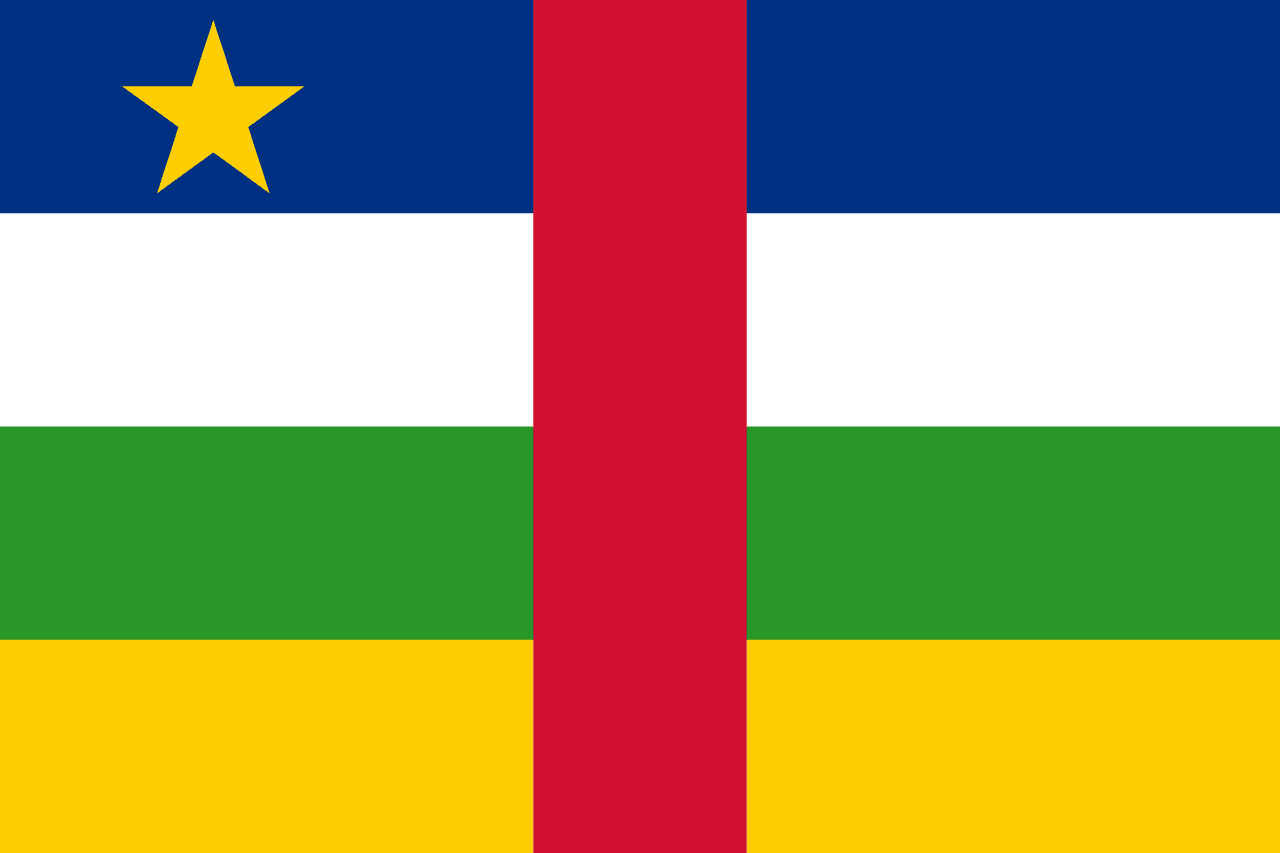
The national flag is one of the most symbolically dense in the world. It combines four horizontal stripes, blue, white, green, and yellow, crossed by a single vertical red band down the middle, with a yellow star in the upper corner. The four horizontal colors echo the French tricolor and the Pan-African palette, deliberately uniting the influences of Europe and Africa. The red stripe stands for the blood shared by all people and the connection between the two color groups. Designed at independence in the late 1950s, it remains a striking emblem of a nation seeking to bridge its colonial past and African identity.
Frequently Asked Questions
What is the capital of the Central African Republic?
The capital is Bangui, a riverside city on the Ubangi River that serves as the country's political, economic, and cultural center. It is by far the largest city in the country and the hub of most of its infrastructure.
What is the Central African Republic famous for?
It is best known for its extraordinary wildlife, especially the forest elephants of the Dzanga Bai clearing, its central position in Africa, and the diamonds mined within its borders. Historically, it is also remembered for the short-lived "Central African Empire" of the 1970s.
Why do so many forest elephants gather at the Dzanga Bai?
The Dzanga Bai is a natural clearing where mineral-rich water and soil draw elephants from miles around. They come to drink the salts and minerals their forest diet lacks, and the open space lets large numbers gather and socialize, creating one of the rarest wildlife spectacles on Earth.
Conclusion
The Central African Republic is a land of striking contrasts, a country at the heart of Africa that holds both immense natural wealth and profound challenges. From the elephant gatherings of the southern rainforest to the rivers that built its capital and the languages that unite its people, it is a nation that rewards anyone willing to look beyond the headlines. These ten facts are only a starting point for discovering one of the world's most fascinating and least-understood countries.