
Tucked into the very center of Europe, the Czech Republic packs an astonishing amount of history, beauty, and quirk into a country smaller than the U.S. state of South Carolina. It gave the world the word "robot," the modern beer that fills millions of glasses every night, and a fairy-tale capital that survived two world wars almost untouched. Here are ten genuinely surprising facts that go far beyond what a guidebook will tell you.
1. It Sits Almost Exactly in the Middle of Europe
The Czech Republic is a landlocked country bordered by Germany, Poland, Austria, and Slovakia, and several towns around the country cheerfully claim to mark the "geographic center of Europe." The nation is made up of three historic lands: Bohemia in the west, Moravia in the east, and a sliver of Czech Silesia in the northeast. Bohemia is ringed by low mountain ranges that form natural borders, giving the country the shape of a tidy basin. Despite having no coastline, the Czechs are surprisingly proud sailors, and Czech-flagged boats can be spotted on the Adriatic every summer.
2. Prague Is One of Europe's Best-Preserved Medieval Cities
Prague, the capital and home to over 1.3 million people, escaped the heavy bombing that flattened so many European cities in World War II. The result is a living museum where Gothic spires, Baroque palaces, Renaissance facades, and Art Nouveau cafes stand side by side. Prague Castle is recognized as the largest ancient castle complex in the world, sprawling across roughly 70,000 square meters. The medieval Astronomical Clock in the Old Town Square, installed in 1410, is the oldest astronomical clock still operating today. To dig deeper into the country's regions and travel logistics, see our country guide.
3. Czechs Drink More Beer Per Person Than Anyone on Earth
If there is one statistic Czechs love, it is this: the Czech Republic consistently ranks as the world's top beer-drinking nation per capita, comfortably ahead of Germany. Beer here is cultural bedrock, not just a beverage. The city of Plzeň (Pilsen) gave birth to Pilsner in 1842, the crisp golden lager that became the template for most of the world's beer today. Pubs are community living rooms, and in many of them a fresh glass simply keeps arriving until you place a coaster on top to say "enough." Beer is often cheaper than bottled water in restaurants.
4. The Word "Robot" Was Invented Here
The Czech language gave the world one of its most futuristic words. In 1920, playwright Karel Čapek premiered his science-fiction play R.U.R. (Rossum's Universal Robots), introducing the term "robot," derived from the Czech word robota, meaning forced labor or drudgery. The play's artificial workers who eventually rebel against humanity set the template for a century of science fiction. Karel credited his brother, the painter Josef Čapek, with suggesting the word. It is now used in nearly every language on Earth, an outsized linguistic export from a country of just over ten million people.
5. A Nation of Castles and Chateaux
With more than 2,000 castles, chateaux, and fortress ruins, the Czech Republic has one of the highest densities of castles in the world. Many crown rocky hilltops or guard river bends, and a remarkable number are UNESCO-listed. Český Krumlov, a tiny Bohemian town wrapped in a loop of the Vltava River, is dominated by a sprawling castle complete with a rare Baroque theatre and a moat once home to bears. The country has a dozen UNESCO World Heritage Sites in total, an extraordinary number for its size, ranging from historic town centers to a Tugendhat villa masterpiece of modern architecture in Brno.
6. Czech Is a Slavic Language Famous for Tongue-Twisters
Czech belongs to the West Slavic language family, closely related to Slovak and Polish. It is notorious among learners for words with no vowels at all, strung together entirely from consonants. The classic example is strč prst skrz krk, meaning "stick a finger through the throat," which contains not a single vowel. The language also features a unique letter, ř, a rolled, buzzing sound so difficult that linguists consider it one of the hardest in any language. Czechs are immensely proud of it and delight in challenging foreigners to attempt the composer Antonín Dvořák's surname.
7. Hearty Food Built for Cold Winters
Czech cuisine is comfort food at its finest, designed to pair with beer and survive long Central European winters. The national dish is vepřo-knedlo-zelo: roast pork with bread dumplings and sauerkraut. Those soft, sliced knedlíky (dumplings) accompany nearly every meal, perfect for soaking up rich gravies. Another beloved classic is svíčková, beef in a creamy root-vegetable sauce topped with a spoon of cranberries and whipped cream. For something sweet, trdelník, a spit-roasted pastry coated in sugar and cinnamon, has become a popular street treat, though locals will tell you it is more tourist attraction than ancient tradition.
8. It Was Born From a Peaceful "Velvet" Split
The modern Czech Republic is a young country with deep roots. After the 1989 Velvet Revolution peacefully ended communist rule, Czechoslovakia underwent the Velvet Divorce on January 1, 1993, splitting amicably into the Czech Republic and Slovakia with no violence whatsoever, a rarity in modern history. The first democratic president was the dissident playwright Václav Havel, who had been imprisoned under the previous regime. In 2016 the country adopted the short-form name Czechia to make branding easier, though the longer name remains far more widely used.
9. A Highly Industrial, Innovative Economy
The Czech Republic has one of the most industrialized economies in Central Europe and a long engineering pedigree. It is a major automobile manufacturer, home to Škoda Auto, one of the oldest car companies in the world, now part of the Volkswagen Group. Czech inventors and scientists have an impressive track record: the soft contact lens, the modern sugar cube, and the Semtex plastic explosive were all developed here, and chemist Otto Wichterle pioneered hydrogel lens technology. The country joined the European Union in 2004 but kept its own currency, the Czech koruna, rather than adopting the euro.
10. The Flag Tells a Story of Two Lands United
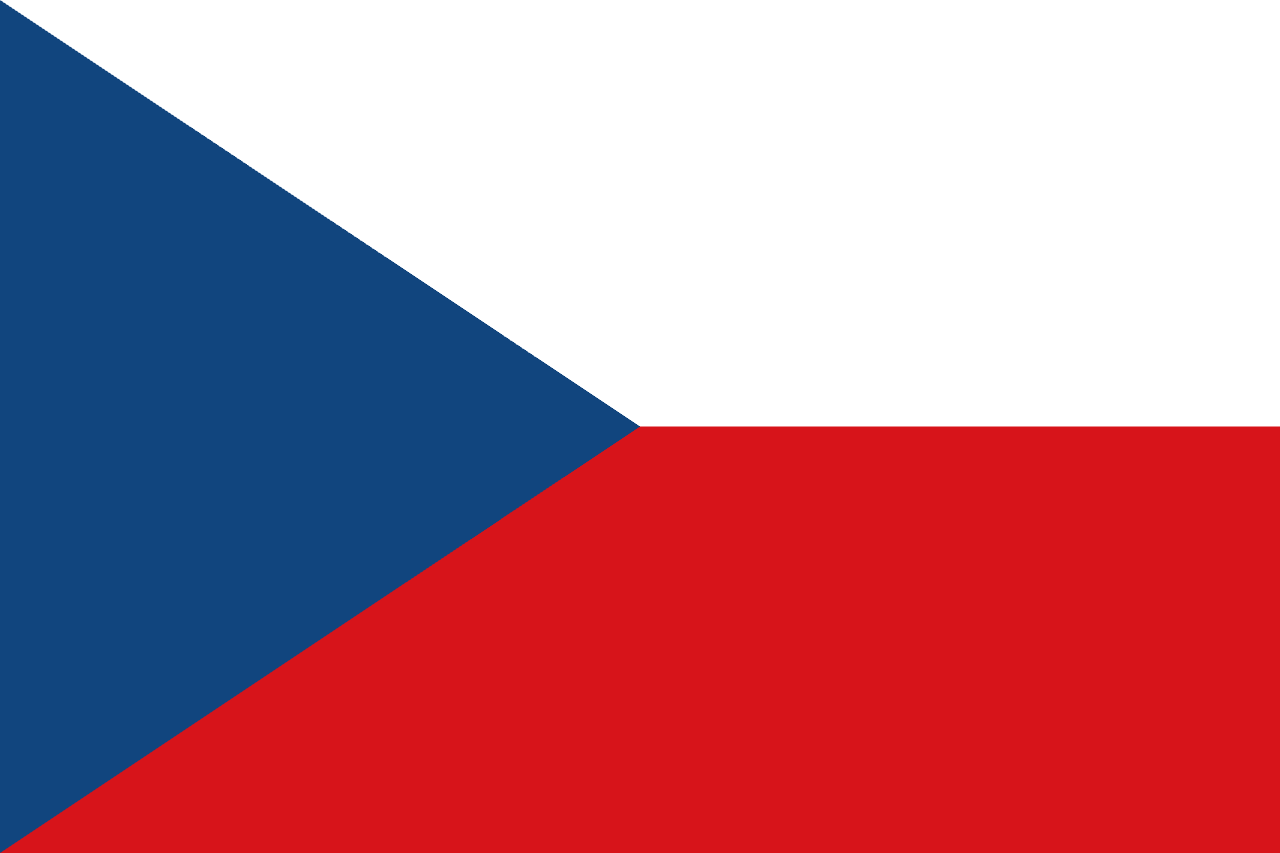
The Czech flag features two horizontal bands of white over red with a blue triangle reaching in from the hoist side. The white and red recall the historic colors of Bohemia, while the blue triangle was added to represent Moravia and Slovakia when Czechoslovakia formed. When the country split in 1993, Slovakia adopted a new flag, but the Czech Republic kept the old Czechoslovak design, a quiet piece of history hiding in plain sight. The colors are also the pan-Slavic colors shared by many nations across the region, linking the country to its broader Slavic family.
Frequently Asked Questions
What is the capital of the Czech Republic?
The capital is Prague (Praha in Czech), a city of roughly 1.3 million people straddling the Vltava River. It is the political, cultural, and economic heart of the country and one of the most visited cities in Europe, famous for its castle, Charles Bridge, and remarkably intact historic center.
What is the Czech Republic most famous for?
The Czech Republic is best known for its world-leading beer culture and the original Pilsner lager, the fairy-tale architecture of Prague, its thousands of castles and chateaux, and beautiful Bohemian crystal glassware. It is also famous for inventing the word "robot" and for the peaceful Velvet Revolution.
Why are there so many castles in the country?
Sitting at the crossroads of Central Europe, Bohemia and Moravia were fought over and fortified for centuries by competing kingdoms, nobles, and empires. Each ruling family built or rebuilt strongholds, leaving behind more than 2,000 castles and chateaux, one of the densest concentrations anywhere in the world.
Conclusion
From vowel-free tongue-twisters and the birthplace of the word "robot" to the world's thirstiest beer drinkers and a capital frozen in medieval splendor, the Czech Republic proves that small countries can leave enormous footprints. Whether you are drawn by its castles, its inventions, or its bottomless glasses of Pilsner, this Central European gem rewards anyone curious enough to look closer.