
Tucked into the armpit of West-Central Africa, Equatorial Guinea is one of the continent's most curious puzzles: a tiny nation split between a chunk of mainland and a scatter of volcanic islands, where the official language is Spanish and the capital sits on the rim of an extinct volcano. Despite being one of Africa's smallest countries by population, it punches well above its weight in oil wealth, biodiversity, and sheer geographic oddity. Here are ten genuinely fascinating facts that go far beyond the textbook.
1. It's the Only Spanish-Speaking Country in Africa
Equatorial Guinea holds a linguistic distinction shared by no other African nation: Spanish is its primary official language, a legacy of nearly two centuries of Spanish colonial rule. Roughly two-thirds of the population speaks it, and it dominates government, education, and the media. The country even joined the Association of Spanish Language Academies and is a member of the Ibero-American community. Alongside Spanish, French and Portuguese were later adopted as co-official languages to strengthen regional ties, while indigenous Bantu languages like Fang and Bubi are spoken in daily life. This makes Equatorial Guinea a singular cultural bridge between Africa, Spain, and Latin America. If you want the bigger picture, our country guide digs deeper.
2. The Country Is Split Across the Sea
Equatorial Guinea is divided into two very different worlds. The mainland portion, called Río Muni, sits on the African continent wedged between Cameroon and Gabon. The rest of the country is insular: a handful of islands scattered across the Gulf of Guinea, the largest being Bioko, with the small, remote island of Annobón lying hundreds of kilometers to the southwest. This geographic split means the capital is actually on an island, separated from the bulk of the population on the mainland by open ocean. Few countries in the world are so dramatically divided between continental and island territory, and it gives Equatorial Guinea an identity that feels simultaneously African, Atlantic, and oceanic.
3. The Capital Sits Inside a Volcano's Shadow
Malabo, the capital, is perched on the northern coast of Bioko Island, in the crater rim of an ancient volcano. The island is dominated by Pico Basile, a towering volcanic peak rising to around 3,000 meters that is the highest point in the country. Malabo's colonial-era Spanish architecture, pastel cathedrals, and harbor give it a flavor unlike any other African capital. However, because the capital is on an island far from the mainland's population center and oil-driven growth, the government has been building an entirely new planned capital called Ciudad de la Paz (formerly Oyala) deep in the mainland jungle of Río Muni, intended to become the future seat of power.
4. Oil Turned It Into One of Africa's Richest Nations Per Capita
The discovery of major offshore oil reserves in the 1990s transformed Equatorial Guinea almost overnight. For years it boasted one of the highest GDP-per-capita figures in all of Africa, rivaling some European countries on paper. Petroleum and natural gas dominate the economy, accounting for the overwhelming majority of exports and government revenue. Yet this wealth is famously uneven: despite the headline numbers, a large share of the population has seen little of the prosperity, and the country remains heavily dependent on a single resource. The boom also fueled rapid construction, gleaming new infrastructure, and ambitious projects, making Equatorial Guinea a striking study in the paradoxes of resource wealth.
5. It Was a Spanish Colony Until 1968
Equatorial Guinea is the only sub-Saharan African country that was a Spanish colony, known then as Spanish Guinea. Spain controlled the territory for generations, leaving behind the language, Catholicism, and architectural touches still visible today. The country gained independence on October 12, 1968, a date now celebrated as its national day. Independence was followed by a turbulent and often dark political history under its first leaders. The colonial relationship still shapes modern ties, with Spain remaining a key cultural and diplomatic partner. This unusual Hispanic colonial heritage is exactly why Equatorial Guinea stands apart from its French- and Portuguese-influenced neighbors in the region.
6. The Bubi and Fang Peoples Define Its Culture
Equatorial Guinea's society is built around several ethnic groups, the two most prominent being the Fang, who dominate the mainland of Río Muni and form the majority nationwide, and the Bubi, who are indigenous to Bioko Island. Each group brings distinct traditions, music, and social structures. Traditional Fang sculpture and the rhythmic music played on instruments like the mvet, a stringed harp-zither, are central to cultural expression. Storytelling, dance, and elaborate ceremonies remain woven into community life, blending pre-colonial African heritage with Spanish-Catholic influences in a way that produces festivals and customs found nowhere else on the continent.
7. Its Cuisine Mixes African Roots with Spanish Flair
Food in Equatorial Guinea reflects its layered identity. Staples include cassava, plantains, rice, and yams, often paired with fish and seafood thanks to the country's long Atlantic coastline and island geography. A beloved national favorite is succotash-style stews and dishes featuring peanut and palm oil sauces. Bushmeat and freshwater fish appear in rural cooking, while coastal communities lean heavily on grilled and stewed seafood. Spanish colonial influence lingers in the presence of bread, certain pastries, and cooking techniques. Tropical fruits like mango, banana, and pineapple grow abundantly, and meals are typically communal, shared affairs that reinforce family and village bonds.
8. It Hosted the Africa Cup of Nations Twice
For such a small country, Equatorial Guinea has made a surprising mark on African football. It co-hosted the 2012 Africa Cup of Nations with neighboring Gabon, then stepped in as a solo host of the 2015 edition on short notice after the original host withdrew. Its national team, nicknamed Nzalang Nacional, has produced memorable runs, including a stunning surge to the semifinals in 2015 as host. Football is the country's most popular sport by far, uniting its dispersed island and mainland populations. These tournaments put Equatorial Guinea on the international sporting map and showcased its willingness to invest in stadiums and global visibility.
9. Bioko Island Is a Hotspot for Rare Primates and Sea Turtles
Equatorial Guinea is a treasure chest of biodiversity. Bioko Island alone is home to several endangered primate species, including rare monkeys and the distinctive drill, making it a focus of international conservation efforts. The country's tropical rainforests, part of the broader Congo Basin ecosystem, shelter forest elephants, gorillas, and a dazzling array of birds. The remote beaches of Bioko are also critical nesting grounds for endangered sea turtles, including leatherbacks and green turtles, which haul ashore by the thousands. Conservation groups work alongside local communities to protect these species from poaching, turning the country into an unexpected frontier for ecotourism and wildlife research.
10. The Flag and National Motto Tell a Story
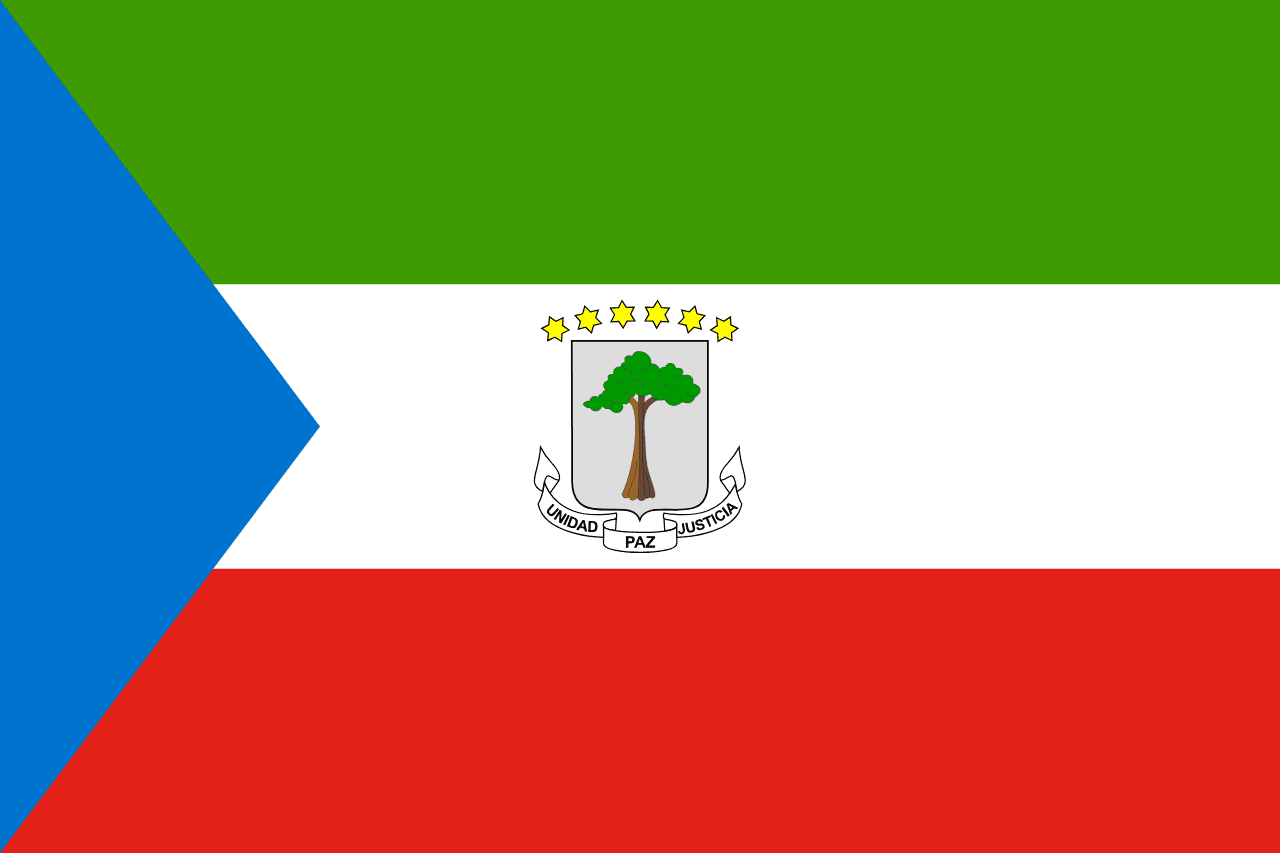
Equatorial Guinea's national symbols are rich with meaning. The country's flag features green, white, and red horizontal bands with a blue triangle at the hoist representing the sea that connects the mainland to its islands. At its center sits a coat of arms with a silk-cotton (ceiba) tree, a species deeply significant in local tradition and history, beneath six stars symbolizing the mainland and the five islands. The national motto, Unidad, Paz, Justicia ("Unity, Peace, Justice"), reflects the aspiration to bind together a nation literally divided by the ocean. Few flags pack as much geographic and cultural storytelling into a single design.
Frequently Asked Questions
What is the capital of Equatorial Guinea?
The capital is Malabo, located on Bioko Island off the coast of Cameroon. However, the government is developing a new inland capital called Ciudad de la Paz on the mainland, which is planned to eventually take over as the seat of power.
What is Equatorial Guinea famous for?
It is best known for being the only Spanish-speaking country in Africa, for its substantial offshore oil and gas wealth, and for its unusual geography split between the mainland region of Río Muni and the volcanic islands of the Gulf of Guinea, including Bioko and Annobón.
Why does Equatorial Guinea speak Spanish?
Spanish is spoken because the territory was a Spanish colony for nearly two centuries until independence in 1968. It remains the dominant official language today, though French and Portuguese were later added as co-official languages, and indigenous languages such as Fang and Bubi are widely spoken.
Conclusion
Equatorial Guinea defies easy categorization. It is African yet Hispanic, oil-rich yet uneven, divided by ocean yet bound by a motto of unity. From the volcanic peaks of Bioko to the rainforests of Río Muni, from rare drills and nesting sea turtles to a national football team that once stunned a continent, this small nation overflows with stories. These ten facts only begin to capture its singular character, and they are an open invitation to keep exploring one of Africa's most intriguing and underappreciated countries.