
Tucked between South Africa and Mozambique, Eswatini is one of Africa's smallest nations and one of its most surprising. It is a kingdom where a reigning monarch still holds real power, where tens of thousands of young women dance before the royal family once a year, and where you can drive from misty highland forests to lion-filled lowland savanna in a single afternoon. Here are ten facts that reveal why this little country punches far above its size.
1. It Changed Its Name in 2018
For most of the modern era the country was known as Swaziland, the name it carried from British colonial rule through independence in 1968. In April 2018, on the fiftieth anniversary of independence, King Mswati III announced that the nation would henceforth be called the Kingdom of Eswatini, meaning "land of the Swazis" in the siSwati language. The king explained that the old name was too often confused with Switzerland, and that he wanted the country to reclaim an indigenous identity rather than a colonial one. The change rippled through embassies, maps, and sports jerseys worldwide, making Eswatini one of the most recent countries to officially rebrand itself.
2. It Is One of the World's Last Absolute Monarchies
Eswatini is ruled by King Mswati III, who ascended the throne in 1986 at just eighteen years old, making him one of the youngest monarchs in the world at the time. He governs alongside the Queen Mother, known as the Ndlovukati or "Great She-Elephant," in a dual monarchy system rooted in Swazi tradition. The king appoints the prime minister and can dissolve parliament, giving him sweeping authority that places Eswatini among the very few remaining absolute monarchies on Earth. This blend of traditional kingship and modern statehood shapes nearly every aspect of national life, from politics to ceremony.
3. It Has Two Capitals
Eswatini cleverly splits its capital duties between two cities. Mbabane, perched in the cool highveld hills, serves as the administrative and executive capital, home to government offices and the largest urban population. Lobamba, about thirty kilometres away in the Ezulwini Valley, is the royal and legislative capital, where parliament sits and where the royal residences and key national ceremonies are based. This division reflects the country's effort to honour both modern governance and the traditional seat of the monarchy. For a deeper dive into the kingdom's regions and cities, see our country guide.
4. The Umhlanga Reed Dance Is a Spectacle Like No Other
Each year, tens of thousands of unmarried Swazi girls and young women gather for the Umhlanga, or Reed Dance, one of the largest cultural ceremonies in Africa. Participants cut tall reeds, carry them to the Queen Mother's royal village, and present them to help repair the windbreaks around her residence. They then dance in vibrant traditional attire over several days, celebrating chastity, solidarity, and Swazi identity. The festival is a vital expression of national heritage and draws spectators from around the world. A separate male equivalent, the Incwala or "first fruits" ceremony, is considered the most sacred ritual of the Swazi calendar.
5. You Can Cross Four Distinct Climate Zones in One Country
Despite being only around 17,000 square kilometres, Eswatini packs an astonishing variety of landscapes into a tiny footprint. The land descends from the cool, mountainous Highveld in the west, through the temperate Middleveld, into the hot, subtropical Lowveld savanna, and finally up against the Lubombo escarpment along the eastern border with Mozambique. This compression means a traveller can experience misty pine plantations, rolling grasslands, dry bushveld, and rugged plateaus all within a short drive, making Eswatini a remarkably diverse destination for its size.
6. siSwati and English Share Official Status
Eswatini has two official languages. siSwati (also spelled Swazi) is a Bantu language closely related to Zulu and is spoken by the vast majority of the population as a mother tongue, carrying the proverbs, praise poetry, and oral history of the Swazi people. English, a legacy of British administration, is used in government, business, and most schooling. The two languages coexist easily in daily life, and you will often hear them blended in conversation, on the radio, and across signage throughout the kingdom.
7. It Faces One of the World's Highest HIV Rates
Eswatini carries a sobering public-health distinction: it has long had one of the highest HIV prevalence rates in the world, affecting a substantial share of adults. The epidemic placed enormous strain on the nation's roughly 1.2 million people, lowering life expectancy for years and orphaning many children. In recent decades, however, Eswatini has become a model of progress, dramatically expanding access to antiretroviral treatment and prevention programmes. The country has been recognised internationally for reaching key treatment milestones, a hard-won turnaround that shows how a small nation can mount a determined response to a generational crisis.
8. The Economy Leans Heavily on a Single Powerful Neighbour
Eswatini is landlocked and economically intertwined with South Africa, which surrounds it on three sides and supplies the overwhelming majority of its imports while buying much of its exports. The Swazi lilangeni is pegged one-to-one with the South African rand, and the rand circulates freely within the country. Sugarcane is a cornerstone of the economy, with Eswatini ranking among Africa's notable sugar producers, alongside textiles, soft-drink concentrate manufacturing, and wood pulp. This close dependence brings stability but also leaves the kingdom vulnerable to its giant neighbour's economic swings.
9. It Is a Conservation Success Story
Eswatini's wildlife was once nearly wiped out by hunting and habitat loss, but a remarkable recovery has taken place. The Big Game Parks trust, founded by the conservationist Ted Reilly, helped reintroduce species and establish protected areas such as Hlane Royal National Park, Mlilwane Wildlife Sanctuary, and Mkhaya Game Reserve. Today visitors can see elephants, lions, rhinos, giraffes, and an exceptional diversity of birds. Eswatini is also known for taking a tough stance against rhino poaching, and its compact reserves offer an intimate, uncrowded alternative to the famous parks of its larger neighbours.
10. Its Flag Tells a Story of Kingship and Defence
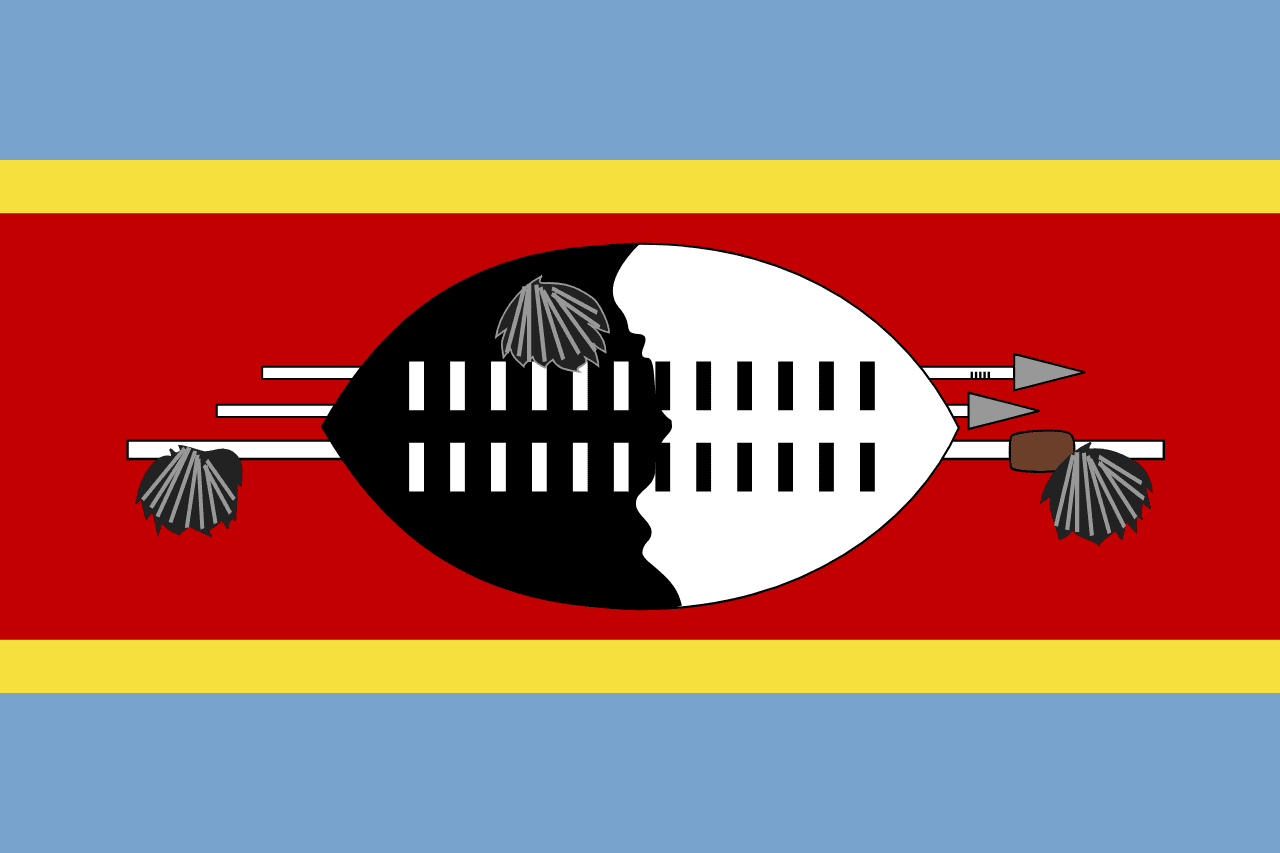
The Eswatini flag is among the most distinctive in the world, dominated by a black-and-white Nguni shield laid across crimson, blue, and yellow bands. The shield, flanked by two spears and a fighting stick decorated with tassels called injobo, symbolises protection of the nation, while its black and white colours represent the peaceful coexistence of Black and white people. The crimson band stands for past battles, blue for peace, and yellow for the kingdom's mineral wealth. Learn more about its meaning and design in our guide to the flag of Eswatini.
Frequently Asked Questions
What is the capital of Eswatini?
Eswatini has two capitals. Mbabane is the administrative and executive capital, located in the highland hills, while Lobamba in the Ezulwini Valley serves as the royal and legislative capital, home to parliament and the monarchy.
What is Eswatini famous for?
Eswatini is best known for being one of the world's last absolute monarchies, ruled by King Mswati III, and for its vibrant cultural ceremonies such as the Umhlanga Reed Dance and the sacred Incwala festival. It is also celebrated for its wildlife reserves and its diverse landscapes packed into a small area.
Why did Swaziland change its name to Eswatini?
In 2018 King Mswati III renamed the country to mark fifty years of independence. He wanted to restore an indigenous siSwati name meaning "land of the Swazis" and to end the frequent confusion between Swaziland and Switzerland.
Conclusion
Eswatini proves that a country need not be large to be extraordinary. From its dual monarchy and twin capitals to its dramatic ceremonies, recovering wildlife, and landscapes that shift in a matter of kilometres, this little kingdom offers a depth of culture and natural beauty that rewards anyone willing to look closer. Whether you come for the Reed Dance, the rhinos, or simply the chance to understand one of Africa's most singular nations, Eswatini leaves a lasting impression.
