
Mexico is a country that refuses to be summarized in a single image. It is at once a land of smoking volcanoes and turquoise cenotes, of bustling megacities and silent Maya pyramids, of ancient gods and Friday-night lucha libre. Here are ten genuinely surprising facts that reveal why this North American giant is one of the most fascinating places on Earth.
1. Mexico City Is Slowly Sinking Into a Drained Lake
The Aztec capital of Tenochtitlan was built on an island in the middle of Lake Texcoco. After the Spanish conquest, the lake was deliberately drained to control flooding, and modern Mexico City now sits on the soft, clay-rich lakebed that remains. The consequence is dramatic: parts of the city are sinking by up to 50 centimeters a year as groundwater is pumped out from beneath it.
You can see the effects everywhere. The colonial-era Metropolitan Cathedral leans visibly, sidewalks buckle, and historic buildings tilt at odd angles. Engineers constantly battle to keep the metro and water systems functioning on this shifting ground, making the capital one of the world's great experiments in living on unstable earth.
2. It Holds More UNESCO World Heritage Sites Than Any Country in the Americas
With 35 UNESCO World Heritage Sites, Mexico outranks every other nation in the Western Hemisphere and sits among the top handful worldwide. The list spans an astonishing range: the pyramids of Teotihuacan, the colonial silver-mining town of Guanajuato, the whale sanctuary of El Vizcaino, and the historic center of Oaxaca.
This density of recognized heritage reflects something deeper about Mexico. Few countries layer so many civilizations on top of one another, from Olmec and Zapotec to Aztec and Spanish colonial. To dive deeper into the nation's regions and history, our country guide is a great place to start.
3. The Chili Pepper, Chocolate, and Corn Were All Domesticated Here
Many of the ingredients the world now takes for granted originated in Mexico thousands of years ago. Maize (corn) was domesticated in the Balsas River valley around 9,000 years ago from a wild grass called teosinte. Cacao was cultivated by Mesoamerican peoples who drank it as a bitter, frothy beverage long before it became sweet chocolate.
Chili peppers, tomatoes, avocados, vanilla, and turkeys also trace their domestication to this region. When these foods spread globally after 1492, they transformed cuisines from Italy to India. It is no exaggeration to say that Italian tomato sauce, Hungarian paprika, and Thai curries all owe a debt to ancient Mexican agriculture.
4. Mexican Cuisine Is Protected by the United Nations
In 2010, UNESCO inscribed traditional Mexican cuisine on its list of Intangible Cultural Heritage of Humanity, one of the first national cuisines to receive the honor. The recognition specifically celebrated the communal practices behind dishes like mole, tamales, and the elaborate preparation of nixtamalized corn.
Food in Mexico is woven into ritual and identity. Mole poblano can require more than 20 ingredients and hours of grinding; the Day of the Dead brings out pan de muerto and sugar skulls; and street tacos al pastor reflect a fusion with Lebanese immigrants who brought shawarma-style spit roasting. Eating in Mexico is a lesson in history served on a plate.
5. It Is the Most Biodiverse Country in North America
Mexico is classified as one of the world's 17 "megadiverse" countries, hosting roughly 10 percent of all known species on Earth. It ranks first globally in reptile diversity and is a world leader in mammals, amphibians, and plants. This richness comes from its position straddling tropical and temperate zones, plus its dramatic range of altitudes.
Among its natural treasures are the monarch butterflies that migrate thousands of kilometers to overwinter in central Mexican forests, blanketing whole trees in orange. Sadly, it is also home to the vaquita, a tiny porpoise in the Gulf of California that is the rarest marine mammal on the planet, with only a handful of individuals remaining.
6. Spanish Is Spoken Here by More People Than Anywhere Else
With around 130 million people, Mexico is by far the largest Spanish-speaking country in the world, home to more native Spanish speakers than Spain, Argentina, and Colombia. But Spanish tells only part of the linguistic story.
The country officially recognizes 68 Indigenous languages, grouped into hundreds of dialects and spoken by millions of people. Nahuatl, the language of the Aztecs, still has well over a million speakers, and words like chocolate, tomato, avocado, and coyote come directly from it. Maya languages remain widely spoken across the Yucatan Peninsula, keeping pre-Columbian voices alive in everyday conversation.
7. The National Flag Tells an Aztec Legend
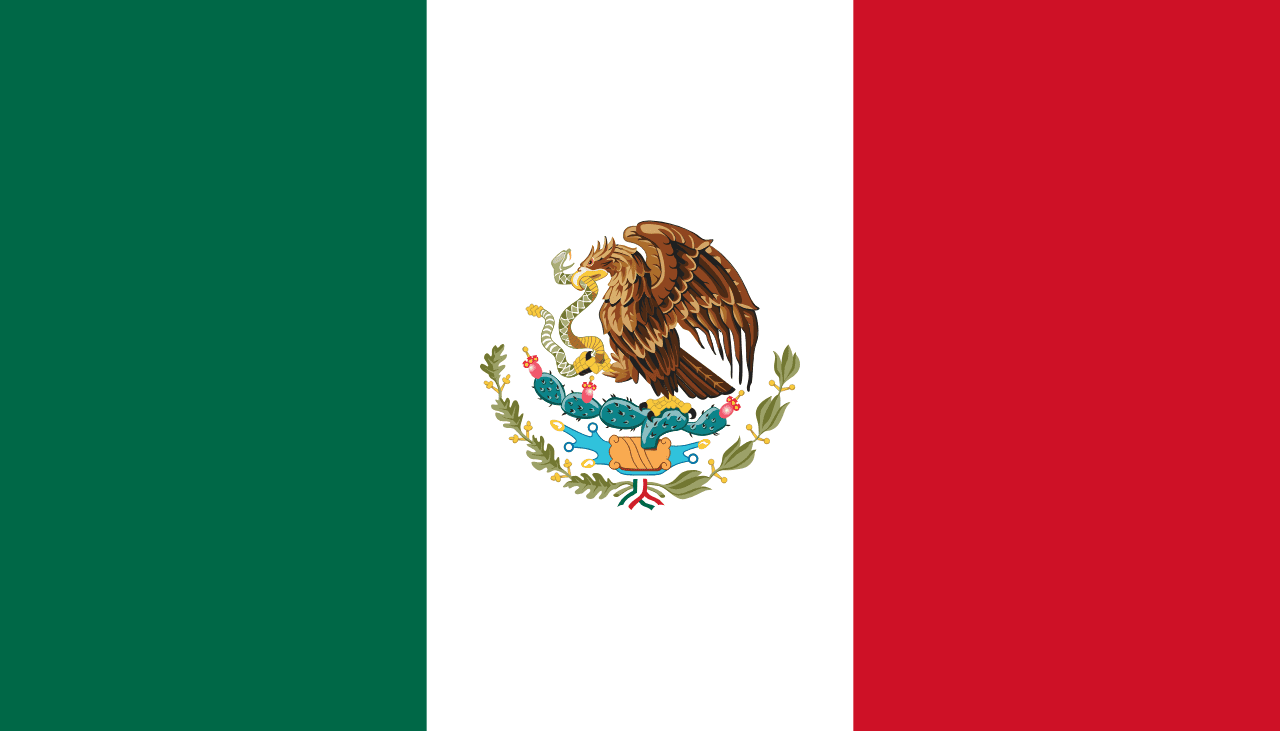
At the center of Mexico's green, white, and red flag stands a golden eagle perched on a prickly pear cactus, devouring a serpent. This is not mere decoration: it depicts the founding myth of Tenochtitlan. According to legend, the wandering Mexica people were told by their god Huitzilopochtli to settle where they saw an eagle eating a snake atop a cactus.
They found exactly that sign on an island in Lake Texcoco in 1325 and built their capital there, on the spot that became modern Mexico City. Few national flags are so directly tied to a foundational story, turning a piece of cloth into a living monument to the country's deepest origins.
8. Mexico Has the Largest Pyramid in the World by Volume
Egypt may have the tallest pyramids, but the Great Pyramid of Cholula in Puebla is the largest by volume anywhere on Earth, with a base four times the size of the Great Pyramid of Giza. Built and rebuilt over centuries by various Mesoamerican cultures, it is so overgrown that it looks like a natural hill.
The Spanish, not realizing what lay beneath, built a Catholic church on its summit in the colonial era. That church still stands today, offering one of the most striking visual symbols in the country: a Christian chapel crowning a buried indigenous pyramid, the two worlds of Mexico literally stacked one upon the other.
9. Lucha Libre Is a Cultural Institution, Not Just a Sport
Masked wrestling, or lucha libre, is one of Mexico's most beloved spectacles, second only to football in popularity. The colorful masks worn by luchadores are sacred to their identity; losing one's mask in a "lucha de apuestas" match is considered a profound humiliation, and some wrestlers guard their unmasked faces for entire careers.
The most famous luchador of all, El Santo, became a national hero who wrestled, starred in dozens of films, and was even buried in his silver mask. Lucha libre blends athletic theater, melodrama, and folk heroism, with crowds cheering the noble "tecnicos" and jeering the villainous "rudos" in arenas across the country.
10. The First Printing Press in the Americas Operated Here
Long before the English colonies in North America had a single book published, Mexico City was already a center of learning. The first printing press in the Americas began operating there around 1539, and the Royal and Pontifical University of Mexico was founded in 1551, making it one of the oldest universities in the hemisphere.
This intellectual head start helped Mexico become a hub of scholarship, science, and literature for the Spanish colonial empire. Centuries later that legacy continues, with Mexican writers like Octavio Paz winning the Nobel Prize in Literature and the country producing a vibrant tradition of art, film, and ideas that reaches far beyond its borders.
Frequently Asked Questions
What is the capital of Mexico?
The capital is Mexico City, one of the largest urban areas in the world. Built on the site of the ancient Aztec capital of Tenochtitlan, it is the political, cultural, and economic heart of the nation and sits at a lofty altitude of around 2,240 meters above sea level.
What is Mexico most famous for?
Mexico is famous for its ancient Maya and Aztec ruins, including Chichen Itza and Teotihuacan, as well as its UNESCO-protected cuisine, vibrant Day of the Dead celebrations, beach resorts like Cancun, tequila, mariachi music, and its extraordinary biodiversity.
Why does Mexico City keep sinking?
Because the city was built on the drained bed of Lake Texcoco, its soft clay foundation compacts as groundwater is extracted to supply the population. This causes the ground to subside by tens of centimeters per year in some areas, tilting historic buildings and cracking infrastructure across the metropolis.
Conclusion
From a capital sinking into an ancient lake to pyramids buried beneath churches and butterflies that travel continents, Mexico is a country layered with surprises. Its food, languages, wildlife, and traditions all carry the imprint of millennia of human and natural history. These ten facts are only an invitation to explore further, because in Mexico there is always another story waiting just beneath the surface.