
Stretched along nearly 2,500 kilometres of the Indian Ocean, Mozambique is a sun-soaked Southern African nation where Portuguese colonial echoes meet Swahili coastal culture and some of the wildest seascapes on Earth. From a peace-named capital to islands that once minted their own legends, this is a country still revealing itself to the world. Here are ten facts that capture the soul of Mozambique.
1. Its Coastline Is One of Africa's Longest and Most Spectacular
Mozambique boasts roughly 2,500 kilometres of Indian Ocean coastline, one of the longest of any African country. This vast shoreline is studded with palm-fringed beaches, mangrove estuaries, and turquoise lagoons that have made it a rising star of adventure tourism. Offshore lie two of the continent's marine jewels: the Bazaruto Archipelago and the Quirimbas Archipelago, where coral reefs shelter dugongs, whale sharks, manta rays, and humpback whales that migrate past each year. The warm Mozambique Channel separating the mainland from Madagascar is also one of the most biodiverse stretches of ocean anywhere. For a country whose interior holds savanna and highlands, it is the sea that defines its identity most powerfully.
2. Maputo Is a Capital Designed by a Famous Engineer
The capital, Maputo, sits on a sweeping bay in the far south and is one of the most architecturally distinctive cities in Africa. Its leafy avenues and Mediterranean-style buildings earned it the nickname "the Pearl of the Indian Ocean" during the colonial era. The city's striking CFM railway station is often attributed to the influence of the Eiffel workshop, and Maputo also has an "iron house" (Casa de Ferro) linked to Gustave Eiffel's studio. Today around a million people live in the city proper, drawn by its port, universities, jazz clubs, and bustling markets. You can dig deeper into its story in our country guide.
3. It Is the Only Country Whose Name Starts and Ends with the Same Three Letters
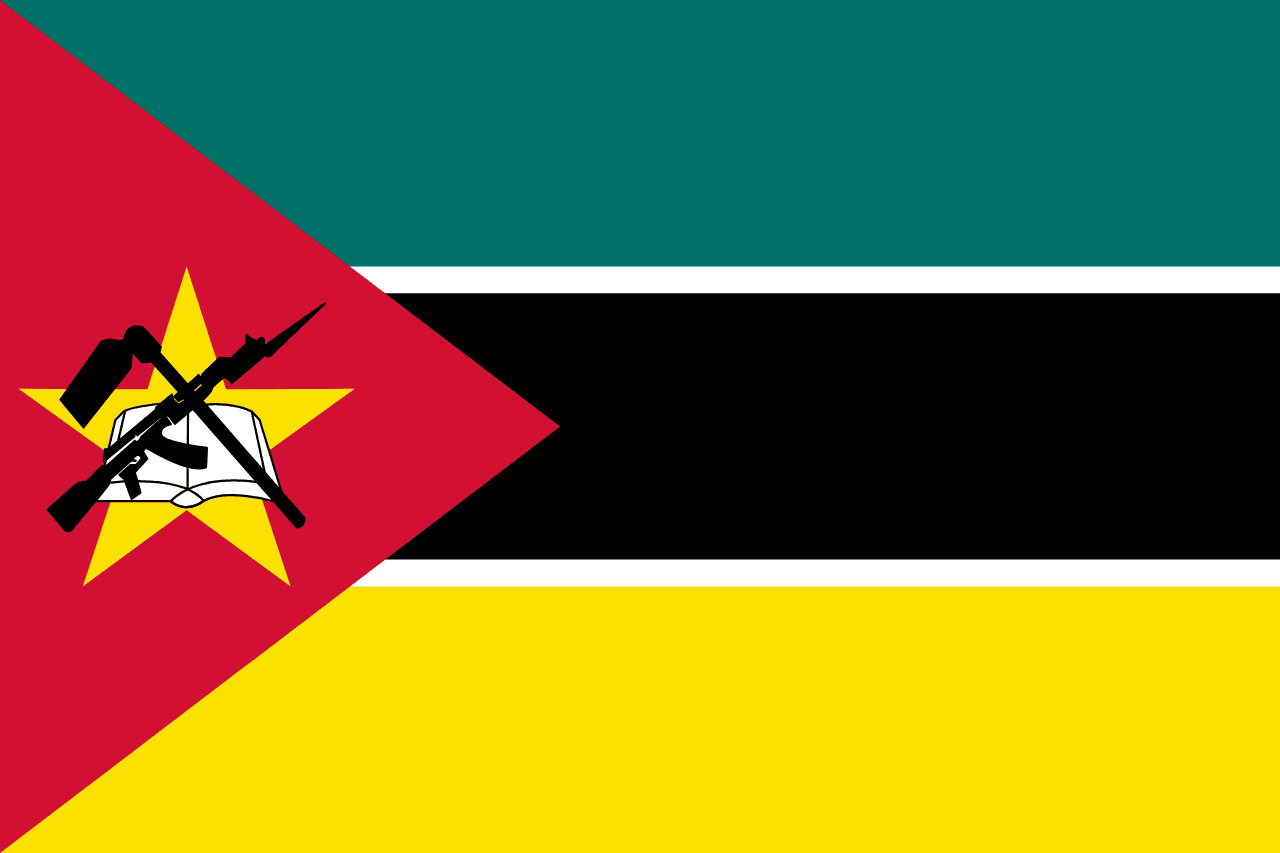
Here is a piece of trivia geography lovers adore: Mozambique begins and ends with the letter sequence that makes it a favourite quiz answer, but more reliably, it is famous for being the only nation in the world whose flag features a modern firearm. The country's flag carries an AK-47 rifle crossed with a hoe, alongside an open book. The rifle represents the armed struggle for independence, the hoe symbolises agriculture and the peasantry, and the book stands for education. It is one of the boldest and most debated national emblems on the planet. Learn the full symbolism in our piece on the Mozambican flag.
4. Portuguese Is the Official Language, but It Is the Mother Tongue of Few
Mozambique is the largest of the Portuguese-speaking nations in Africa and a proud member of the Lusophone community. Yet Portuguese is the first language of only a minority of citizens. Most Mozambicans grow up speaking one of dozens of Bantu languages, with Makhuwa, Sena, Tsonga, and Lomwe among the most widely used. Portuguese serves as the unifying language of government, schooling, and the media, binding together a linguistically rich population. This layering of a European colonial tongue over deep indigenous roots gives Mozambican culture its distinctive bilingual texture, heard everywhere from radio broadcasts in Maputo to market chatter in rural Nampula.
5. The Country Is Named After an Island Sultan
Mozambique takes its name from the Island of Mozambique (Ilha de Moçambique), a tiny coral island that was the colonial capital for nearly four centuries. The name is widely believed to derive from Mussa Bin Bique, an Arab trader and sultan who ruled the island when Portuguese explorer Vasco da Gama arrived in 1498. The island became a crucial stop on the spice route between Europe and India. Its remarkably preserved Stone Town, with whitewashed churches, mosques, and the imposing Fort São Sebastião, is now a UNESCO World Heritage Site, a living museum of Swahili, Arab, and Portuguese influences fused over a thousand years of trade.
6. Gorongosa National Park Is One of Conservation's Great Comeback Stories
Once considered among Africa's finest wildlife reserves, Gorongosa National Park in central Mozambique lost the vast majority of its large animals during the country's long civil war, which ended in 1992. In the decades since, an ambitious restoration partnership has rewilded the park, reintroducing species and allowing populations of elephants, lions, buffalo, and antelope to recover dramatically. Gorongosa is now celebrated worldwide as a model of ecosystem revival and community-led conservation, where local people are partners rather than bystanders. The park sits at the southern tip of the Great Rift Valley, blending floodplains, savanna, and montane rainforest, making it one of Africa's most biodiverse protected areas.
7. Peri-Peri and Coconut Define the National Cuisine
Mozambican food is a delicious collision of African, Portuguese, Arab, and Indian flavours, all amplified by the country's love of the fiery peri-peri (piri-piri) chilli. The signature dish, frango à zambeziana or grilled peri-peri chicken, has become famous far beyond the country's borders. Along the coast, coconut milk enriches seafood stews and curries, while prawns from Mozambican waters are prized as some of the finest in the world. Cassava, maize porridge known as xima, and cashew nuts, of which Mozambique was once the world's leading producer, round out the table. Meals are typically communal, lingering affairs best enjoyed with cold beer and ocean breeze.
8. Its Population Is Young, Fast-Growing, and Overwhelmingly Rural
With a population of roughly 33 to 36 million people, Mozambique is one of Africa's more populous nations, and it is growing rapidly. The median age is strikingly low, with a large majority of citizens under 25, giving the country an enormous youth bulge that will shape its future. The largest ethnic group is the Makhua, concentrated in the north, while groups such as the Tsonga, Sena, and Shona contribute to a vibrant patchwork of cultures. Although cities like Maputo, Matola, Beira, and Nampula are expanding quickly, the majority of Mozambicans still live in rural areas, working in subsistence farming and fishing.
9. Marrabenta Music Is the Heartbeat of the Nation
Mozambique's most beloved musical style, marrabenta, emerged in the suburbs of Maputo in the mid-twentieth century, blending traditional Tsonga rhythms with Portuguese folk melodies and improvised guitar. Played on instruments often handmade from cans and fishing wire, marrabenta became the soundtrack of urban Mozambican life and a quiet form of cultural resistance during colonial times. Alongside the music, Mozambique is renowned for its vibrant visual arts, especially the work of painter Malangatana and the makonde wood carvers of the north, whose intricate sculptures are prized internationally. Dance, storytelling, and timbila xylophone orchestras, recognised by UNESCO, keep the country's artistic traditions thriving.
10. The Mighty Zambezi River Crosses Its Heart
The Zambezi, Africa's fourth-longest river, flows across central Mozambique before emptying into the Indian Ocean through a sprawling delta. Along its course lies the colossal Cahora Bassa Dam, one of the largest hydroelectric projects on the continent, supplying power both domestically and to neighbouring countries. The river has shaped settlement, agriculture, and trade for centuries and remains a lifeline for the communities along its banks. Mozambique shares borders with six nations, including South Africa, Zimbabwe, and Tanzania, making its rivers and ports vital arteries for landlocked neighbours seeking access to the sea, a geographic role that gives the country outsized regional importance.
Frequently Asked Questions
What is the capital of Mozambique?
The capital is Maputo, located on a large bay in the far south of the country. It is Mozambique's largest city and its political, cultural, and economic hub, known for its colonial architecture, busy port, and lively music scene.
What is Mozambique famous for?
Mozambique is famous for its stunning Indian Ocean beaches and archipelagos, its peri-peri grilled prawns and chicken, the historic Island of Mozambique, the conservation success of Gorongosa National Park, and being the only country with a rifle on its national flag.
Why does Mozambique's flag have an AK-47?
The AK-47 on the flag commemorates the country's armed struggle for independence from Portugal, achieved in 1975. It appears alongside a hoe symbolising agriculture and an open book representing education, together capturing the ideals of the new nation.
Conclusion
From its rifle-emblazoned flag and Eiffel-linked railway station to its rewilded wildlife parks and coconut-laced cuisine, Mozambique is a country full of surprises and resilience. Shaped by ocean, river, and a remarkable blend of cultures, it rewards anyone willing to look beyond the headlines. These ten facts are only an invitation to keep exploring one of Africa's most fascinating and underrated nations.