
Myanmar is a land of golden pagodas, mighty rivers, and one of the most layered cultural tapestries in all of Asia. Tucked between India, China, and Thailand, this Southeast Asian nation spent decades largely cut off from the outside world, leaving its temples, traditions, and landscapes feeling remarkably untouched. From a planned capital city built almost from scratch to a road map where everyone suddenly switched sides, here are ten facts that reveal just how surprising Myanmar really is.
1. It Has Two Names and a Long-Running Debate
Few countries spark as much naming controversy as Myanmar. For most of the 20th century, the world knew it as Burma, the name used under British colonial rule and by the Burmese-speaking majority. In 1989, the military government officially changed the country's English name to Myanmar, arguing it was more inclusive of the nation's many ethnic groups. The shift remains politically charged: some governments and opposition figures still prefer "Burma," seeing the renaming as illegitimate, while international bodies like the United Nations adopted "Myanmar." In the Burmese language, both names have long coexisted, with "Myanma" being the more formal, literary version and "Bama" the colloquial one.
2. Naypyidaw Is an Eerily Empty Planned Capital
In 2005, the government abruptly moved the capital from bustling Yangon to a purpose-built city carved out of farmland: Naypyidaw. The relocation was so secretive that even civil servants were given just days to pack up. Today Naypyidaw is famous for its surreal scale, including a 20-lane highway that often sits almost completely empty. The city sprawls across an area many times larger than most capitals, with vast roundabouts, oversized government complexes, replica pagodas, and shopping zones that can feel deserted. Learn more in our country guide. Naypyidaw stands as one of the world's strangest capitals, a place designed for millions that often feels nearly empty.
3. Bagan Holds Thousands of Ancient Temples
On a plain beside the Irrawaddy River lies Bagan, one of the most astonishing archaeological sites on Earth. Between the 11th and 13th centuries, the kings of the Pagan Kingdom built more than 10,000 Buddhist temples, pagodas, and monasteries here. Around 2,000 still survive today, scattered across roughly 40 square miles of dusty plains. At sunrise, the silhouettes of countless brick stupas emerging from the morning mist create one of travel's most iconic scenes. Bagan was finally inscribed as a UNESCO World Heritage Site in 2019, recognizing both its scale and its religious significance as one of the great centers of Theravada Buddhism in Southeast Asia.
4. It's One of the Most Ethnically Diverse Nations in Asia
Myanmar officially recognizes 135 distinct ethnic groups, organized into eight major "national races" including the Bamar, Shan, Karen, Rakhine, Mon, Kachin, Chin, and Kayah. The Bamar form the majority, but the highlands and border regions are home to a dazzling array of cultures, languages, and traditions. This diversity, while a source of incredible richness in dress, festivals, and cuisine, has also fueled some of the world's longest-running civil conflicts, as various groups have sought autonomy for decades. The result is a country where you can travel a few hundred miles and encounter entirely different alphabets, religions, and ways of life.
5. The Shwedagon Pagoda Glitters With Real Gold
Rising nearly 100 meters above Yangon, the Shwedagon Pagoda is the spiritual heart of Myanmar and one of Buddhism's most sacred sites. The towering golden stupa is genuinely covered in gold plates and leaf, and its crown is studded with thousands of diamonds, rubies, and other gemstones, including an enormous diamond at the very top. According to tradition, the pagoda enshrines relics of four previous Buddhas, including eight hairs of the Gautama Buddha. Believers say parts of it are over 2,600 years old, though historians date the bulk of construction to later centuries. At dusk, when the gold catches the fading light, the sight is unforgettable.
6. People Wear Their Sarong Every Day
Walk down any street in Myanmar and you'll notice that most people, men and women alike, wear a longyi, a tube of cloth wrapped and tucked around the waist that falls to the ankles. Far from a tourist costume, the longyi is everyday national dress worn to offices, markets, weddings, and schools. Men tie theirs with a front knot, while women fold and tuck at the side. Equally distinctive is thanaka, a yellowish-white paste ground from tree bark and smeared on the cheeks, nose, and arms. It serves as sunscreen, cosmetic, and skin treatment all at once, and has been used for over 2,000 years.
7. Mohinga Is the National Breakfast
Ask anyone in Myanmar about their favorite dish and the answer is often mohinga, a hearty fish-based noodle soup eaten morning, noon, and night, but classically for breakfast. Made with rice vermicelli, catfish broth, lemongrass, banana stem, and a tangle of crunchy toppings, it is considered the unofficial national dish. Burmese cuisine more broadly blends Indian, Chinese, and Thai influences with its own distinct flavors. Don't miss lahpet thoke, a one-of-a-kind salad made from fermented tea leaves tossed with peanuts, fried garlic, beans, and tomatoes. Myanmar is one of the only countries in the world where people both drink tea and eat it as food.
8. Almost Everyone Drives on the Right, but the Cars Are on the Wrong Side
Here's a quirk that baffles visitors: Myanmar drives on the right-hand side of the road, yet the overwhelming majority of cars have the steering wheel on the right too, the configuration meant for left-side driving. The reason is historical. As a former British colony, Myanmar originally drove on the left. In 1970, the government abruptly switched the country to right-hand driving, reportedly on the advice of an astrologer or to break from the colonial past. But because so many imported used vehicles still have right-side steering, drivers overtaking traffic often cannot see oncoming cars, making everyday driving genuinely hazardous.
9. It Produces Most of the World's Finest Jade and Rubies
Myanmar sits on some of the richest gem deposits on the planet. The Mogok region, known as the "Valley of Rubies," has produced the world's most coveted "pigeon's blood" rubies for centuries, prized for their intense red color. The country is also believed to supply the vast majority of the world's high-quality jadeite, the rare emerald-green jade so treasured in China that single boulders have sold for staggering sums. Alongside teak timber, oil, and natural gas, these resources make Myanmar enormously wealthy in raw materials, even as much of the population remains poor and the gem trade has been clouded by smuggling and conflict.
10. The Irrawaddy River Is the Nation's Lifeline
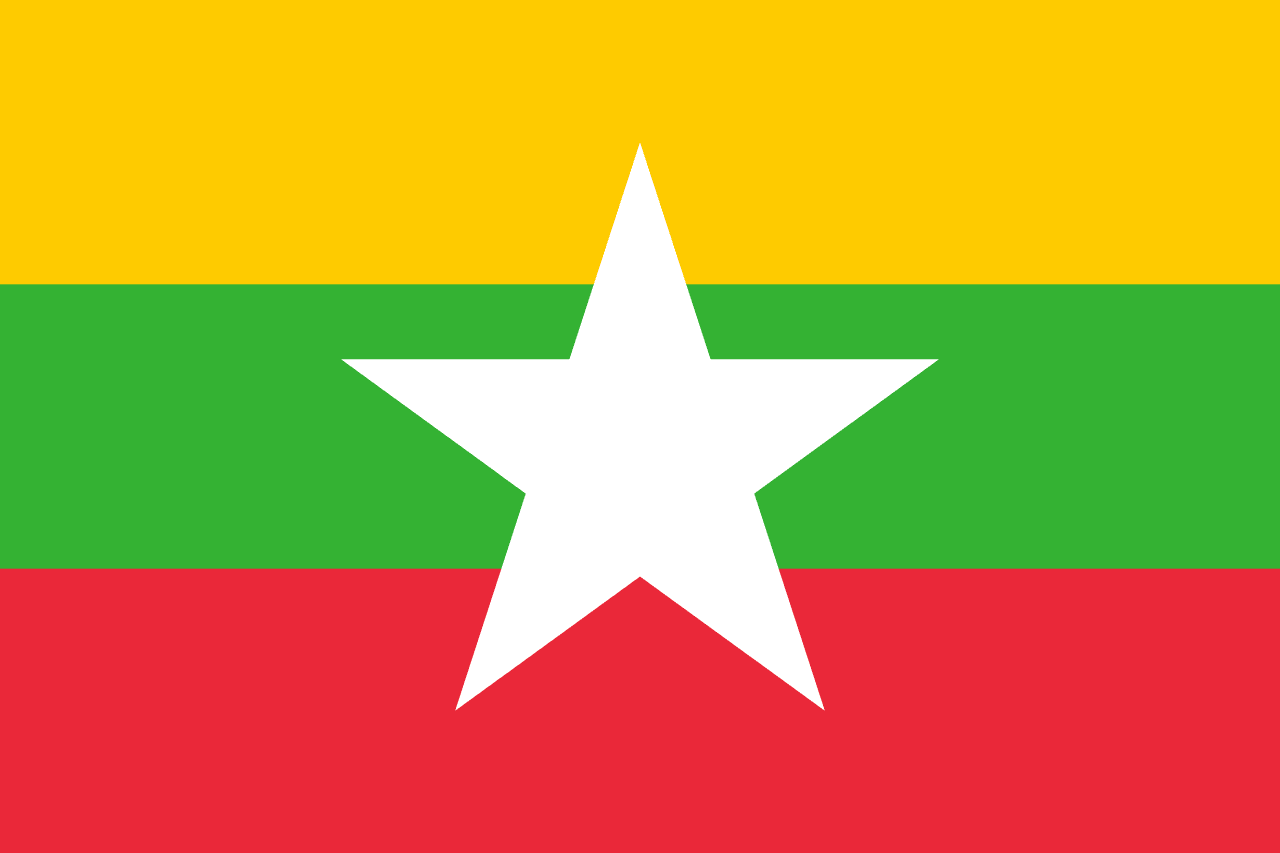
Flowing nearly 2,170 kilometers from the Himalayan foothills to the Andaman Sea, the Irrawaddy (Ayeyarwady) River is the spine of Myanmar. Its fertile delta is the country's rice bowl, feeding the nation and shaping settlement patterns for millennia. The river is also home to the rare Irrawaddy dolphin, a snub-nosed freshwater dolphin that has developed an extraordinary cooperative fishing relationship with local fishermen, herding fish toward their nets in exchange for an easy meal. Beyond the river, Myanmar's wild landscapes range from snow-capped northern mountains to dense tropical forests sheltering Asian elephants, tigers, and gibbons. You can see the national colors on our flag page.
Frequently Asked Questions
What is the capital of Myanmar?
The capital of Myanmar is Naypyidaw, a purpose-built city established in 2005 when the government relocated from the former capital, Yangon (Rangoon). Yangon remains the country's largest city and main commercial hub, but Naypyidaw houses the parliament, ministries, and government offices.
What is Myanmar famous for?
Myanmar is famous for its thousands of golden Buddhist pagodas, especially the ancient temple plain of Bagan and the dazzling Shwedagon Pagoda in Yangon. It is also renowned for its high-quality rubies and jade, its tea-leaf salad, and its deeply rooted Theravada Buddhist traditions.
Why do people in Myanmar wear paste on their faces?
The yellowish paste is called thanaka, made by grinding the bark of certain trees with water. Worn for over 2,000 years, it acts as a natural sunscreen, helps cool the skin, treats acne, and is considered beautiful. You'll see it on the cheeks of children, women, and many men across the country.
Conclusion
From the empty highways of Naypyidaw to the misty temple fields of Bagan and the gold-clad spire of Shwedagon, Myanmar is a country that constantly defies expectations. Its blend of 135 ethnic groups, ancient Buddhist heritage, unique cuisine, and curious everyday quirks makes it one of Asia's most fascinating and least understood nations. Whether you're drawn by its rubies, its rivers, or its remarkable resilience, Myanmar rewards anyone willing to look a little closer.