
Tucked into the rugged center of the Balkan Peninsula, North Macedonia is a small, landlocked nation that punches far above its weight in history, mythology, and natural drama. It is a land where Alexander the Great's homeland legacy collides with Ottoman bazaars, ancient lakes older than the Mediterranean, and a capital that reinvented itself overnight. Here are ten genuinely fascinating facts about this often-overlooked European country.
1. It Sits on One of Europe's Oldest Lakes
Lake Ohrid, straddling the border with Albania, is estimated to be around three million years old, making it one of the oldest and deepest lakes on Earth. This ancient body of water is so biologically rich that scientists call it a "museum of living fossils," home to more than 200 endemic species found nowhere else on the planet. Designated a UNESCO World Heritage Site for both its natural and cultural value, Ohrid's crystalline waters lap against a lakeside town that once claimed 365 churches, one for every day of the year. The lake's age and isolation have made it a living laboratory for evolutionary biologists studying how species develop in deep, stable freshwater environments.
2. Skopje Was Largely Rebuilt After a Devastating Earthquake
The capital, Skopje, was flattened by a catastrophic earthquake in July 1963 that killed over 1,000 people and destroyed roughly 80 percent of the city. The world rallied to help rebuild it, and the reconstruction drew on bold modernist and Brutalist architecture, some of it designed under the influence of Japanese architect Kenzo Tange. Decades later, a controversial government project called "Skopje 2014" added dozens of neoclassical buildings, fountains, and enormous statues, transforming the skyline into a startling mix of concrete modernism and marble grandeur. You can learn more about the country in our country guide.
3. The Country Changed Its Name in 2019
For nearly three decades after declaring independence from Yugoslavia in 1991, the country was locked in a bitter naming dispute with neighboring Greece, which objected to the use of "Macedonia" because of its own northern region of the same name. The standoff blocked the country's path into NATO and the European Union for years. In 2019, under the historic Prespa Agreement, the country formally became the Republic of North Macedonia. The compromise cleared the way for NATO membership in 2020 and remains one of the rare cases of a nation officially renaming itself to resolve an international diplomatic deadlock.
4. It Is the Birthplace of Mother Teresa
One of the 20th century's most famous humanitarians, Mother Teresa, was born Anjezë Gonxhe Bojaxhiu in Skopje in 1910, when the city was part of the Ottoman Empire. Though she spent most of her life serving the poor in India, North Macedonia proudly claims her as a national figure. A Memorial House dedicated to her now stands in central Skopje, built on the approximate site of the church where she was baptized. Her Albanian Catholic family roots also reflect the country's deep ethnic and religious diversity, a recurring theme in its history.
5. A Quarter of the Population Is Ethnic Albanian
With a population of roughly 1.8 million, North Macedonia is one of Europe's most ethnically layered small countries. While ethnic Macedonians form the majority, ethnic Albanians make up about a quarter of the population, alongside smaller communities of Turks, Roma, Serbs, and Vlachs. This diversity is reflected in the country's languages: Macedonian, a South Slavic language written in Cyrillic, is the official language, while Albanian holds co-official status nationally. The blend of Orthodox Christian and Muslim heritage gives towns a distinctive character, where church bells and the call to prayer often sound within the same neighborhood.
6. Its Cuisine Is a Delicious Balkan Crossroads
Macedonian food reflects centuries of Ottoman, Mediterranean, and Slavic influence. The unofficial national dish is tavche gravche, baked beans slow-cooked with peppers and spices in a clay pot. Just as beloved is ajvar, a smoky red pepper relish so central to autumn life that families gather to roast and jar enormous batches in a seasonal tradition. Flaky burek pastry, grilled meats, sheep's-milk cheeses, and rich red wines from the Tikveš region round out the table. Meals here are leisurely social affairs, often stretching for hours over coffee, rakija (fruit brandy), and conversation.
7. It Is Almost Entirely Mountainous
North Macedonia is a strikingly vertical country, crisscrossed by mountain ranges and high plateaus. More than 50 named peaks rise above 2,000 meters, with Mount Korab on the Albanian border reaching 2,764 meters as the highest point. These mountains cradle three large tectonic lakes, Ohrid, Prespa, and Dojran, and feed the Vardar River, which slices through the country from north to south. The dramatic terrain has historically isolated communities, helping preserve folk traditions, distinct dialects, and centuries-old villages where life still follows the rhythm of the seasons rather than the modern clock.
8. Ohrid Trout Is Found Nowhere Else on Earth
The Ohrid trout, a prized and endangered fish, lives exclusively in Lake Ohrid and its sister lake Prespa. Considered a delicacy for centuries, it became so threatened by overfishing that the government has imposed strict catch bans to allow populations to recover. Beyond the trout, North Macedonia's forests shelter brown bears, wolves, wild boar, and the critically endangered Balkan lynx, of which only a few dozen are thought to survive. National parks like Mavrovo, Pelister, and Galičica protect these fragile ecosystems and the rare alpine flora that thrives in the country's high country.
9. It Has a Surprisingly Strong Handball and Football Tradition
For a nation of fewer than two million people, North Macedonia has produced outstanding athletes. Handball is hugely popular, and the country has hosted major European competitions and fielded clubs that compete at the continental elite level. In football, the national team enjoyed a fairy-tale moment by qualifying for the European Championship for the first time at Euro 2020, where veteran striker Goran Pandev, a national icon, scored a historic goal. Sport serves as a powerful unifying force across the country's diverse communities and a reliable source of national pride.
10. The Red-and-Yellow Sun Banner Is Steeped in Symbolism
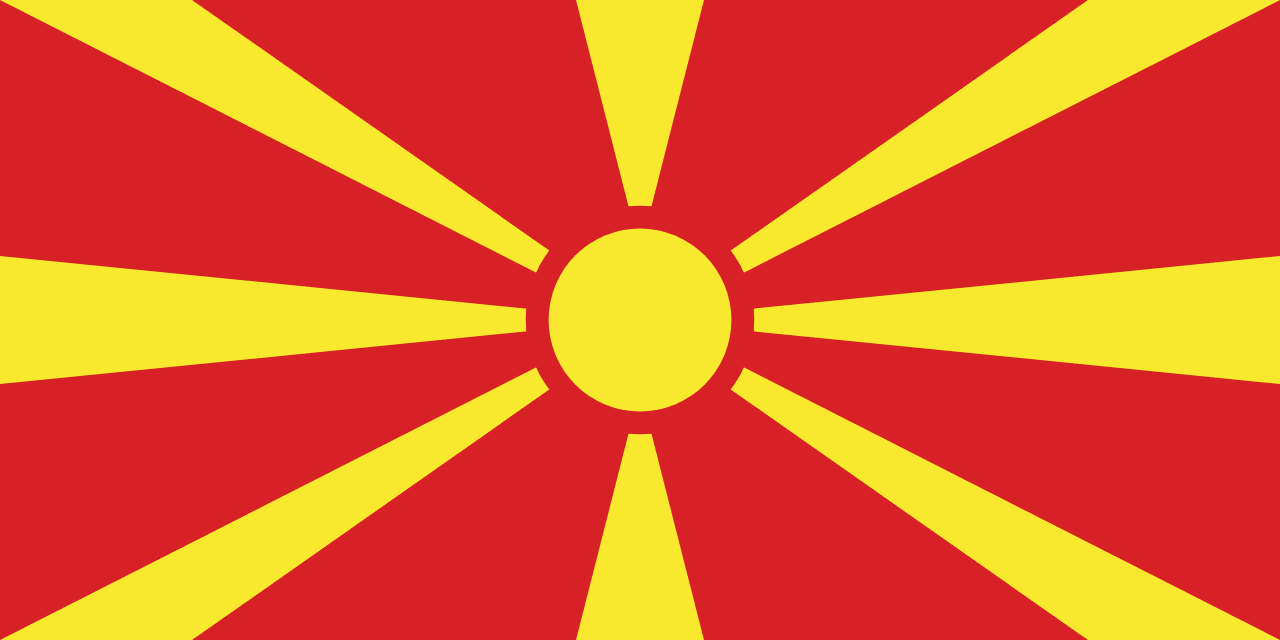
North Macedonia's striking national emblem features a stylized golden sun with radiating rays on a vivid red background, a design adopted in 1995. The original post-independence flag used the ancient Vergina Sun, a symbol linked to the dynasty of Alexander the Great, but it was changed as part of the long dispute with Greece. The current "new sun" remains a powerful emblem of identity and the dawn of freedom. You can read more about its meaning and history in our guide to the North Macedonian flag.
Frequently Asked Questions
What is the capital of North Macedonia?
The capital is Skopje, the country's largest city and political, cultural, and economic hub. Set along the Vardar River, it is famous for its eclectic mix of Ottoman-era landmarks, Brutalist architecture from its post-earthquake rebuild, and the dramatic monuments added during the Skopje 2014 project.
What is North Macedonia famous for?
North Macedonia is best known for ancient Lake Ohrid and its UNESCO-listed lakeside town, for being the birthplace of Mother Teresa, and for its rich Balkan cuisine featuring dishes like tavche gravche and ajvar. It is also recognized for its mountainous landscapes, Orthodox monasteries, and its 2019 name change.
Why did North Macedonia change its name?
The country added "North" to its name in 2019 to resolve a decades-long dispute with Greece, which objected to the unqualified use of "Macedonia." The Prespa Agreement settled the disagreement and opened the door for the country to join NATO and pursue European Union membership.
Conclusion
North Macedonia may be small and landlocked, but it offers an extraordinary depth of history, nature, and culture, from a three-million-year-old lake to a capital that rebuilt itself twice over. Whether you are drawn by its ancient monasteries, its endemic wildlife, or its slow, generous meals, this Balkan crossroads rewards the curious traveler and the armchair geographer alike. It is proof that some of Europe's most surprising stories are hiding in its quietest corners.
