
Qatar is a small but mighty peninsula jutting into the Persian Gulf, a place where pearl divers once ruled the economy and where today the world's largest natural gas field bankrolls gleaming skylines and a national airline that reaches almost every corner of the planet. In the space of a single lifetime, this desert nation transformed from a cluster of fishing villages into one of the richest countries on Earth. Here are ten genuinely fascinating facts that capture what makes Qatar so unique.
1. It Is a Thumb-Shaped Peninsula in the Persian Gulf
Qatar is a peninsula that points northward into the Persian Gulf, sharing its only land border with Saudi Arabia to the south. The country is remarkably flat and almost entirely desert, with vast stretches of sand and gravel plains broken only by low limestone outcrops. Its highest point, Qurayn Abu al Bawl, rises just over 100 metres, making Qatar one of the flattest nations anywhere.
The peninsula stretches roughly 160 kilometres from north to south, and nowhere are you far from the coast. This intimate relationship with the sea shaped everything from the country's diet to its historic pearling industry. To learn more, explore our full country guide.
2. Almost Nobody Living There Is Actually Qatari
Qatar is home to roughly 3 million people, but here is the astonishing part: only around 10 to 12 percent of them are Qatari citizens. The overwhelming majority are foreign workers, drawn from India, Nepal, Bangladesh, the Philippines, Egypt and dozens of other nations to power the country's construction, services and energy sectors.
This makes Qatar one of the most demographically lopsided countries on Earth, with expatriates vastly outnumbering nationals. It also explains the dramatic gender imbalance, since labour migration brings far more men than women. The result is a strikingly cosmopolitan society where you can hear dozens of languages on a single street in Doha.
3. Doha Holds Nearly the Entire Population
Doha, the capital, is the undisputed heart of Qatar, home to the vast majority of the country's residents. Built along a sweeping crescent bay, its waterfront promenade, the Corniche, frames a futuristic skyline of twisting towers that glow at night.
Doha is also where you find the spectacular Museum of Islamic Art, designed by I. M. Pei on its own purpose-built island, and Souq Waqif, a restored traditional market where falcons are bought and sold. The city has hosted the Asian Games, world championships and a FIFA World Cup, reinventing itself as a global hub for sport, diplomacy and culture in just a few decades.
4. Arabic Is Official, but English Rules the Streets
Arabic is the official language of Qatar, used in government, education and law, and the local dialect belongs to the Gulf Arabic family. Yet because expatriates dominate the population, English functions as the everyday lingua franca that ties the diverse community together.
Walk through a Doha shopping mall and you are as likely to hear Hindi, Urdu, Malayalam, Tagalog or Nepali as you are Arabic. English is widely spoken in business, healthcare and hospitality, and most road signs and menus appear in both Arabic and English. This linguistic blend mirrors Qatar's identity as a meeting point between the Arab world and a global workforce.
5. Pearls Once Ran the Entire Economy
Long before oil and gas, Qatar's fortunes rested on the seabed. For centuries, pearl diving was the backbone of the local economy, with fleets of dhows sailing out each summer so divers could plunge to the Gulf floor and gather oysters, holding their breath with only a nose clip and a weighted rope.
The trade collapsed in the early twentieth century when Japanese cultured pearls flooded the market and the Great Depression crushed demand. The years that followed were desperately hard. Then, in the late 1930s and 1940s, oil was discovered, and within a generation Qatar's destiny was rewritten entirely.
6. It Sits on One of the Largest Gas Fields on Earth
Qatar's modern wealth flows from the North Field, an enormous offshore natural gas reservoir it shares with Iran, where it is called South Pars. It is the largest single non-associated natural gas field in the world, and it has made Qatar one of the planet's top exporters of liquefied natural gas.
This resource transformed a once-poor pearling society into a country with one of the highest incomes per person anywhere. The revenue funds free healthcare and education for citizens, a sovereign wealth fund with stakes in landmark companies and buildings worldwide, and ambitious projects that have reshaped the skyline of Doha within a single human lifetime.
7. The Falcon Is a National Obsession
Falconry is woven deep into Qatari heritage, a tradition inherited from Bedouin ancestors who used trained birds of prey to hunt in the desert. Today it is treasured as a cultural art form, and prized falcons can change hands for staggering sums at markets like Souq Waqif.
Qatar takes its raptors so seriously that Doha has a dedicated falcon hospital, where the birds receive advanced veterinary care. Falcons even travel with their owners by airplane, sometimes occupying their own passenger seats, and Qatar issues official passports for the birds to ease international travel. Few symbols capture the blend of old and new in Qatari life quite so vividly.
8. Camel Racing Now Uses Robot Jockeys
Camel racing is a beloved traditional sport in Qatar, drawing crowds to desert tracks where prized animals sprint across the sand. For generations, the camels were ridden by very light riders, but the practice raised serious welfare and human rights concerns.
The ingenious modern solution is the robot jockey, a small lightweight device strapped to the camel's back. Owners follow alongside the track in their vehicles, controlling the robots remotely and even operating tiny mechanical whips by radio signal. The sight of high-tech robots guiding racing camels across the dunes perfectly sums up Qatar's fusion of ancient custom and futuristic innovation.
9. The 2022 World Cup Made History
In 2022, Qatar became the first Arab and first majority-Muslim nation ever to host the FIFA World Cup, football's biggest tournament. The country built or overhauled multiple stadiums for the event, including one assembled from shipping containers that was later dismantled.
Because Qatar's summers are scorching, the tournament was held in November and December rather than the traditional mid-year window, a first in World Cup history. Several stadiums were fitted with advanced cooling systems to keep players and fans comfortable. The event placed this tiny peninsula firmly on the global stage and capped its remarkable rise as a sporting destination.
10. The Maroon Flag Is the World's Most Elongated
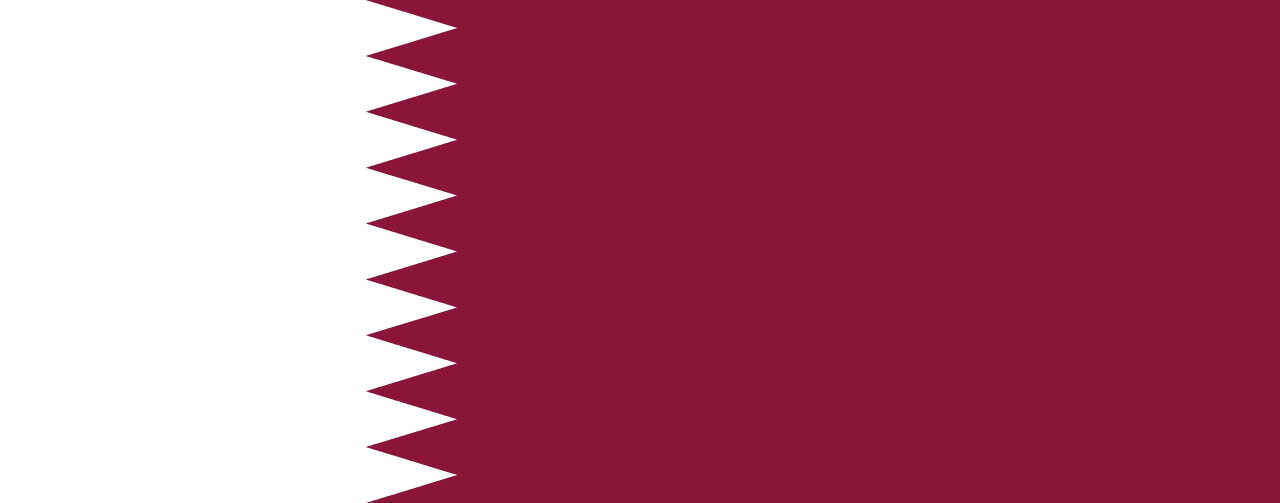
Qatar's national flag is instantly recognisable for its deep maroon colour and white serrated band of nine points, separating the two sections like the teeth of a saw. The maroon shade is said to have developed from a natural red dye that darkened over time in the harsh Gulf sun.
Uniquely, Qatar's flag has an official ratio of 28 to 11, making it proportionally the most elongated national flag in the world. The nine white points are often said to mark Qatar's accession as the ninth member of the reconciled emirates of the Gulf. Discover more about its meaning in our guide to the Qatari flag.
Frequently Asked Questions
What is the capital of Qatar?
The capital of Qatar is Doha, located on the east coast along a curving bay. It is by far the largest city and home to the overwhelming majority of the country's population, as well as its main museums, government institutions, business districts and the Hamad International Airport.
What is Qatar famous for?
Qatar is famous for its immense natural gas wealth, its airline Qatar Airways, the Al Jazeera news network, and for hosting the 2022 FIFA World Cup. It is also known for its futuristic Doha skyline, its historic pearl-diving past and rich Bedouin traditions like falconry.
Do falcons really fly on planes in Qatar?
Yes. Falcons are so culturally important in Qatar that they are issued official passports and are permitted to travel in airplane cabins, sometimes with their own seats. Qatar Airways has clear rules allowing a certain number of falcons aboard, reflecting the bird's deep status in Qatari heritage.
Conclusion
From a flat desert peninsula that once lived by the pearl to a gas-rich powerhouse hosting the world's biggest sporting event, Qatar is a country of dramatic contrasts. Falcons with passports, camels guided by robots and one of the most elongated flags on Earth all hint at a nation where ancient tradition and dazzling modernity sit side by side. Qatar proves that even the smallest places can leave an outsized mark on the world.