
Tucked into the rugged center of the continent, Slovakia is the kind of country that surprises almost everyone who looks closely. It packs jagged alpine peaks, medieval castles, hidden caves, and one of Europe's youngest capitals into a space smaller than many people imagine. Here are ten genuinely interesting facts that reveal why this Central European nation deserves a much closer look.
1. It Is Geographically the Center of Europe (Sort Of)
Slovakia loves to claim the title of "the heart of Europe," and it has a decent case. Near the village of Kremnické Bane, a small church is sometimes cited as marking the geographic midpoint of the continent, and the country sits almost exactly between the Atlantic and the Ural Mountains. Whatever the precise truth, the location has defined Slovakia's identity for centuries.
The terrain itself is dramatically varied. The High Tatras in the north form the smallest high-mountain range in the world, with sharp granite peaks rising above 2,600 meters, while the southern lowlands flatten into fertile plains drained by the Danube. To dig deeper into the land and its borders, see our country guide.
2. Bratislava Is the Only Capital Bordering Two Countries
Bratislava holds a distinction no other national capital can match: it sits directly on the borders of two other countries, Austria and Hungary. You can stand in the Slovak capital and look across the Danube toward both neighbors, and Vienna is barely an hour away by train or boat.
Crowned by a four-towered castle overlooking the river, Bratislava blends a compact, walkable medieval old town with communist-era housing estates and gleaming new riverfront towers. It is also unusually green, ringed by vineyards and the forested foothills of the Little Carpathians, making it feel less like a sprawling metropolis and more like a city that never quite left nature behind.
3. A Nation of Around 5.5 Million People
Slovakia is home to roughly 5.5 million people, the vast majority of whom are ethnic Slovaks. The largest minority is the Hungarian community, concentrated in the south near the border, a legacy of the centuries when the region belonged to the Kingdom of Hungary.
Despite its modest population, Slovakia is densely woven with small towns and villages rather than dominated by a single giant city. Outside Bratislava and Košice, life unfolds at a gentler pace, and traditions remain strong. Folk costumes, regional dialects, and village festivals are not museum pieces here but living parts of community life, especially in the mountainous central and northern regions.
4. The Slovak Language Is the "Esperanto" of Slavic Tongues
Slovak is the official language, and linguists sometimes call it the most "central" of the Slavic languages because speakers can often understand a remarkable range of neighbors, from Czech and Polish to the South Slavic tongues. Slovaks and Czechs in particular understand each other almost effortlessly, a hangover from decades of shared statehood.
The language uses the Latin alphabet decorated with an impressive collection of diacritical marks, including the rare "ľ" and "ô." Slovak is also famous among linguists for tongue-twisting words built entirely without vowels, such as strč prst skrz krk ("stick a finger through your throat"), a phrase Slovaks delight in challenging foreigners to pronounce.
5. Born From a Peaceful "Velvet Divorce" in 1993
Modern Slovakia is a young country. It became fully independent on January 1, 1993, when Czechoslovakia split into two nations in an event so calm and amicable it earned the nickname the "Velvet Divorce." No shots were fired and no border disputes erupted, a rare model of peaceful separation.
But the Slovak story stretches back far further, through the medieval Kingdom of Hungary, the Austro-Hungarian Empire, and the brief Great Moravian Empire of the 9th century, often regarded as the first major Slavic state in the region. This long history left behind a landscape studded with fortresses and a culture proud of its endurance.
6. It Has More Castles Per Capita Than Almost Anywhere
Few countries can rival Slovakia's density of fortifications. Estimates put the number of castles, manor houses, and château ruins at well over 100, scattered across hilltops and river valleys throughout the country. For a nation of its size, that is an extraordinary concentration of stone history.
The crown jewel is Spiš Castle in the east, one of the largest castle complexes in Central Europe and a UNESCO World Heritage Site. Its sprawling pale ruins crowning a green hill are among the most photographed sights in the country. Bojnice Castle, by contrast, looks like a fairy-tale chateau lifted straight from a storybook, complete with romantic turrets and a moat.
7. One of the World's Top Car Producers Per Capita
Slovakia quietly became one of the planet's most prolific car manufacturers. Relative to its population, it produces more cars per capita than any other country, with major plants run by Volkswagen, Kia, Peugeot, and Jaguar Land Rover. Roughly a million vehicles roll off Slovak assembly lines in a typical year.
This automotive boom transformed the economy after independence, drawing investment and turning the country into a key link in Europe's manufacturing chain. As a member of the European Union and the eurozone, Slovakia uses the euro and has positioned itself as an industrial powerhouse far larger than its compact size would suggest.
8. Home to Brown Bears, Wolves, and Lynx
The Carpathian Mountains that arc across Slovakia shelter some of Europe's last great wilderness. Brown bears, gray wolves, and elusive lynx still roam the forests, alongside chamois, marmots, and golden eagles. It is one of the few places in Europe where all of the continent's large carnivores survive together in significant numbers.
Slovakia is also riddled with caves. The Slovak Karst and Aggtelek caves form a UNESCO-listed network, and the country boasts rare ice caves and aragonite caves that are extraordinarily uncommon worldwide. Above ground, nine national parks protect everything from glacial Tatra lakes to deep limestone gorges.
9. Sheep Cheese Dumplings Are the National Dish
If Slovakia has a single iconic plate, it is bryndzové halušky: soft potato dumplings smothered in tangy sheep's cheese and topped with crispy bacon. Hearty and unapologetically rustic, it reflects the country's pastoral mountain roots and is celebrated with its own annual cooking championship.
Slovak cuisine leans warming and filling, built for cold Carpathian winters. Sauerkraut soup (kapustnica) is a Christmas staple, while the sweet, hollow, cinnamon-dusted pastry called trdelník turns up at markets and fairs. Wine from the Little Carpathians and a potent juniper spirit called borovička round out the table.
10. The Flag and the Mountains Tell the Same Story
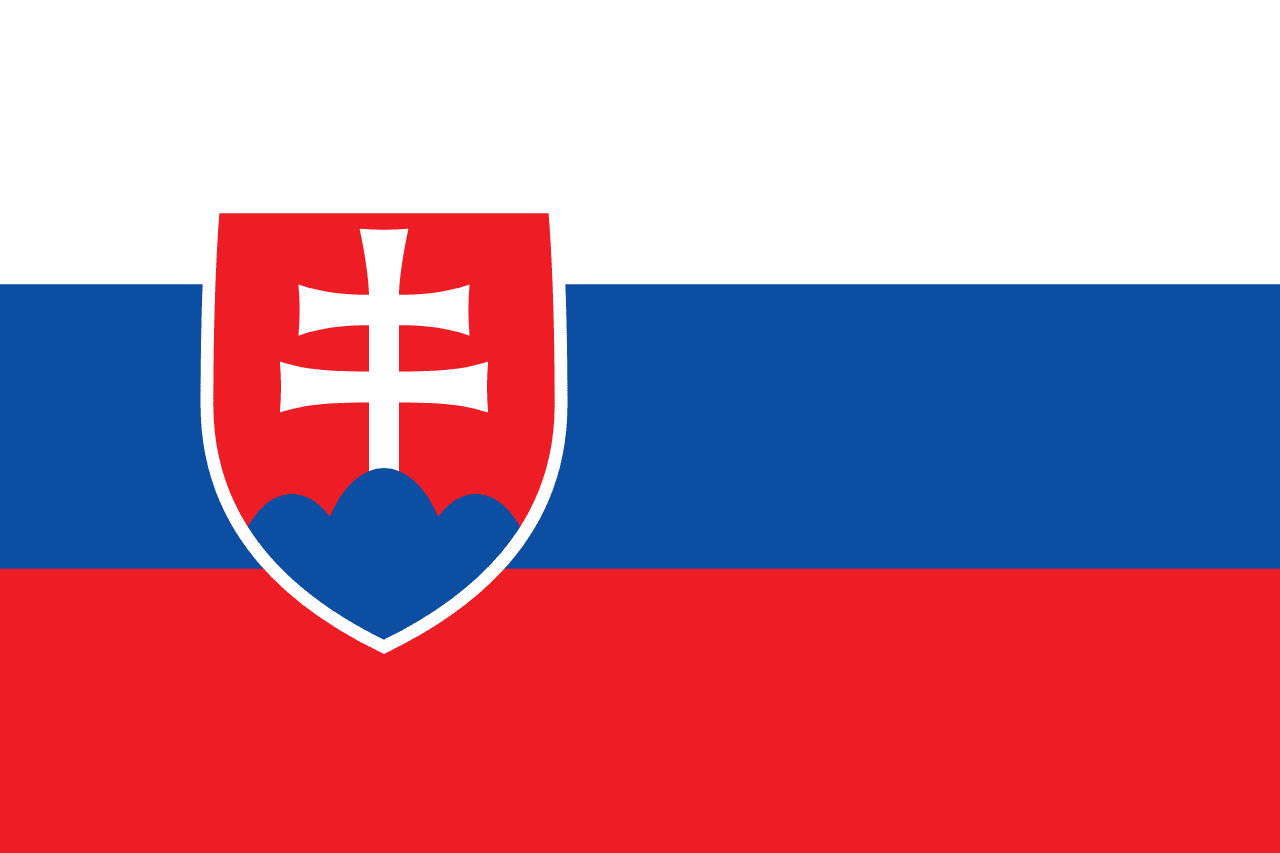
Slovakia's national symbols are steeped in geography. The country's coat of arms features a double cross standing on three blue hills, traditionally said to represent three mountain ranges: Tatra, Fatra, and Matra. That same emblem sits at the heart of the national flag, tying the country's identity directly to its peaks. You can explore the design's history and meaning in our piece on the flag.
Those mountains are more than symbols. The Tatras are a source of fierce national pride, drawing hikers and skiers, and they appear on Slovak euro coins, postcards, and even the labels of local mineral water, a reminder that in Slovakia, the landscape is never far from the sense of nationhood.
Frequently Asked Questions
What is the capital of Slovakia?
The capital is Bratislava, located in the far west of the country on the Danube River. It is uniquely positioned on the borders of both Austria and Hungary, making it one of the most internationally connected capitals in Europe and only a short trip from Vienna.
What is Slovakia famous for?
Slovakia is best known for its dramatic High Tatra mountains, its remarkable density of castles including the UNESCO-listed Spiš Castle, its thriving car-manufacturing industry, and rugged Carpathian wilderness still home to brown bears, wolves, and lynx. Hearty dishes like bryndzové halušky add to its reputation.
Is it true Slovaks have a word with no vowels?
Yes. Slovak is celebrated for tongue-twisting phrases built without any vowels, the most famous being strč prst skrz krk, meaning "stick a finger through your throat." Slovaks often dare visitors to attempt it, and the consonant-heavy sound surprises almost everyone who tries.
Conclusion
From vowel-free tongue-twisters and fairy-tale castles to bear-filled forests and the world's most car-producing economy per capita, Slovakia constantly defies expectations. It is a small country with an outsized personality, where ancient history and modern industry share the same mountain-framed landscape. The ten facts above are only the beginning of what this captivating Central European nation has to offer.