
Tucked into the northeastern shoulder of South America, Suriname is the continent's smallest sovereign nation and one of its most surprising. It is a place where Hindu temples stand beside mosques and synagogues, where wooden Dutch colonial houses line tropical streets, and where untouched rainforest still swallows the vast majority of the land. Here are ten genuinely fascinating facts about this little-known country.
1. It Is the Most Forested Country on Earth
No nation on the planet is more thickly cloaked in trees than Suriname. Roughly 93 percent of its territory remains covered in dense, largely untouched Amazonian rainforest, the highest proportion of forest cover of any country in the world. This means that while Suriname is comparable in area to a mid-sized European nation, the overwhelming majority of it is green wilderness rather than farmland or city.
The crown jewel of this wilderness is the Central Suriname Nature Reserve, a UNESCO World Heritage Site covering about 1.6 million hectares of pristine forest, granite domes, and rivers. Because so little of the land has been developed, Suriname is one of the few carbon-negative countries on Earth, absorbing more greenhouse gas than it emits. You can learn more in our country guide.
2. Paramaribo Has a UNESCO-Listed Wooden Old Town
The capital, Paramaribo, is home to around half the country's population and sits on the banks of the Suriname River. Its historic inner city is itself a UNESCO World Heritage Site, prized for a remarkable blend of Dutch colonial architecture built almost entirely from timber.
Wander the streets and you will find elegant white-painted wooden buildings with red-tiled or shingled roofs, brick foundations, and shuttered windows, an architectural style that fused European design with local materials and tropical practicality. The skyline famously juxtaposes the towering wooden Saint Peter and Paul Cathedral, one of the largest wooden buildings in the Western Hemisphere, with a neighboring mosque and synagogue that share a fence, a powerful symbol of the country's religious coexistence.
3. It Is South America's Only Dutch-Speaking Country
Suriname is the sole nation in South America where Dutch is the official language, a legacy of centuries of colonial rule by the Netherlands. Dutch is used in government, schools, newspapers, and formal life, making the country a linguistic island on a continent dominated by Spanish and Portuguese.
But Dutch is only part of the story. The true lingua franca of the streets is Sranan Tongo, an English-based creole that almost everyone speaks. Add to that Sarnami Hindustani, Javanese, various Maroon languages, Chinese, and Indigenous tongues, and Suriname becomes one of the most multilingual societies on Earth for its size. Many Surinamese effortlessly switch between several languages in a single conversation.
4. One of the Most Ethnically Diverse Nations Anywhere
With a population of only around 645,000, Suriname packs in extraordinary diversity. Its people descend from Indian and Javanese indentured laborers, enslaved Africans, Chinese migrants, Dutch and other Europeans, Lebanese traders, and Indigenous peoples such as the Arawak and Carib.
This mosaic emerged from the colonial plantation economy: after slavery was abolished, the Dutch imported contract workers from across their empire and beyond. The result is a society where Hinduism, Islam, Christianity, and traditional African and Indigenous beliefs all flourish side by side. Public holidays reflect this blend, with the nation celebrating Holi (locally called Phagwa), Eid, Christmas, and the Maroon and Indigenous holidays alike. Few countries this small contain so many distinct cultural worlds.
5. The Maroons Preserve a Living African Heritage
One of Suriname's most remarkable communities is the Maroons, descendants of enslaved Africans who escaped the coastal plantations and built independent societies deep in the rainforest interior. Groups such as the Saramaka and Ndyuka fought the Dutch to a standstill and won treaties recognizing their autonomy in the 1700s.
Today, generations later, the Maroons maintain some of the best-preserved African cultural traditions in the Americas, including distinctive languages, drumming, woodcarving, and spiritual practices that trace directly back to West and Central Africa. Their intricately carved wooden art and textiles are celebrated nationally and internationally, offering a rare and tangible link to pre-colonial African heritage.
6. Its Cuisine Is a Delicious Global Fusion
Suriname's food might be the tastiest expression of its multicultural identity. On a single street you can eat Javanese nasi goreng and bami, Indian-style roti wrapped around curried chicken and long beans, Chinese stir-fries, and Creole specialties.
The unofficial national dish is pom, a baked casserole made from grated pomtajer (a local root vegetable) layered with citrus-marinated chicken, a Creole favorite at parties and celebrations. Street food culture thrives too, from grilled snacks at roadside warungs (a word borrowed from Javanese) to fresh tropical juices. Eating in Suriname is less about a single national cuisine and more about a constant, joyful crossing of culinary borders inherited from four continents.
7. It Is the Smallest Independent Country in South America
By land area, Suriname is the smallest sovereign state on the South American continent, covering roughly 164,000 square kilometers. It is bordered by Guyana to the west, French Guiana (an overseas territory of France) to the east, and the giant of Brazil to the south, with the Atlantic Ocean to the north.
Despite its modest size, Suriname has long-running, unresolved border disputes with both of its neighbors over jungle and river territory. Its compact dimensions belie an immense natural wealth, and most of the population is concentrated along the narrow coastal plain, leaving the forested interior sparsely inhabited and difficult to reach except by boat or small aircraft.
8. Independence Came Only in 1975
For more than three centuries Suriname was a Dutch colony, originally seized from the English in 1667 in a swap that famously saw the Dutch hand over New Amsterdam, today's New York City, in return. Suriname finally gained full independence from the Netherlands on November 25, 1975.
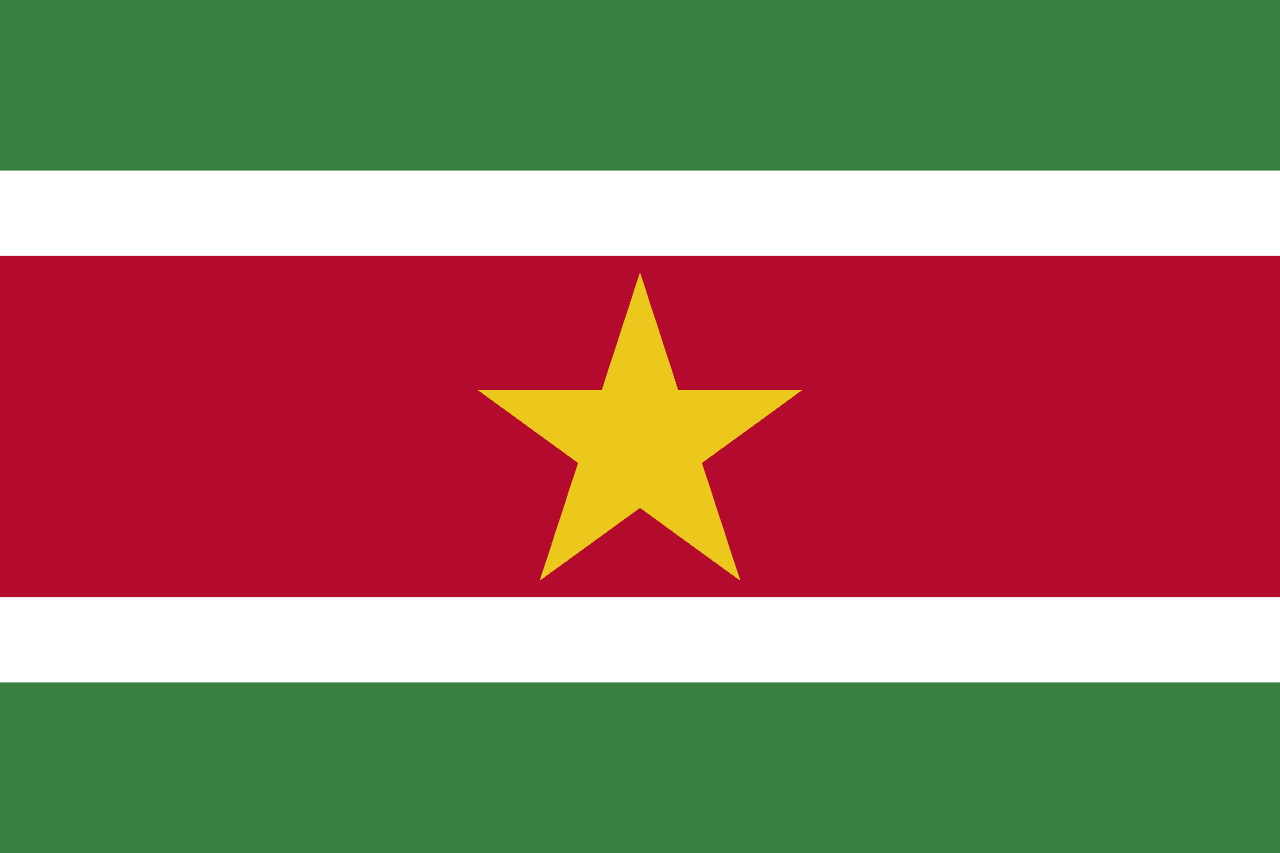
Independence triggered a dramatic exodus: fearing instability, around a third of the population emigrated to the Netherlands in the years surrounding the transition. To this day, a huge Surinamese diaspora lives in Dutch cities, and the cultural ties between the two countries remain extremely strong, from football players to cuisine to the Dutch language itself. The country's red, green, white, and yellow-star banner reflects this hopeful new chapter, as you can read in our piece on the flag.
9. Wildlife Found Almost Nowhere Else
Suriname's vast rainforests are a sanctuary for some of the planet's most spectacular and endangered wildlife. The interior shelters jaguars, giant river otters, tapirs, capybaras, and eight species of monkey, along with the formidable harpy eagle and countless species of frogs, butterflies, and orchids.
Because so much of the country is undisturbed, scientific expeditions regularly discover species new to science here. The Sipaliwini savanna and the granite massifs of the interior add ecological variety to the dominant rainforest. Sea turtles, including the enormous leatherback, nest on the beaches of the northeastern coast at places like Galibi, drawing conservationists and eco-tourists eager to witness one of nature's great spectacles.
10. An Economy Built on Gold, Oil, and the Forest
For a small nation, Suriname has significant natural resources. Gold mining is a cornerstone of the economy, and the country has long exported bauxite (aluminum ore), though that industry has declined. Agriculture, especially rice and bananas, also plays an important role on the coastal plain.
The biggest story of the 2020s, however, lies offshore. Major oil discoveries in Suriname's Atlantic waters have raised hopes of an economic transformation in the coming years, potentially turning this quiet country into a notable petroleum producer. The challenge facing Suriname is balancing this new wealth against the priceless ecological treasure of its forests, the very thing that makes the country globally unique.
Frequently Asked Questions
What is the capital of Suriname?
The capital of Suriname is Paramaribo, located on the banks of the Suriname River near the Atlantic coast. It is home to roughly half the country's population and its historic wooden inner city is a UNESCO World Heritage Site.
What is Suriname famous for?
Suriname is best known for being the most forested country on Earth, with around 93 percent rainforest cover. It is also famous for its extraordinary ethnic and religious diversity, its status as South America's only Dutch-speaking nation, and its fusion cuisine.
Why are there a mosque and synagogue next to each other in Paramaribo?
In central Paramaribo a mosque and a synagogue sit peacefully side by side, sharing a wall. The arrangement has become a beloved symbol of Suriname's tradition of religious tolerance, where Muslims, Jews, Hindus, and Christians have long lived as neighbors.
Conclusion
Suriname proves that geographic size has little to do with cultural richness or natural splendor. From its record-breaking forests and rare wildlife to its kaleidoscope of languages, faiths, and flavors, it is a country that constantly defies expectations. For anyone curious about the world's hidden corners, Suriname offers an endlessly rewarding place to explore.