
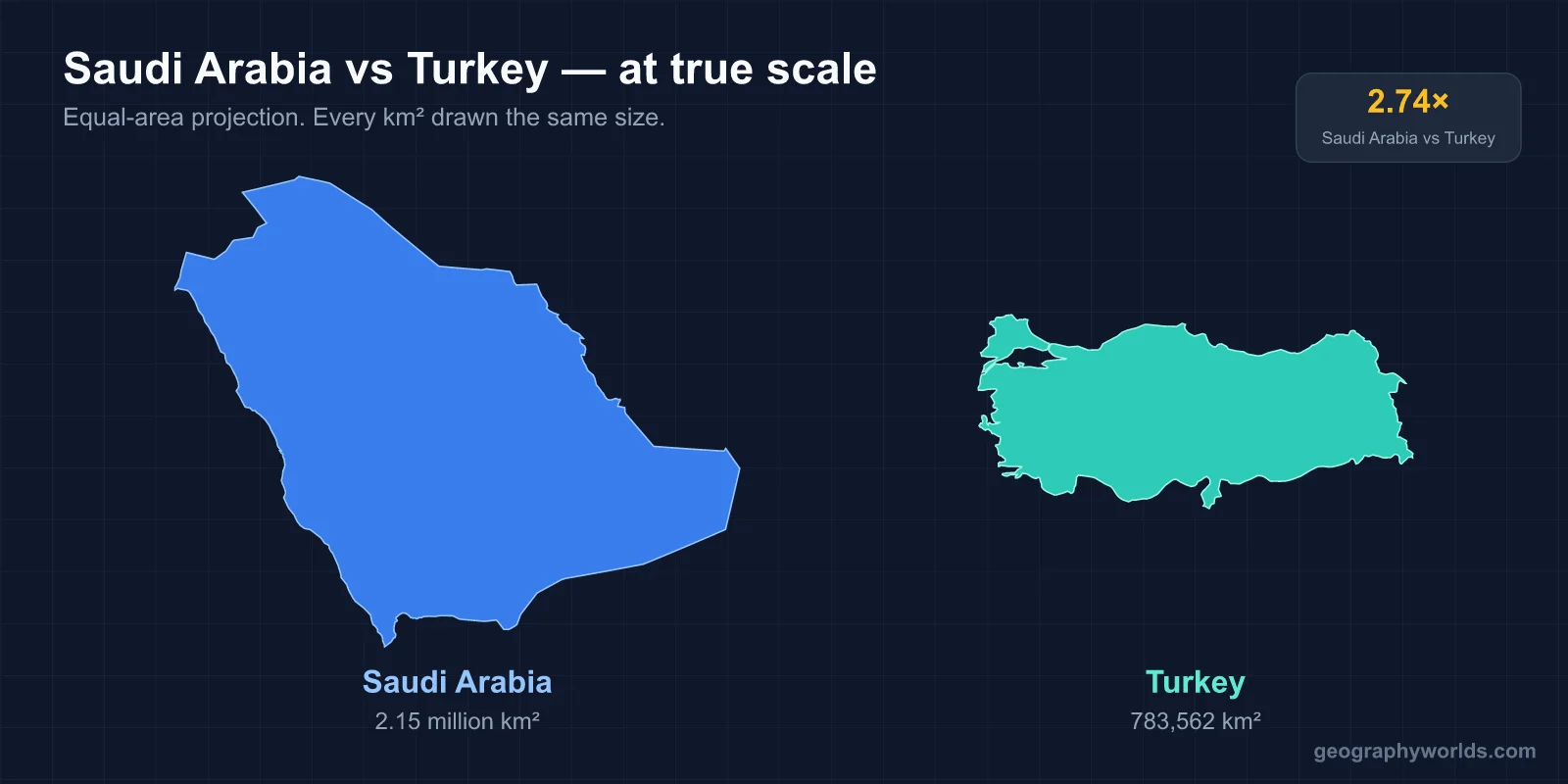
Saudi Arabia is about 2.7 times the size of Turkey (roughly 2.15 million km² against 783,562 km²), but Turkey has well over twice the people: about 85.7 million at the end of 2024, against 32.2 million counted in Saudi Arabia's 2022 census, some 42 per cent of whom were foreign nationals. Turkey is a mountainous, well-watered country with a broad manufacturing economy; Saudi Arabia is a riverless desert state whose wealth rests on oil and which now makes most of its city water from the sea.
Both are Sunni-majority regional powers, but one sits on the headwaters of the rivers that created Mesopotamia and the other has no permanent river at all. One was the seat of an empire; the other was, for four centuries, partly ruled by it. The clearest way to compare them is to start with water.
Headwaters Against Wadis: Who Has the Water
Both the Tigris and the Euphrates rise in eastern Anatolia. The Euphrates forms where the Karasu and the Murat join near Keban, and most of its flow, commonly put at close to 90 per cent, is generated inside Turkey before the river crosses into Syria. The Tigris rises near Lake Hazar, south of Elazığ. Snowmelt from the eastern highlands feeds both in spring.
Since the 1970s Turkey has turned that upstream position into concrete. The Southeastern Anatolia Project, known by its Turkish initials GAP, plans 22 dams and 19 hydropower plants on the two rivers. Its centrepiece, the Atatürk Dam on the Euphrates, was begun in 1983 and completed in 1990. It stands 169 metres high, holds back a reservoir of about 817 km², and its eight turbines can generate 2,400 megawatts. Two tunnels, each 26.4 km long, carry water from the reservoir to irrigate the Harran plain around Şanlıurfa. When Turkey stopped the Euphrates for about a month in January 1990 to begin filling the reservoir, Syria and Iraq protested strongly, and the episode still shapes how the downstream states view Ankara. Our guide to the Euphrates and ancient Mesopotamia follows the river the rest of the way.

Saudi Arabia has none of this. It is the largest country in the world without a permanent river, and it has no natural lake of any size. What it has instead are wadis, dry valleys that run with water for a few hours after rare storms, and deep aquifers filled during wetter periods thousands of years ago. In the 1980s the kingdom pumped that fossil water to grow wheat in the desert, briefly becoming an exporter, before phasing domestic wheat out by 2016 as the aquifers fell.
The answer since then has been the sea. Saudi Arabia is the world's largest producer of desalinated water, generating something like a fifth of global output from plants on the Red Sea and the Gulf such as Ras Al-Khair and Jubail; daily capacity passed 16 million cubic metres by the end of 2025. Inland, the Rub' al Khali, the Empty Quarter, covers roughly 650,000 km² of the south, an area close to the size of Turkey itself. The Rub' al Khali guide covers its dunes and the oil field beneath its northern edge.
Relief tells the same story. Turkey's highest point, Ağrı Dağı (Mount Ararat), reaches 5,137 metres near the Iranian and Armenian borders. Saudi Arabia's highest ground is in the Asir and Sarawat mountains above the Red Sea, where Jabal Sawda near Abha is officially listed at about 3,000 metres; a 2018 survey suggested nearby Jabal Ferwa may be marginally higher.
The Ottoman Thread: Mecca, Medina and the Hejaz Railway
The two countries share a history that neither tends to dwell on. When Selim I defeated the Mamluks in 1516 and 1517, the Ottoman sultans inherited the Hejaz, the strip of western Arabia holding Mecca and Medina, and took the title Servant of the Two Holy Sanctuaries. For four centuries the Hejaz was Ottoman, governed through the Sharifs of Mecca. The interior was not. When the first Saudi state, founded at Diriyah in the 18th century, captured the holy cities, an army sent in the sultan's name under Ibrahim Pasha of Egypt crushed it and razed Diriyah in 1818.
The empire's last great project in Arabia was the Hejaz Railway, built from 1900 to carry pilgrims from Damascus to the holy cities. It reached Medina on 1 September 1908, about 1,300 km from Damascus, though it never reached Mecca. In June 1916 Sharif Hussein of Mecca launched the Arab Revolt against Ottoman rule, and British-backed raiding parties, T. E. Lawrence among them, repeatedly blew up the line. The Ottoman garrison in Medina under Fakhri Pasha held out until January 1919, two months after the armistice.

Hussein's Kingdom of Hejaz did not last. Abdulaziz ibn Saud took Mecca in 1924 and Jeddah in December 1925, and in 1932 merged his lands into the Kingdom of Saudi Arabia. The Ottoman Empire had by then been dissolved and replaced by the Republic of Turkey; the full story of how the empire's map came apart is in our piece on the fall of the Ottoman Empire.
Ankara and Riyadh: Two Inland Capitals
Both countries chose interior capitals over their great coastal cities, and both choices were political. Mustafa Kemal (Atatürk) ran the war of independence from Ankara, a small Anatolian town where the Grand National Assembly first met on 23 April 1920. On 13 October 1923, a fortnight before the republic was declared, Ankara was made the capital, a deliberate break with Istanbul and the sultanate. Istanbul, with about 15.7 million people in 2024, remains far larger than Ankara province's roughly 5.9 million and is still the country's commercial centre.
Riyadh's claim is older and dynastic. Ibn Saud recaptured the town and its Masmak fortress from the rival Al Rashid in January 1902, the starting point of the modern Saudi state, and it sits beside the ruins of Diriyah in the central Najd plateau, some 400 km from the Gulf coast. Jeddah on the Red Sea served as the diplomatic capital into the 1980s, when ministries and embassies moved to Riyadh. The city's population reached about 7 million in the 2022 census, making it the largest in the kingdom, ahead of Jeddah.
Factories and Oil Fields
The two economies are now roughly the same size in dollar terms. Saudi Arabia's GDP was about $1.09 trillion in 2024 at current prices, according to the national statistics authority; Turkey's was around $1.3 trillion. How they earn it is very different.
Turkey exports cars and buses, machinery, steel, textiles and clothing and white goods, mostly to the European Union, with which it has had a customs union since 1996. Its merchandise exports were about $262 billion in 2024, and it draws more than 50 million foreign tourists a year. Its weakness has been high inflation and a falling lira since 2018.
Saudi Arabia holds some of the largest proven oil reserves in the world, and Saudi Aramco, listed on the Riyadh exchange in December 2019, is among the most valuable companies anywhere. Oil still dominates exports and government revenue. Vision 2030, announced in April 2016, is the plan to change that: tourist visas from 2019, women driving from 2018, giant projects such as NEOM, and an expanding private sector. Official figures put non-oil activities at about half of GDP. The Hajj, which drew about 1.8 million pilgrims in 2024, is the one economic asset with no Turkish equivalent.
85 Million Citizens, 32 Million Residents
Turkey's 85.7 million people (TÜİK, end of 2024) are overwhelmingly Turkish citizens, although the country also hosts one of the world's largest refugee populations, mostly Syrians. Kurds, concentrated in the south-east around Diyarbakır and Van, are usually estimated at 15 to 20 per cent of the population.
Saudi Arabia's 2022 census counted 32.2 million residents, of whom 18.8 million (58.4 per cent) were Saudi citizens and 13.4 million (41.6 per cent) foreign nationals, the largest groups from Bangladesh and India. Because most migrant workers are men, 61 per cent of residents were male. The median age was 29, and among Saudi citizens it was 25.
Population density follows from the water. Turkey averages about 109 people per km² and is farmed across most of its plateau. Saudi Arabia averages around 15, but that figure means little: its people are packed into a handful of urban corridors around Riyadh, Jeddah and Mecca, and the Dammam–Khobar area on the Gulf, with vast stretches almost empty.
Adding Iran: The Third Corner of the Triangle
Comparing Turkey and Saudi Arabia makes more sense once Iran is added, because the three are the region's most populous and powerful Turkish, Arab and Persian states. Iran covers about 1.65 million km², between the other two, and has roughly 90 million people, slightly more than Turkey.
Physically Iran resembles Turkey: a high plateau ringed by young mountains, the Zagros and Alborz, with Damavand rising to 5,610 metres, and a long shared border with Turkey of roughly 530 km that has been stable since the Treaty of Zuhab in 1639. Economically it resembles Saudi Arabia, with some of the world's largest oil and natural gas reserves. Politically it has been Riyadh's main rival: the two broke off relations in January 2016 and restored them only under a China-brokered agreement in March 2023. Turkey has generally tried to keep working relations with both.
Rivers, Rock and Oil: Why the Two Diverged
Set side by side, Turkey and Saudi Arabia show how much a country's economy follows from its rivers and rocks. Turkey's snow-fed headwaters gave it farms, dams and a dense, spread-out population that later fed a manufacturing base. Saudi Arabia's lack of surface water kept its population small and clustered until oil, and then desalination, paid for cities in the desert. The Ottoman railway station in Medina is a reminder that for four centuries the two were joined. For the third side of the triangle, read how Turkey measures up in our Turkey vs Iran comparison.