
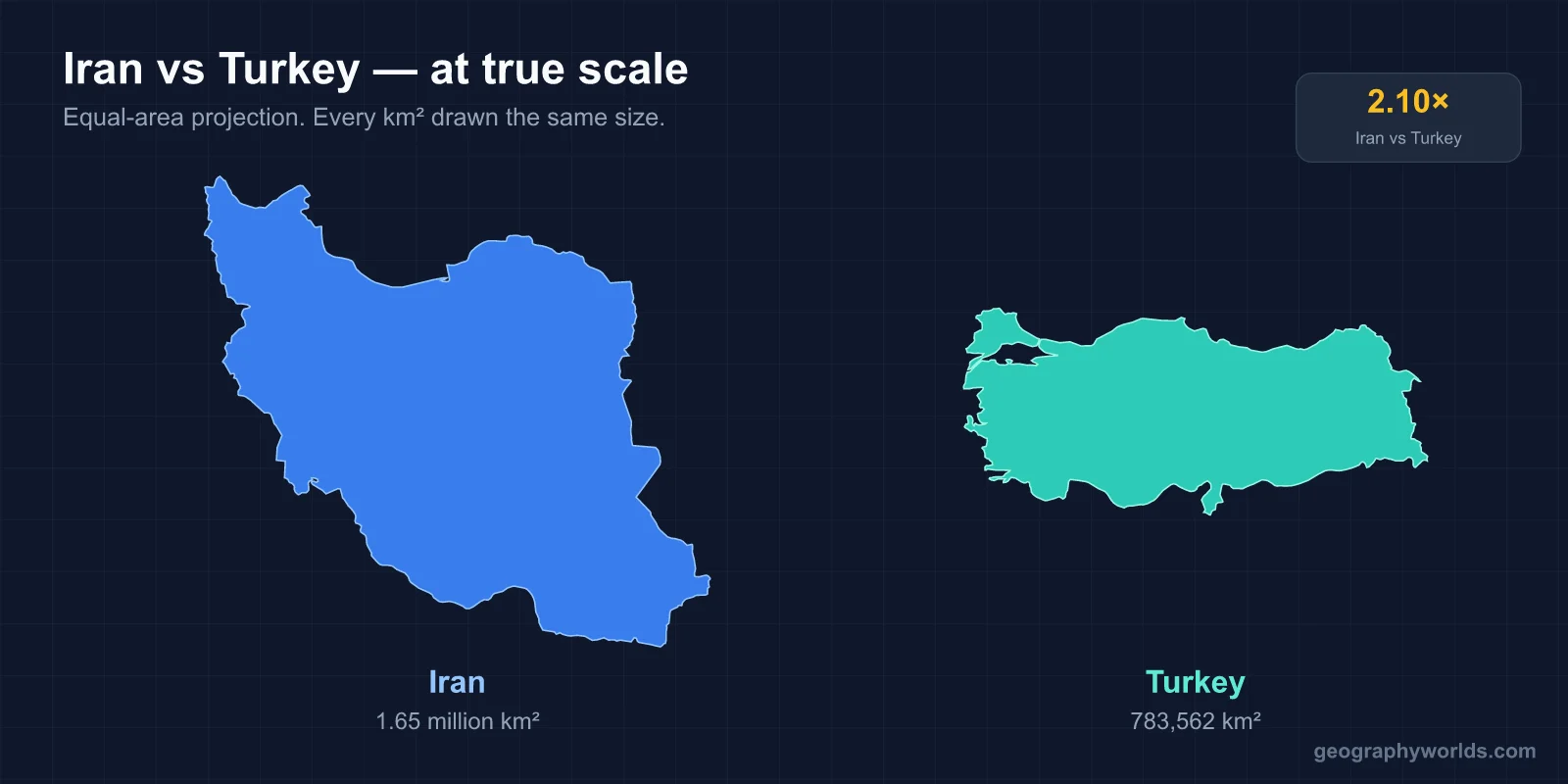
Iran is more than twice the size of Turkey and has slightly more people, but Turkey is much richer per person. Iran covers 1,648,195 km² against Turkey’s 783,562 km², and had roughly 92 million inhabitants in 2025 against Turkey’s 86.1 million at the end of that year. On IMF estimates for 2026, Turkey’s GDP per capita is about US$19,000 and Iran’s about US$3,400, a gap widened by sanctions and a rial that hit record lows in 2025. Turkey’s capital is Ankara and its language Turkish; Iran’s capital is Tehran and its language Persian. The two share a 534 km mountain border that has barely moved since 1639, and they differ in almost every other way: landscape, script, religion in public life, system of government and economic model.
Anatolia’s Coasts Against the Walled Iranian Plateau
Both countries are built on high plateaus ringed by mountains, but Turkey’s plateau opens to the sea and Iran’s mostly does not. About 97% of Turkey lies in Asia, on the Anatolian peninsula, with the small remainder in East Thrace across the Bosporus. The Pontic Mountains line the Black Sea coast in the north and the Taurus Mountains the Mediterranean coast in the south, while the Aegean coast in the west is broken into bays and peninsulas. Three seas give Turkey long, well-watered coastal plains and much of its modern economy.
Iran’s plateau is enclosed. The Zagros Mountains run down the west and south, and the Alborz arc along the southern shore of the Caspian Sea. Between and beyond them lie desert basins: the Dasht-e Kavir, Iran’s largest desert, and the Dasht-e Lut, where NASA’s Aqua satellite recorded a land-surface temperature of 70.7 °C in 2005, the highest it measured anywhere between 2003 and 2010. Only two strips are lush: the Hyrcanian forests and plains of the Caspian coast in the north, and the lowlands at the head of the Persian Gulf in the southwest.

Iran also has the higher summit. Mount Damavand, a dormant volcano in the Alborz north-east of Tehran, rises to about 5,610 m (18,406 ft), the highest volcano in Asia. Turkey’s high point, Mount Ararat, stands at 5,137 m (16,854 ft) in the far east, close to the Iranian border. Each country’s largest lake is a salt lake close to their shared border: Lake Van in eastern Turkey, a saline soda lake with no outlet, and Lake Urmia in north-western Iran, once about 6,000 km² and the sixth-largest saltwater lake on Earth, which by late 2017 had shrunk to about a tenth of its former size through drought and damming. In water resources Turkey is the stronger: the Tigris, Euphrates and Aras all rise in eastern Anatolia.
Turkish Speakers and Kurds Against Persians and Azerbaijanis
The populations are of similar size but differently composed. Most of Turkey’s 86 million are ethnic Turks, with Kurds as the largest minority, concentrated in the south-east. Iran has never counted ethnicity in its census, and the balance between its largest groups is disputed; a 2003 estimate put Persians at about 51% of the population, Azerbaijanis at 24%, Gilaks and Mazanderanis at 8%, Kurds at 7%, and Arabs, Lurs, Baluch and Turkmen at 2–3% each.
That creates a linguistic overlap across the border. Azerbaijani, spoken by Iran’s largest minority in cities such as Tabriz, is a Turkic language closely related to Turkish, while Kurdish communities live on both sides of the frontier; the border zone itself is populated mostly by Kurds. Both countries have urbanised quickly: Iran’s urban share rose from 27% in 1950 to 60% by 2002, while Turkey’s population more than quadrupled between 1950 and 2020, from 20.9 million to 83.6 million, and Istanbul alone grew tenfold.
The capitals reflect two different histories of state-building. Turkey’s largest city, Istanbul, with over 15 million people and about 18% of the national population, is not its capital: Ankara, a provincial town in central Anatolia, replaced the old Ottoman seat when the republic was founded in 1923, and today its urban centre holds a little over 5 million. In Iran, Tehran is both capital and largest city, with around 9 million people in the city and about 16.8 million in the wider metropolitan area, the largest in the Middle East. It was chosen as capital in 1786 by Agha Mohammad Khan of the Qajar dynasty, partly for its closeness to the Caucasus territories then contested with Russia, and it was the 51st place to serve as Iran’s capital. Where Turkey split its political and economic centres, Iran concentrated both in one city at the foot of the Alborz.
Atatürk’s 1923 Republic Against Khomeini’s 1979 Revolution
For a time the two countries were modernising along the same line. The Republic of Turkey was proclaimed in Ankara on 29 October 1923, three months after the Treaty of Lausanne recognised it as the Ottoman Empire’s successor, and Mustafa Kemal Atatürk set out to make it a secular nation state. In Iran, Reza Shah ousted the last Qajar ruler in 1925 and founded the Pahlavi dynasty. Between 16 June and 2 July 1934 he visited Turkey at Atatürk’s invitation and was impressed by its reforms; the following year he asked foreign governments to stop calling his country Persia and use Iran instead.
The paths split in 1979. After months of mass protest, a referendum on 31 March 1979 made Iran an Islamic Republic, and Ayatollah Ruhollah Khomeini became Supreme Leader that December. Iran’s constitution makes Twelver Shia Islam the state religion, followed by about 90–95% of Iranians, and clerical bodies oversee elected institutions. Turkey, by contrast, is constitutionally secular with no state religion, although most of its people are Muslim, predominantly Sunni, with a large Alevi minority.
Their alliances diverged too. Turkey joined NATO in 1952 after fighting in the Korean War, entered the EU Customs Union in 1995 and opened EU accession talks in 2005, now frozen. Iran was a close US ally under the last Shah but has been under American sanctions for much of the period since 1979; the United States withdrew from the 2015 nuclear agreement in 2018 and reimposed them.
Latin Letters in Istanbul, Perso-Arabic Script in Isfahan
Culture shows the same pattern of shared roots and deliberate breaks. For centuries Ottoman Turkish was written in a version of the Arabic alphabet, as Persian still is. On 1 November 1928, Turkey’s parliament passed Law No. 1353 adopting a Latin-based Turkish alphabet as part of Atatürk’s reforms. Iran kept the Perso-Arabic script, so the classical poetry of Ferdowsi and Hafez is printed today in the same letters its authors used.

Both countries hold deep archaeological and architectural records. Iran lists 30 UNESCO World Heritage Sites, the tenth-highest total in the world, from Persepolis to the mosques of Isfahan. Turkey has more than 20, among them Istanbul’s historic peninsula, Ephesus and the Hittite capital Hattusa. Both are major tourist destinations, but on very different scales: Turkey ranks as the fourth most visited country in the world, and Euromonitor placed both Istanbul and Antalya among the world’s ten most visited cities in 2024.
Car Plants and Beach Resorts Against Gas Fields and Sanctions
The gap in income is the sharpest contrast of all. Turkey’s economy is estimated at about US$1.64 trillion for 2026, more than five times Iran’s US$300 billion, even though Iran has more people. Turkey’s growth has come from manufacturing, especially after the 1995 customs union with the EU, together with construction, services and tourism. Iran holds the world’s second-largest natural gas reserves and is the third-largest gas producer, with large oil reserves besides, but sanctions have restricted its exports and investment, and the rial fell to a record low against the dollar in December 2025.
Adjusted for local prices, the gap narrows but remains: about US$46,700 per person in Turkey against US$20,300 in Iran. On the Human Development Index the two are closer, at 0.853 for Turkey and 0.799 for Iran in 2023. Trade links the two economies across the border. The 2,577 km Tabriz–Ankara pipeline, commissioned in July 2001, carries Iranian gas west, and Turkey does not require visas of Iranian citizens, which makes it one of the most accessible foreign destinations for Iranians.
One Frontier Fixed at Qasr-e Shirin in 1639
For all their differences, the two states have kept one of the oldest stable borders in the region. The Ottoman and Safavid empires fought repeatedly after the Ottoman victory at Chaldiran in 1514, a rivalry sharpened by the Safavids’ adoption of Twelver Shia Islam as their state religion in a largely Sunni region. The Treaty of Zuhab, signed at Qasr-e Shirin on 17 May 1639, ended the war of 1623–1639 and set the rough outline of the frontier, broadly along the Zagros Mountains; exact demarcation began only in the 19th century, but the division has held in broad outline ever since.
Today the 534 km border runs from the tripoint with Azerbaijan’s Nakhchivan exclave on the Aras river to the tripoint with Iraq, through high, largely Kurdish-populated mountains. Near its northern end a short stretch of the Karasu Çayı gives Turkey its narrow link to Nakhchivan. To read more about the land on the eastern side, see our guide to Iran’s geography, or compare the two capitals in our profiles of Ankara and Tehran, Iran’s capital beneath the Alborz.