
Introduction
Spain 🇪🇸 and Portugal 🇵🇹 share the Iberian Peninsula, the broad block of land that hangs off the southwestern corner of Europe. They have been neighbors for centuries, and although Spain wraps around its smaller western neighbor on three sides, the two countries have built distinct identities, languages, and ways of life.
This side-by-side comparison lays out the essential geography of both nations, so whether you are studying for class, planning a trip across the peninsula, or simply curious, you will find the key facts in one place.
Size & Geography
| Feature | Spain 🇪🇸 | Portugal 🇵🇹 |
|---|---|---|
| Area | 505,992 km² | 92,212 km² |
| Continent | Europe | Europe |
| Region | Southern Europe | Southern Europe |
| Land Borders | France, Portugal, Andorra, Morocco (Ceuta), Gibraltar | Spain |
| Landscape | large central plateau (Meseta), mountains, coastal plains | mountainous north, rolling plains in south |
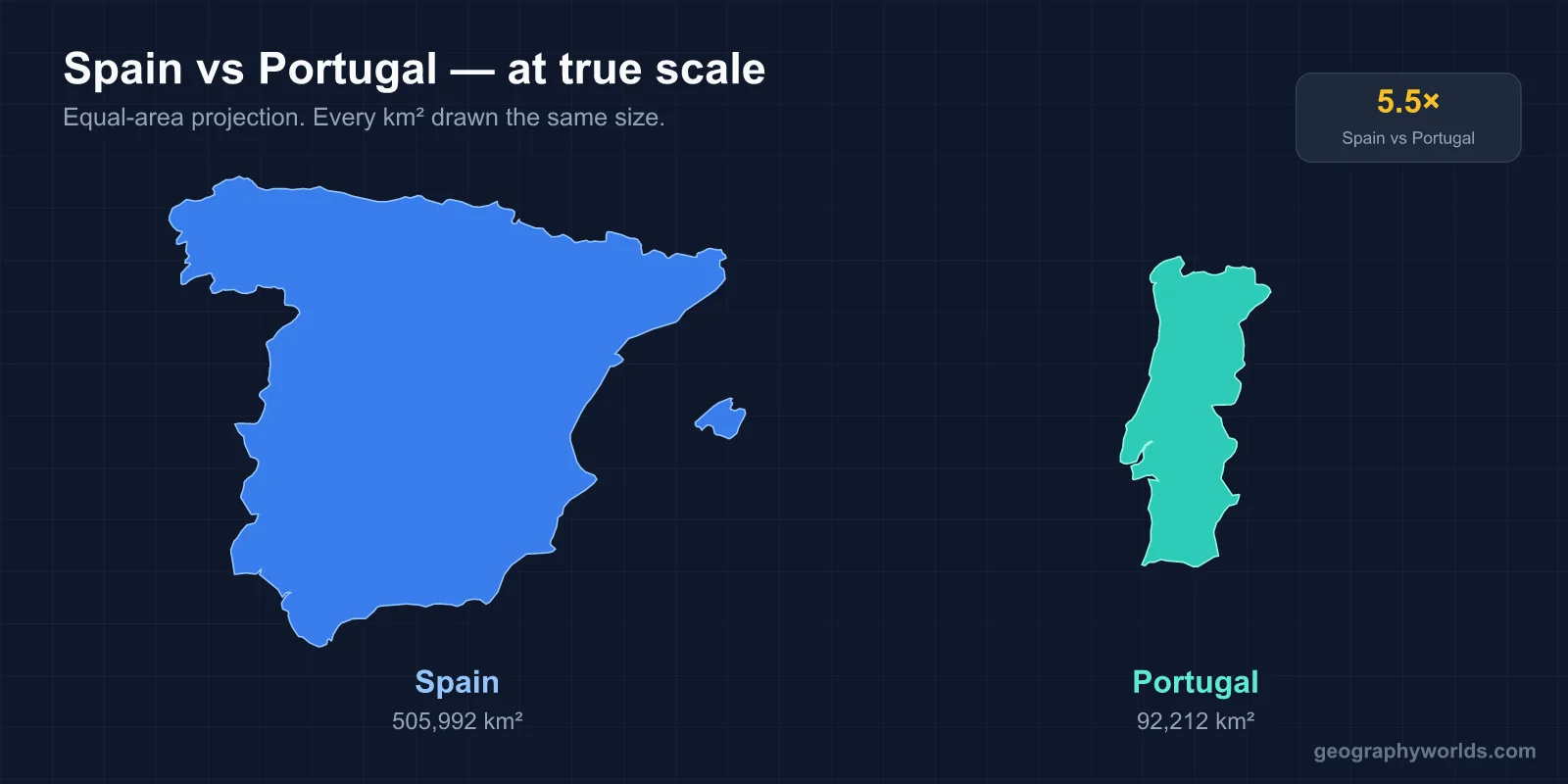
The contrast in size is the first thing that stands out. At 505,992 km², Spain is roughly 5.5 times the area of Portugal's 92,212 km², which is why Spain occupies the bulk of the peninsula while Portugal runs as a long coastal strip down the Atlantic edge. Spain's interior is dominated by the Meseta, a high central plateau rimmed by mountains and edged with coastal plains, whereas Portugal divides between a mountainous, greener north and the gentler rolling plains of its south. One quirk worth noting: Portugal borders only a single country, Spain, while Spain shares frontiers with France, Andorra, and even Morocco and Gibraltar at its southern tip.
Population & Demographics
| Metric | Spain 🇪🇸 | Portugal 🇵🇹 |
|---|---|---|
| Population | 47.9 million | 10.4 million |
| Population Density | 94.6 per km² | 112.7 per km² |
Spain's 47.9 million people outnumber Portugal's 10.4 million by about 4.6 to one. Yet the density figures flip the story: because Portugal packs its population into a much smaller footprint, it is actually the more crowded of the two, at 112.7 people per km² against Spain's 94.6 — a gap of roughly 18.2 people per km². In other words, Spain has far more people overall, but Portugal feels more tightly settled on the ground.
Capital Cities
Madrid is the capital of Spain, sitting almost exactly at the country's geographic center on the Meseta, while Lisbon is Portugal's capital, perched on the Atlantic where the Tagus River meets the sea. Both are Southern European capitals, but one is a landlocked interior city and the other a port — a fitting summary of how each country relates to its terrain.
Language, Currency & Culture
| Aspect | Spain 🇪🇸 | Portugal 🇵🇹 |
|---|---|---|
| Languages | Spanish/Castilian (official), Catalan, Galician, Basque | Portuguese (official) |
| Currency | Euro (EUR) | Euro (EUR) |
Both countries are part of the eurozone, so the Euro (EUR) is spent on either side of the border. Language is where they diverge most clearly. Spain is officially multilingual, recognizing Spanish (Castilian) alongside regional languages such as Catalan, Galician, and Basque, while Portugal is essentially monolingual, with Portuguese as its sole official language. Spanish and Portuguese both descend from Latin and look similar in writing, but they sound markedly different when spoken.
Climate & Natural Features
| Aspect | Spain 🇪🇸 | Portugal 🇵🇹 |
|---|---|---|
| Climate | Mediterranean and oceanic; hot summers in interior | Mediterranean; mild winters, warm dry summers |
| Key Features | Pyrenees, Sierra Nevada, Canary Islands, Balearic Islands | Algarve coast, Douro Valley, Azores, Madeira Islands |
| Economy | tourism, agriculture, automotive, renewable energy | tourism, textiles, cork, wine, technology |
Spain's larger landmass gives it a wider climatic range, from Mediterranean and oceanic conditions to genuinely hot summers in the interior, while Portugal's Atlantic-facing position keeps its Mediterranean climate milder, with gentle winters and warm, dry summers. Their signature landscapes reflect this: Spain claims the Pyrenees, the Sierra Nevada, and two island groups, the Canary and Balearic Islands, while Portugal is known for the sun-soaked Algarve coast, the terraced Douro Valley, and its Atlantic archipelagos of the Azores and Madeira. Tourism anchors both economies, but Portugal leans additionally on cork, wine, and textiles, and Spain on agriculture, automotive manufacturing, and renewable energy.
What Makes Each Country Unique
Spain is internationally renowned for flamenco dancing, La Sagrada Família, tapas culture, and passionate football (soccer). Spain has the second-highest number of UNESCO World Heritage Sites in the world and is Europe's most popular tourist destination after France.
Portugal is best known for Age of Exploration, port wine, pastéis de nata (custard tarts), and Fado music. Portugal established the first global maritime empire and Portuguese is now spoken by over 250 million people worldwide.
Key Differences at a Glance
- Area: Spain (505,992 km²) vs Portugal (92,212 km²) — Spain is 5.5x larger
- Population: Spain (47.9 million) vs Portugal (10.4 million) — Spain is 4.6x more populous
- Capitals: Madrid vs Lisbon
- Currency: Euro (EUR) vs Euro (EUR)
- Continents: Europe vs Europe
- Density: Portugal is more densely populated (difference of ~18.2 people per km²)
- Languages: Spanish/Castilian (official) vs Portuguese (official)
Verdict
Spain and Portugal show how two neighbors sharing a single peninsula can still feel like separate worlds. Spain dominates on scale, with 5.5 times the land and 4.6 times the population, yet Portugal turns the tables on density, fitting more people into each square kilometer. It is a neat reminder that bigger does not automatically mean more crowded.
Spain spreads across a sun-baked interior framed by the Pyrenees and reaches out to the Canary and Balearic Islands, while Portugal stays close to the Atlantic, defined by the Algarve coast and its far-flung island regions. Both trade heavily on tourism, but Portugal adds cork and wine to the mix while Spain layers in automotive and renewable-energy industries.
Taken together, the two countries make the Iberian Peninsula one of Europe's most rewarding regions to study. Comparing them side by side sharpens your sense of how land, people, and climate combine into a national character.
Test Your Knowledge!
Think you know your countries? Try our interactive geography quiz!
Play Geography Games →