
Introduction
Poland 🇵🇱 and Ukraine 🇺🇦 share one of Eastern Europe's busier borders, yet the two countries can feel like mirror images that never quite line up. One is a compact EU member built on industry; the other is a sprawling agricultural giant nearly twice its neighbor's size. This comparison walks through how they differ in land area, population, capitals, climate, and economy.
If you are studying European geography, mapping a trip, or just trying to keep two neighboring countries straight in your head, the side-by-side figures below lay out the essentials.
Size & Geography
| Feature | Poland 🇵🇱 | Ukraine 🇺🇦 |
|---|---|---|
| Area | 312,696 km² | 603,500 km² |
| Continent | Europe | Europe |
| Region | Eastern Europe | Eastern Europe |
| Land Borders | Germany, Czech Republic, Slovakia, Ukraine, Belarus, Lithuania, Russia (Kaliningrad) | Belarus, Poland, Slovakia, Hungary, Romania, Moldova, Russia |
| Landscape | mostly flat plains; mountains along southern border | mostly fertile plains (steppes) and plateaus |
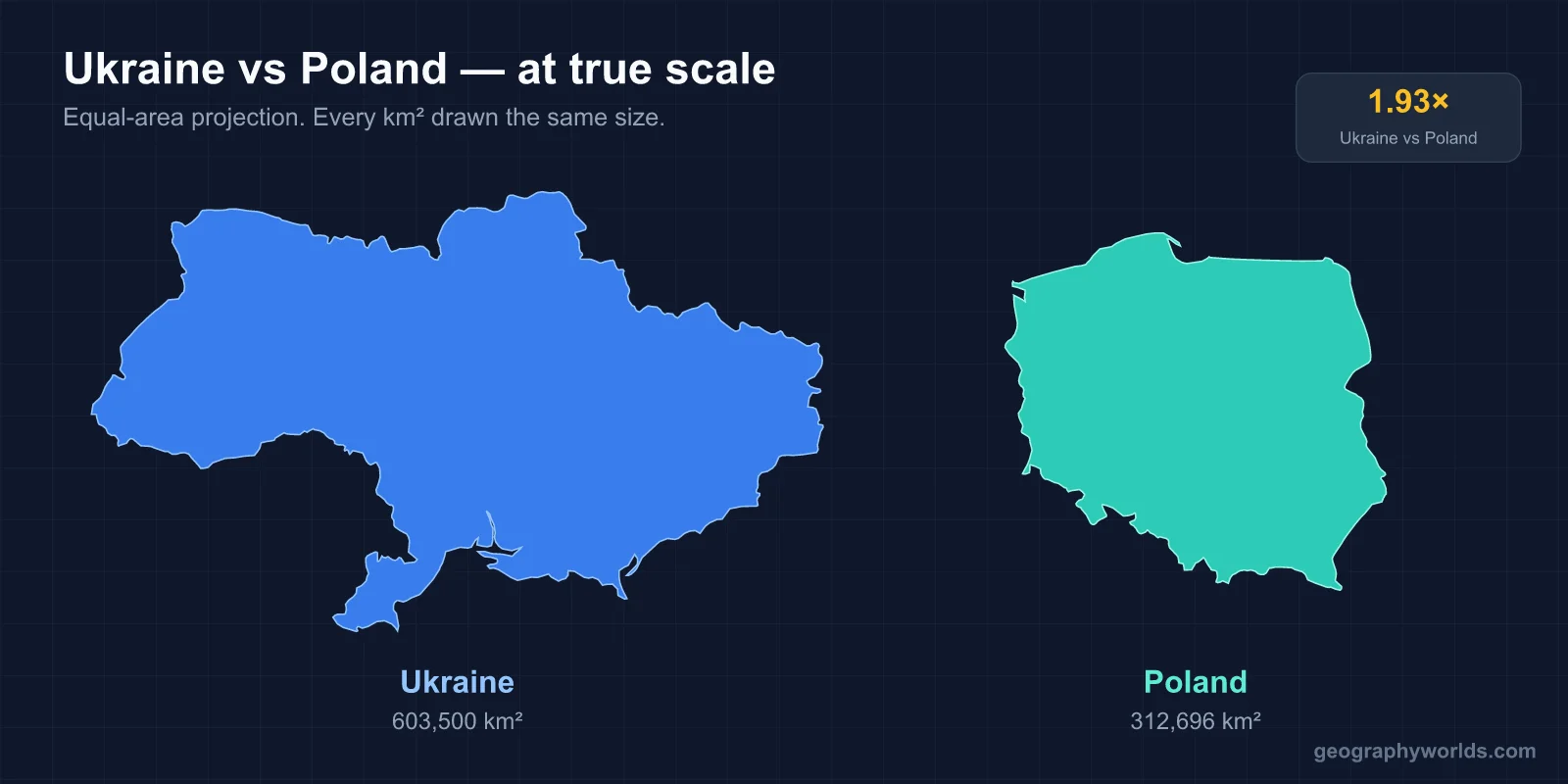
Ukraine is roughly 1.9 times the size of Poland, at 603,500 km² against Poland's 312,696 km² — the difference between a mid-sized European state and the largest country lying wholly within Europe. The two share a long common border, and both are predominantly low-lying: Poland is mostly flat plains, rising to mountains only along its southern border, while Ukraine spreads across fertile plains (steppes) and plateaus that run for hundreds of kilometers with little interruption. Poland's seven land neighbors and Ukraine's seven place both at the crossroads of Central and Eastern Europe.
Population & Demographics
| Metric | Poland 🇵🇱 | Ukraine 🇺🇦 |
|---|---|---|
| Population | 37.8 million | 39.5 million |
| Population Density | 121.0 per km² | 65.5 per km² |
Here is where the size gap stops telling the whole story. Ukraine edges ahead on headcount with 39.5 million people to Poland's 37.8 million — almost a tie despite Ukraine's far larger territory. The result is a sharp split in density: Poland packs 121.0 people per km² while Ukraine spreads thin at 65.5 per km², a gap of about 55.5 people per square kilometer. In practical terms, Poland's population is squeezed into a country half the size, which is exactly why its towns and farmland sit closer together than Ukraine's.
Capital Cities
Warsaw is the capital of Poland, and Kyiv is the capital of Ukraine. Both are large inland cities set on major rivers — Warsaw on the Vistula, Kyiv on the Dnieper — and each serves as the political, economic, and cultural anchor of its country. They sit within a few hundred kilometers of each other in Eastern Europe.
Language, Currency & Culture
| Aspect | Poland 🇵🇱 | Ukraine 🇺🇦 |
|---|---|---|
| Languages | Polish (official) | Ukrainian (official) |
| Currency | Polish Złoty (PLN) | Ukrainian Hryvnia (UAH) |
Polish (official) and Ukrainian (official) are both Slavic languages, but they belong to different branches — Polish to the West Slavic group, Ukrainian to the East Slavic — so they are related without being mutually intelligible. Each country keeps its own currency: the Polish Złoty (PLN) and the Ukrainian Hryvnia (UAH). Poland remains outside the eurozone even as an EU member, so the złoty is still in everyday use.
Climate & Natural Features
| Aspect | Poland 🇵🇱 | Ukraine 🇺🇦 |
|---|---|---|
| Climate | temperate with cold, cloudy winters and warm summers | temperate continental; Mediterranean on southern coast |
| Key Features | Tatra Mountains, Masuria lakes, Baltic coast, Białowieża Forest | Carpathian Mountains, Black Sea coast, Dnieper River, fertile steppes |
| Economy | manufacturing, agriculture, IT services | agriculture (breadbasket of Europe), metallurgy, IT |
Poland's climate is temperate with cold, cloudy winters and warm summers, a fairly even pattern across the country. Ukraine is broadly temperate continental, but its southern coast turns Mediterranean — the only stretch where either country touches a warm sea. That coast is the Black Sea, one of Ukraine's defining features alongside the Carpathian Mountains, the Dnieper River, and the fertile steppes that give the country its agricultural reputation. Poland's landscape leans toward the Tatra Mountains in the south, the Masuria lakes, the Baltic coast in the north, and the ancient Białowieża Forest. The economies follow the terrain: Poland balances manufacturing, agriculture, and IT services, while Ukraine builds on agriculture (breadbasket of Europe), metallurgy, and IT.
What Makes Each Country Unique
Poland is internationally known for Kraków's Old Town, the Auschwitz memorial, pierogi, and a long history of resilience through partition and reconstruction. It is also home to the Wieliczka Salt Mine, an underground world of chapels and sculptures carved entirely from rock salt and worked since the 13th century.
Ukraine earns its nickname as the breadbasket of Europe, with Kyiv's golden-domed churches and the Chernobyl site among its most recognized landmarks. Much of that agricultural fame rests on its soil: Ukraine holds some of the most fertile black earth (chernozem) on the planet, covering roughly a third of the world's supply.
Key Differences at a Glance
- Area: Poland (312,696 km²) vs Ukraine (603,500 km²) — Ukraine is 1.9x larger
- Population: Poland (37.8 million) vs Ukraine (39.5 million) — Ukraine is 1.0x more populous
- Capitals: Warsaw vs Kyiv
- Currency: Polish Złoty (PLN) vs Ukrainian Hryvnia (UAH)
- Continents: Europe vs Europe
- Density: Poland is more densely populated (difference of ~55.5 people per km²)
- Languages: Polish (official) vs Ukrainian (official)
Verdict
The headline contrast between these two neighbors is land versus people. Ukraine wins on territory at 1.9x Poland's area, but the two are nearly level on population, so Poland ends up far more densely settled. Bigger on the map does not translate into bigger crowds.
Poland's identity is shaped by its cold-winter, warm-summer temperate climate and signatures like the Tatra Mountains and the EU industrial economy built on manufacturing. Ukraine's runs along a temperate continental climate that softens to Mediterranean on the southern coast, with the Carpathian Mountains, Black Sea, and an agricultural sector that feeds much of the continent. One leans toward factories and forests, the other toward fields and steppe.
Compared side by side, Poland and Ukraine show how two countries can share a border, a Slavic heritage, and a stretch of flat plain yet end up with very different shapes, densities, and economic centers of gravity.
Test Your Knowledge!
Think you know your countries? Try our interactive geography quiz!
Play Geography Games →