
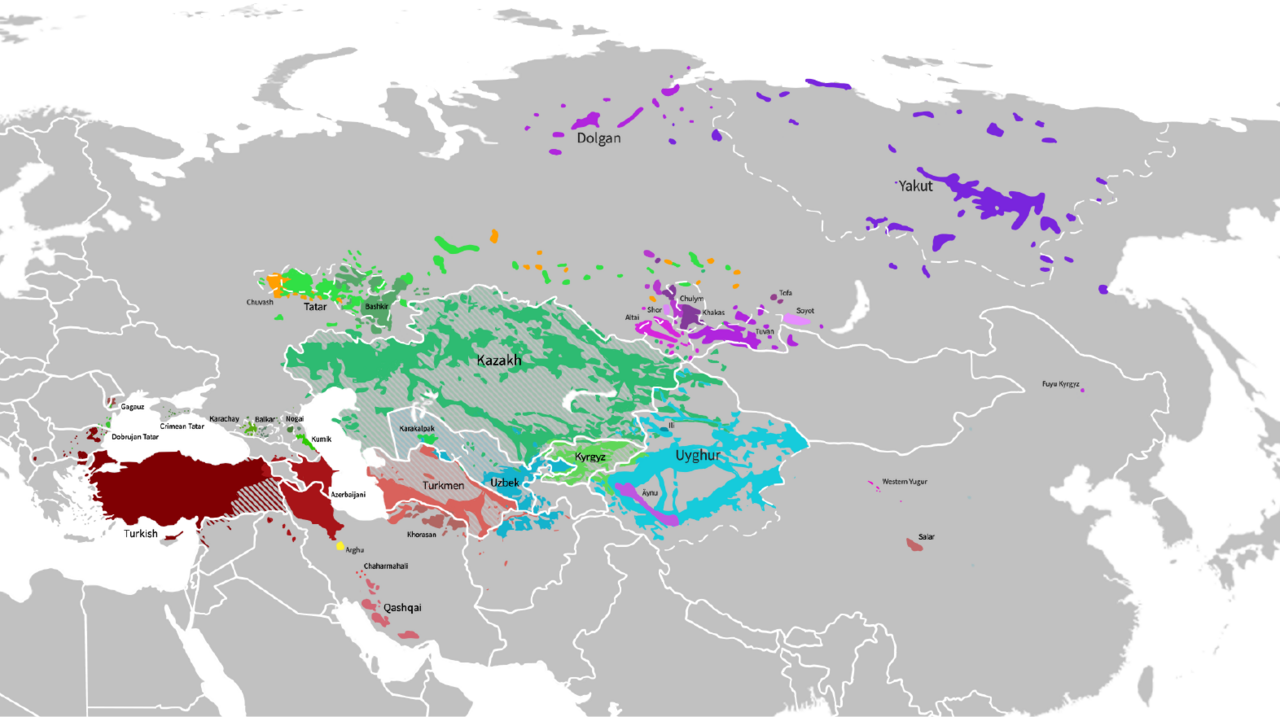
The Turkic language family is one of the world's major language groups, comprising over 35 languages spoken by approximately 200 million people across a vast geographic arc from southeastern Europe to northeastern Siberia. The family includes Turkish (the largest member), Azerbaijani, Uzbek, Kazakh, Kyrgyz, Turkmen, Uyghur, and dozens of smaller languages, all descended from a common ancestor spoken by nomadic peoples of the Central Asian steppes.
Introduction
What unites this enormous family is a remarkable structural consistency. Despite being separated by thousands of kilometers and centuries of divergent history, Turkic languages share vowel harmony, agglutinative grammar, subject-object-verb word order, and large amounts of core vocabulary. A Turkish speaker from Istanbul and a Kazakh speaker from Almaty will find familiar patterns in each other's speech, even if full mutual intelligibility requires effort.

Major Turkic Languages
- Turkish: ~80 million speakers — Turkey, largest Turkic language
- Azerbaijani: ~25 million — Azerbaijan, northwestern Iran
- Uzbek: ~34 million — Uzbekistan, the most spoken Central Asian Turkic language
- Kazakh: ~13 million — Kazakhstan, world's largest landlocked country
- Uyghur: ~12 million — Xinjiang, China
Turkish dominates the western end of the Turkic world with approximately 80 million native speakers. Azerbaijani, closely related to Turkish (often mutually intelligible with effort), adds another 25 million speakers in Azerbaijan and the much larger Azerbaijani-speaking population of northwestern Iran (estimated at 15-20 million). Together, Turkish and Azerbaijani form the Oghuz branch of the Turkic family.
In Central Asia, Uzbek is the most widely spoken Turkic language with approximately 34 million speakers, followed by Kazakh (13 million), Kyrgyz (5 million), and Turkmen (7 million). These languages form the Karluk and Kipchak branches of the family. Uyghur, spoken by approximately 12 million people in China's Xinjiang region, has become the center of an international human rights controversy as the Chinese government's policies have restricted Uyghur language education and cultural expression.
Geographic Spread and History
- Origin: Central Asian steppes, ~2000 years ago or earlier
- Expansion: Nomadic migrations spread Turkic languages west and south
- Ottoman Empire: Carried Turkish to southeastern Europe and the Middle East
- Siberian Languages: Yakut, Tuvan, Khakas — northernmost Turkic languages
The Turkic languages originated in the Central Asian and Siberian steppes, with the earliest known Turkic inscriptions found in Mongolia — the Orkhon inscriptions dating to the 8th century AD. From this Central Asian core, Turkic-speaking nomadic peoples expanded in virtually every direction: westward into Anatolia and the Balkans (eventually becoming the Turks of modern Turkey), southward into Persia and northern India, and northward deep into Siberia.
The furthest-flung Turkic languages reveal the family's extraordinary range. Yakut (Sakha), spoken by approximately 450,000 people in the Sakha Republic of Russia, is one of the northernmost languages in the world, spoken in temperatures that drop to -50°C. Chuvash, spoken by about 1 million people along the Volga River, is the most divergent Turkic language, having separated from the rest of the family over 2,000 years ago. These distant outliers bracket a family spanning over 8,000 kilometers east to west.
Shared Linguistic Features
- Vowel Harmony: Front/back vowels must match within words (like Finnish)
- Agglutinative: Complex words built through suffix chains
- No Grammatical Gender: No he/she distinction in pronouns
- SOV Word Order: Subject-Object-Verb is the standard pattern
Vowel harmony is the hallmark of Turkic languages. Every suffix must harmonize with the vowels in the root word — if the root contains back vowels, suffixes must use back vowels too. This creates a musicality that makes Turkic languages pleasant to hear and gives them a systematic regularity. The same principle operates in Turkish "evlerden" (from houses) where all vowels are front, versus "odalardan" (from rooms) where all are back.
The agglutinative structure of Turkic languages allows remarkable information density. A single Uzbek or Kazakh word can convey what requires an entire English phrase. Combined with the lack of grammatical gender (no "he" vs. "she") and the absence of articles (no "the" or "a"), Turkic grammar is fundamentally different from European languages but highly regular — there are very few irregular verbs in any Turkic language.
Scripts and Politics
- Arabic Script: Used historically; still used for Uyghur
- Latin Script: Adopted by Turkey (1928), Azerbaijan (1991), Uzbekistan (1993), Turkmenistan (1993)
- Cyrillic Script: Imposed by Soviet Union; still official in Kazakhstan, Kyrgyzstan
- Kazakhstan: Currently transitioning from Cyrillic to Latin script (target: 2031)
The story of Turkic writing systems is deeply political. Before the 20th century, most Turkic languages were written in Arabic-based scripts. Turkey's switch to Latin in 1928 inspired Soviet Central Asian republics to briefly adopt Latin in the 1930s, before Stalin imposed Cyrillic to cut cultural ties between Soviet Turkic peoples and Turkey. After the Soviet Union's collapse, Azerbaijan, Uzbekistan, and Turkmenistan switched back to Latin.
Kazakhstan is currently in the midst of a historic script transition from Cyrillic to Latin, with a target completion date of 2031. The change is driven by a desire to modernize, improve digital compatibility, and strengthen ties with other Latin-script Turkic nations, particularly Turkey. Kyrgyzstan has discussed a similar transition. The script politics reflect a broader geopolitical contest between Russian, Turkish, and Chinese influence across the Turkic world.
Key Facts
- The Turkic family includes 35+ languages spoken by ~200 million people from Turkey to Siberia
- Turkish (~80 million speakers) and Uzbek (~34 million) are the two largest Turkic languages
- Vowel harmony — front/back vowel matching in suffixes — is the signature Turkic linguistic feature
- The earliest Turkic inscriptions are the 8th-century Orkhon stones in Mongolia
- Kazakhstan is currently transitioning from Cyrillic to Latin script, with a 2031 target date
Fun Facts
- Yakut (Sakha) is spoken at temperatures as low as -50°C, making it one of the coldest-climate languages
- Turkish and Azerbaijani speakers can often understand each other, despite being in different countries
- Chuvash, spoken along the Volga, is so different from other Turkic languages that its classification was debated for centuries
- The Turkic language family covers 8,000+ km from Istanbul to Yakutsk — wider than the Atlantic Ocean
Final Thoughts
The Turkic language family is a monument to the mobility of steppe peoples and the durability of shared linguistic structures. From Istanbul's minarets to Siberian permafrost, Turkic speakers carry forward a common linguistic heritage of vowel harmony, agglutinative grammar, and a worldview shaped by millennia of nomadic life across the vast Eurasian steppe. As former Soviet republics reassert their Turkic identities through script changes and cultural revival, the family is entering a new chapter of reconnection and renewal.
Test Your Knowledge!
Think you know your world languages? Try our interactive quiz!
Play Geography Games →