
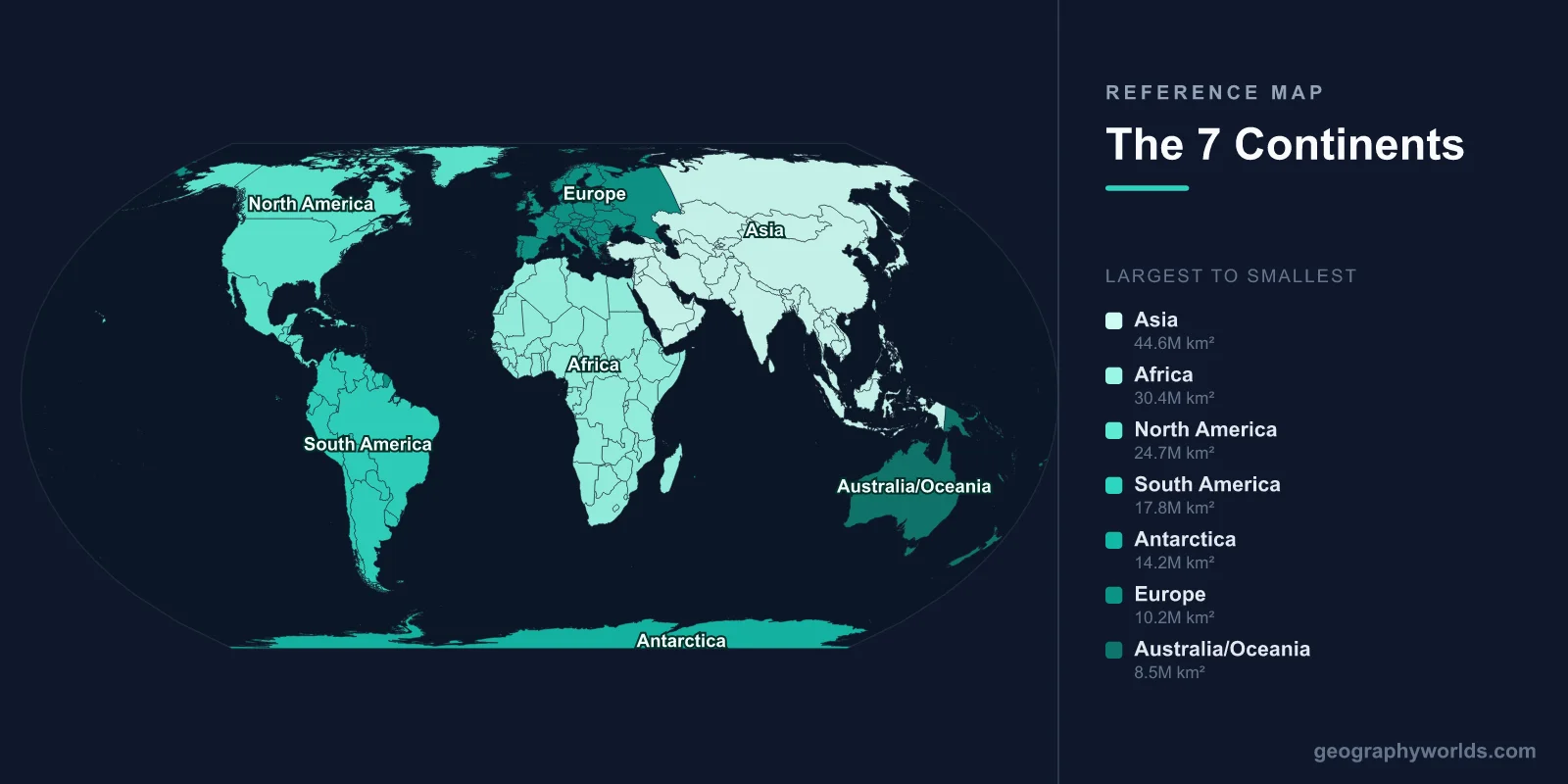
The seven continents of the world are Africa, Antarctica, Asia, Australia (Oceania), Europe, North America, and South America. Together, they make up all 148.94 million km² of Earth's land area. Asia is the largest by both area and population, while Australia is the smallest continent and Antarctica is the least populated with zero permanent residents.
The 7 Continents at a Glance
| Continent | Area (km²) | Population | Countries | Largest Country |
|---|---|---|---|---|
| Asia | 44,580,000 | 4.7 billion | 49 | Russia (Asian part) / China |
| Africa | 30,370,000 | 1.5 billion | 54 | Algeria |
| North America | 24,710,000 | 580 million | 23 | Canada |
| South America | 17,840,000 | 430 million | 12 | Brazil |
| Antarctica | 14,200,000 | ~1,000-5,000 (seasonal) | 0 | N/A (governed by treaty) |
| Europe | 10,180,000 | 750 million | 44 | Ukraine (entirely in Europe) |
| Australia/Oceania | 8,530,000 | 45 million | 14 | Australia |

1. Asia — The Largest Continent
Asia covers 44.58 million km², making it the largest continent by a wide margin — it accounts for nearly 30% of Earth's total land area. Home to 4.7 billion people (about 60% of the global population), Asia contains the world's two most populous countries: China and India. The continent stretches from the Ural Mountains in the west to the Pacific Ocean in the east, and from the Arctic Ocean in the north to the Indian Ocean in the south.
Key features include Mount Everest (8,849 m, the world's highest point), the Dead Sea (the lowest point on land at -430 m), Lake Baikal (the deepest lake), and vast deserts like the Gobi and Arabian. Asia is home to some of the world's oldest civilizations, including those of Mesopotamia, the Indus Valley, and China.
2. Africa — The Second Largest
Africa spans 30.37 million km² and is the second-largest and second-most-populous continent, with about 1.5 billion people across 54 countries. It is the only continent that extends across all four hemispheres (north, south, east, and west of the equator and prime meridian). The Sahara Desert, the world's largest hot desert, covers much of North Africa, while the Congo Rainforest is the second-largest tropical rainforest.
Africa contains the Nile River (the longest river at ~6,650 km), Mount Kilimanjaro (5,895 m, the tallest free-standing mountain), and the Great Rift Valley. The continent has the youngest population of any continent, with a median age of about 19 years.
3. North America — Third Largest
North America covers 24.71 million km² and includes 23 countries, from Canada in the north to Panama in the south, plus the Caribbean islands. The continent is home to about 580 million people. It features enormous geographic diversity: the Rocky Mountains, the Great Plains, the Mississippi River system, the Great Lakes (the largest group of freshwater lakes by area), and the Arctic tundra of northern Canada.
North America contains the world's third-largest country (Canada) and the world's largest economy (United States). Greenland, the world's largest island, is geographically part of North America though politically linked to Denmark.
4. South America — Fourth Largest
South America has an area of 17.84 million km² and a population of about 430 million across 12 countries. Brazil alone accounts for nearly half the continent's area and population. The continent is dominated by the Amazon River (the largest river by volume) and the Amazon Rainforest (the largest tropical rainforest, covering 5.5 million km²).
The Andes Mountains, the world's longest continental mountain range at 7,000 km, run along the entire western coast. South America also contains Angel Falls (the world's tallest waterfall at 979 m) and the Atacama Desert (the driest place on Earth).
5. Antarctica — The Frozen Continent
Antarctica covers 14.2 million km², making it the fifth-largest continent. It has no permanent population — only seasonal researchers staffing about 70 scientific stations. The continent contains 26.5 million km³ of ice, representing about 61% of all fresh water on Earth. If Antarctica's ice sheet melted entirely, global sea levels would rise by approximately 58 meters.
Antarctica is governed by the Antarctic Treaty System (signed 1959), which designates the continent as a scientific preserve and bans military activity. The lowest temperature ever recorded on Earth was measured here: -89.2°C (-128.6°F) at Vostok Station in 1983.
6. Europe — Second Smallest
Europe covers 10.18 million km² and is home to about 750 million people across 44 countries. Despite being the second-smallest continent, Europe has had an outsized influence on world history through colonialism, the Industrial Revolution, and the development of modern democracy. It contains more countries per square kilometer than any other continent.
Major geographic features include the Alps, the Danube River, the Scandinavian fjords, and the Mediterranean coastline. The European Union (27 members) represents one of the world's largest economic blocs.
7. Australia/Oceania — The Smallest
Australia/Oceania is the smallest continental region at 8.53 million km², with a population of about 45 million across 14 countries. Australia itself accounts for 90% of the region's land area. Oceania also includes New Zealand, Papua New Guinea, Fiji, and thousands of Pacific islands spread across Melanesia, Micronesia, and Polynesia.
Australia is the world's flattest continent, with an average elevation of just 330 m. Its Great Barrier Reef is the largest living structure on Earth, stretching 2,300 km along the northeast coast.
Why Do Some People Count Fewer Continents?
The seven-continent model is standard in English-speaking countries, but other models exist. In many Spanish-speaking and some European countries, North and South America are combined into one continent ("America"), yielding six continents. Some models combine Europe and Asia into "Eurasia" (six continents), and a few combine both of those (five continents). The Olympic rings represent five continents (excluding Antarctica), which is why there are five rings.
Key Facts
- Asia is the largest continent (44.58M km²) and contains 60% of the world's population.
- Africa has 54 countries — more than any other continent.
- Antarctica has no permanent residents and is governed by international treaty.
- Australia is the only country that is also a continent.
- Europe is smaller than the United States but contains 44 countries.
- The seven-continent model is not universal — some cultures count as few as four or five.
Fun Facts
- All seven continents have at least one volcano (yes, even Australia — in the Heard and McDonald Islands territory).
- About 250 million years ago, all continents were joined in a single supercontinent called Pangaea.
- Antarctica is technically the world's largest desert — it receives less than 200 mm of precipitation per year.
- If you stacked all seven continents by population density, Asia would tower over the rest with over 100 people per km².
Test Your Knowledge!
Think you know your geography? Try our interactive quiz!
Play Geography Games →