
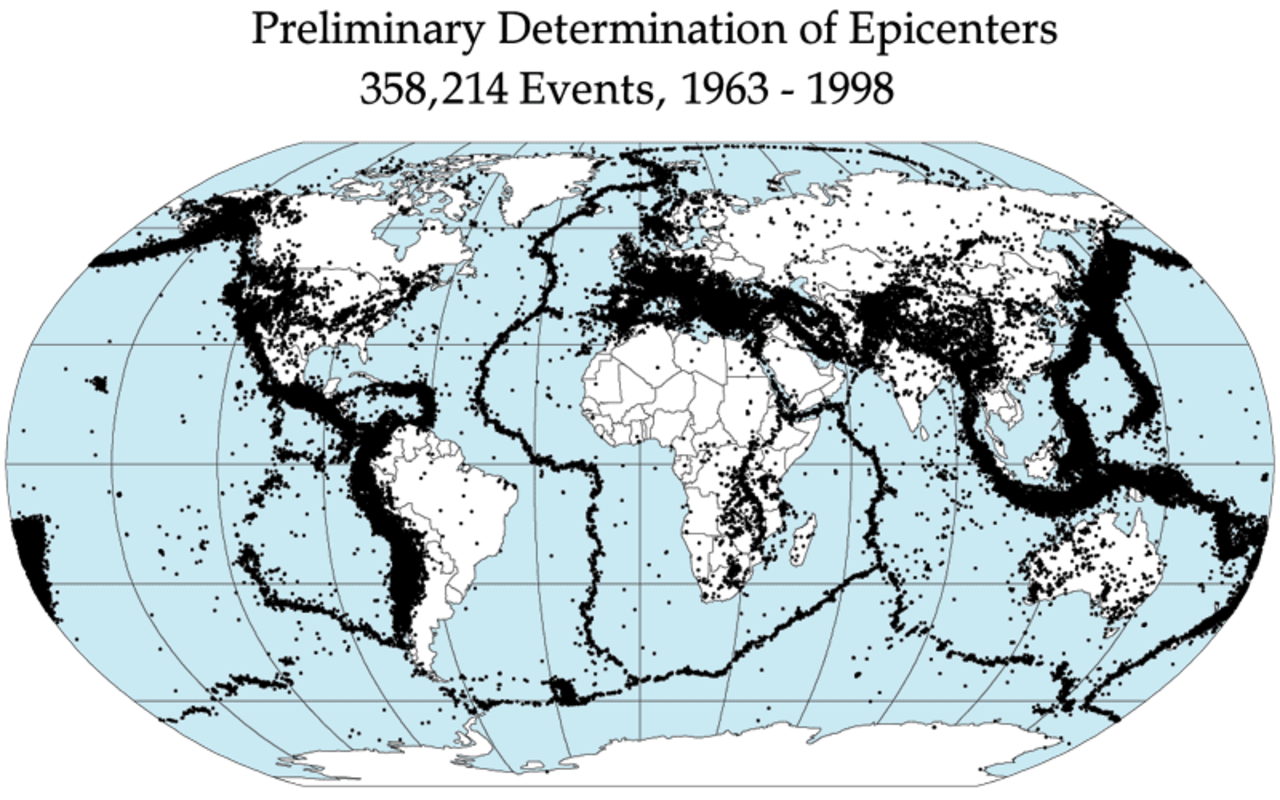
Every year, about 500,000 earthquakes are detected globally — though most are too small for humans to feel. Roughly 100,000 can be felt, and about 100 cause damage. Devastating major earthquakes happen multiple times per year. But what actually causes these dramatic releases of energy? The answer lies in Earth's complex internal structure and the slow but powerful motion of tectonic plates.
The Short Answer
Earthquakes happen when rocks deep in Earth's crust suddenly break or slip past each other, releasing energy as seismic waves. Most earthquakes occur along faults — fractures in the rock where blocks of crust move relative to each other. The primary driver is plate tectonics: the slow movement of large pieces of Earth's crust that creates stress, which eventually exceeds the rock's strength and triggers sudden slip.
Plate Tectonics: The Big Picture
Earth's outer layer is divided into about a dozen major tectonic plates, plus many smaller ones. These plates float on the partially-molten asthenosphere below, moving very slowly — typically 2–10 cm per year, about the speed of fingernail growth. Different parts of these plates push against each other, pull apart, or slide past each other.
Most earthquakes happen at plate boundaries:
- Convergent boundaries — where plates collide. Can produce the world's most powerful earthquakes (subduction zones in particular).
- Divergent boundaries — where plates pull apart. Generally produces smaller, shallower earthquakes.
- Transform boundaries — where plates slide past each other horizontally. The San Andreas Fault is the classic example.
The Elastic Rebound Theory
The most widely accepted explanation for earthquakes is the "elastic rebound theory," proposed by Harry Fielding Reid in 1910 based on observations from the 1906 San Francisco earthquake. The theory says:
- Rocks on either side of a fault are slowly being pushed in different directions by tectonic forces.
- The rocks gradually bend and store elastic energy, like a spring being stretched.
- Eventually, the stress exceeds the rock's strength, and the rocks suddenly break along the fault.
- The stored elastic energy is released as seismic waves that radiate outward — the earthquake.
- The rocks return to a roughly unstressed state but in a new position.
The process is then repeated as stress builds up again over years, decades, or centuries.
Types of Faults
Faults are classified by how the rock blocks move:
- Strike-slip faults: Blocks slide past each other horizontally (e.g., San Andreas Fault).
- Normal faults: One block drops down relative to the other (typical of divergent zones).
- Reverse/thrust faults: One block is pushed up over the other (typical of convergent zones).
- Oblique faults: Combine horizontal and vertical motion.
The 2011 Tōhoku earthquake (Japan, magnitude 9.0) was a megathrust earthquake — a massive reverse fault at a subduction zone. The 1906 San Francisco earthquake was a strike-slip earthquake on the San Andreas Fault.
Subduction Zone Earthquakes
The biggest earthquakes happen at subduction zones, where one tectonic plate dives beneath another. The largest earthquakes ever recorded all happened at subduction zones:
- 1960 Valdivia, Chile (M9.5) — largest ever recorded
- 1964 Alaska (M9.2)
- 2004 Sumatra-Andaman (M9.1–9.3) — caused the devastating Indian Ocean tsunami
- 2011 Tōhoku, Japan (M9.0–9.1) — caused the Fukushima nuclear disaster
- 1952 Kamchatka (M9.0)
Subduction zone earthquakes can rupture along faults thousands of kilometers long, releasing enormous amounts of energy. They also displace massive volumes of seawater, often triggering tsunamis.
The Ring of Fire
About 75% of the world's earthquakes happen along the Pacific Ring of Fire — a horseshoe-shaped zone around the Pacific Ocean where tectonic plates meet. The Ring includes:
- Western coasts of the Americas (from Alaska to Chile)
- Eastern coasts of Asia (Japan, Philippines, Indonesia)
- Pacific islands (Tonga, Solomon, Vanuatu)
- New Zealand
- Parts of Antarctica
The Ring of Fire is also home to about 75% of the world's active volcanoes. The same tectonic processes that cause earthquakes also drive volcanic activity.
Other Causes of Earthquakes
While plate tectonics drives most earthquakes, other phenomena can also cause shaking:
- Volcanic activity: Magma movement and pressure can cause "volcanic earthquakes." These are often smaller but can precede eruptions.
- Landslides and rockslides: Large slope failures can generate seismic waves.
- Collapses: Of caves, mines, or underground voids.
- Human-induced (anthropogenic): Fracking wastewater injection, large reservoirs, mining, and nuclear weapons testing can cause earthquakes.
- Glacial: Ice movement and breakup can generate small earthquakes ("ice quakes").
- Asteroid impacts: Rare but cataclysmic.
Induced Earthquakes
Human activities have caused notable increases in earthquakes in some areas:
- Oklahoma, USA: Wastewater injection from oil and gas operations caused a 1000x increase in earthquake rates in the 2010s.
- Three Gorges Dam, China: The reservoir's weight has caused thousands of small earthquakes.
- Geothermal projects: Some have triggered moderate earthquakes (e.g., Basel, Switzerland 2006).
- Nuclear tests: Underground tests register as earthquakes on seismographs.
Most induced earthquakes are small, but a few have caused damage. The link between fracking-related water injection and earthquakes has led to regulatory changes in several US states.
How Earthquakes Are Measured
Earthquakes are measured in two main ways:
- Magnitude: Energy released. The Moment Magnitude Scale (Mw) replaced the older Richter scale for large earthquakes. The scale is logarithmic — each whole number represents 32× more energy.
- Intensity: Shaking felt at specific locations. The Modified Mercalli Intensity Scale (I to XII) rates effects from "not felt" to "total destruction."
A small M3.0 earthquake might be felt but cause no damage. M5.0 can cause minor damage. M7.0 can cause major damage. M9.0+ are catastrophic. The largest earthquake ever recorded was M9.5 (Chile 1960).
Seismic Waves
Earthquakes generate several types of seismic waves:
- P-waves (primary): Fastest, travel through solids and liquids; compression waves.
- S-waves (secondary): Slower than P-waves, travel only through solids; shear waves.
- Surface waves: Travel along Earth's surface; cause most damage.
P-waves arrive first at a seismograph, then S-waves, then surface waves. The time difference allows scientists to determine how far away an earthquake was. Combining data from multiple seismographs gives an exact location.
Earthquake Prediction
Despite decades of research, scientists cannot reliably predict when earthquakes will occur. Forecasting is limited to:
- Long-term probabilities (e.g., "There's a 30% chance of a major earthquake on the San Andreas in the next 30 years").
- Aftershock forecasts (relatively accurate).
- Earthquake early warning systems (detect P-waves and warn before damaging S-waves arrive — seconds to a minute of warning).
Earthquake early warning systems exist in Japan, Mexico, the US Pacific coast, and a few other regions. They're useful for stopping trains, alerting hospitals, and giving brief moments for people to take cover.
Tsunamis and Earthquakes
Many of the most devastating earthquake-related deaths come not from shaking itself, but from tsunamis. When a large undersea earthquake displaces seawater (especially at subduction zones), the resulting wave can travel across entire oceans at 800 km/h, then build up to terrifying heights as it approaches shore. The 2004 Indian Ocean tsunami killed about 230,000 people across 14 countries. The 2011 Tōhoku tsunami in Japan killed 18,000+ and caused the Fukushima nuclear disaster. Modern tsunami warning systems can give coastal areas tens of minutes to hours of warning depending on distance from the source — though communities closest to the epicenter often have only minutes.
Famous Earthquakes
Major earthquakes in history:
- 1556 Shaanxi (China, M~8.0): Killed ~830,000 — deadliest in history.
- 1906 San Francisco (M7.9): Destroyed much of the city; led to elastic rebound theory.
- 1923 Great Kantō (Japan, M7.9): Killed ~140,000.
- 1960 Valdivia (Chile, M9.5): Largest ever recorded.
- 1976 Tangshan (China, M7.6): Killed ~242,000.
- 2004 Sumatra (M9.1): Caused tsunami killing ~230,000 across 14 countries.
- 2010 Haiti (M7.0): Killed 100,000+ due to poor construction.
- 2011 Tōhoku (Japan, M9.1): Caused tsunami and Fukushima disaster.
Key Facts
- Earthquakes are caused mainly by plate tectonics — the slow movement of Earth's crustal plates.
- About 500,000 earthquakes occur each year; only 100 cause significant damage.
- The largest earthquakes happen at subduction zones.
- About 75% of earthquakes occur along the Pacific Ring of Fire.
- Scientists cannot reliably predict earthquakes but can forecast probabilities.
Fun Facts
- The Moment Magnitude Scale is logarithmic — M8.0 releases ~32× more energy than M7.0.
- The 1960 Chile earthquake caused the entire Earth to ring like a bell for weeks.
- Fracking wastewater injection has caused thousands of earthquakes in Oklahoma.
- Earthquake early warning systems can give seconds to a minute of warning.
- The 2011 Tōhoku earthquake shifted Earth's axis by about 10 cm.
The Bottom Line
Earthquakes are caused mainly by the slow movement of Earth's tectonic plates, which builds up stress in rocks until they suddenly break along faults. The released energy travels as seismic waves that can cause anything from imperceptible vibration to catastrophic destruction. Most earthquakes happen along plate boundaries, especially the Pacific Ring of Fire. While we can't predict individual earthquakes, we can build better structures, develop early warning systems, and prepare communities for inevitable seismic events.