
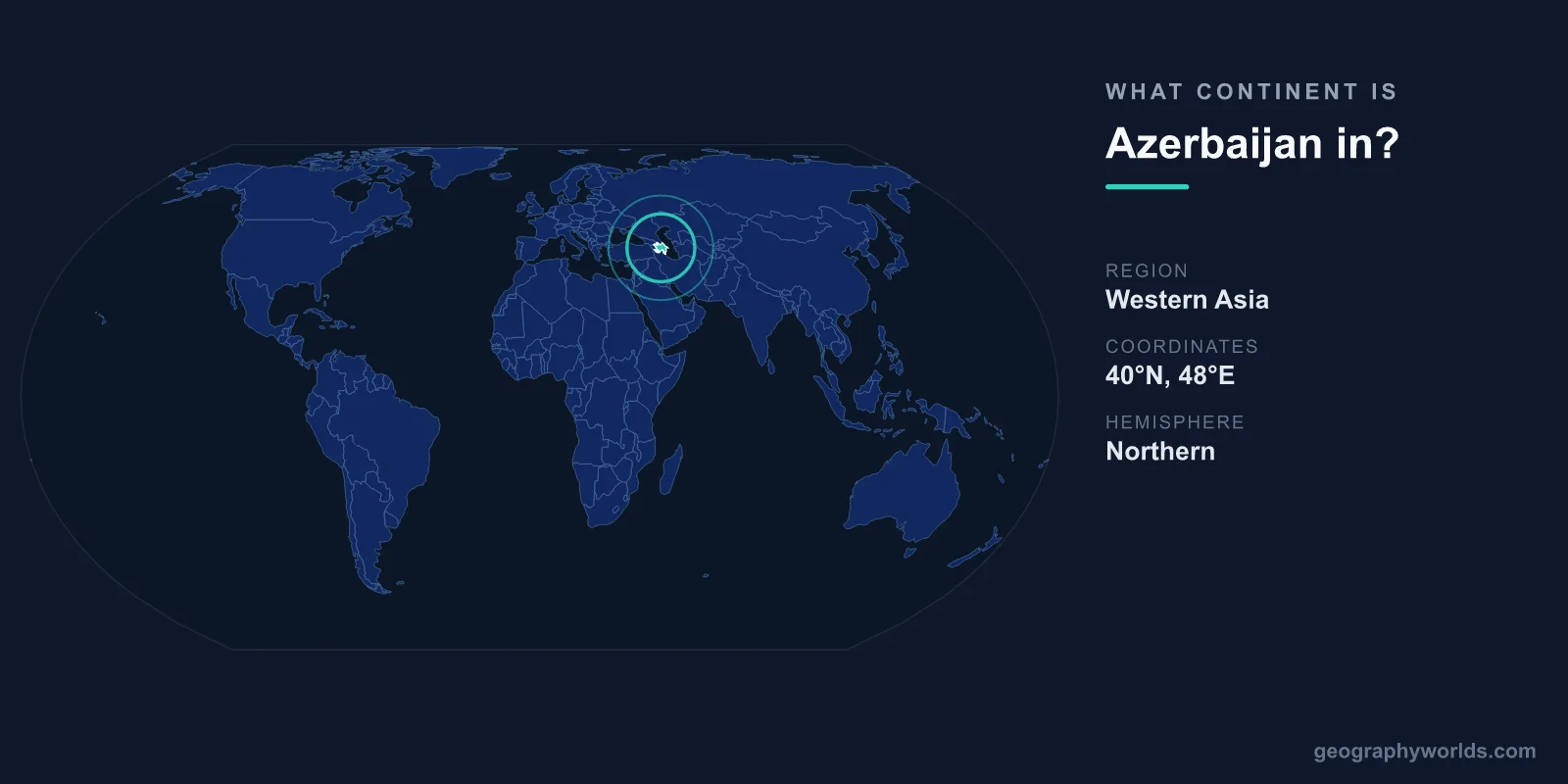
Azerbaijan is in Asia, sitting in the South Caucasus region of Western Asia, just south of the Greater Caucasus mountain range that many geographers treat as the dividing line between Europe and Asia. Because it straddles this traditional boundary, Azerbaijan is sometimes described as a transcontinental country, but the overwhelming consensus among geographers and international bodies places it firmly on the Asian continent.
Asia, the Caucasus, and a Contested Border
The United Nations classifies Azerbaijan as part of Western Asia, grouping it with neighbors such as Georgia, Armenia, and the broader Middle East. The reason for any debate is the Greater Caucasus, a mountain chain whose watershed has long served as one accepted line separating Europe from Asia. The vast majority of Azerbaijan's territory lies south of this range, which is why it is counted as Asian.
A small strip of land in the country's far north, on the European side of the Caucasus watershed, can technically be considered European under some definitions. This sliver is why Azerbaijan occasionally earns the "transcontinental" label, alongside Russia, Kazakhstan, and Turkey. In everyday terms, though, Azerbaijan is an Asian nation, and its history, language, and culture reflect that.
Where Exactly Is Azerbaijan?
Azerbaijan occupies a strategic position at the crossroads of Eastern Europe and Western Asia, wrapped around the western shore of the Caspian Sea. Its borders connect it to several distinct regions:
- North: Russia and Georgia, along the Greater Caucasus
- West: Armenia
- South: Iran
- East: the Caspian Sea (713 km of coastline)
The country also includes the Nakhchivan exclave, a detached pocket of Azerbaijani territory separated from the main country by Armenia and bordered by Iran and Turkey. The capital, Baku, sits on the Absheron Peninsula, which juts dramatically into the Caspian Sea and is one of the lowest-lying capital cities in the world. You can learn more in our azerbaijan country guide.
A Landscape of Extremes
For a country covering roughly 86,600 km², Azerbaijan packs in remarkable geographic variety. It is often said to contain nine of the world's eleven recognized climate zones, ranging from humid subtropical lowlands along the Caspian coast to cold alpine meadows high in the mountains. The elevation swings are equally striking:
- Highest point: Mount Bazardüzü, at about 4,466 m, in the Greater Caucasus
- Lowest point: the Caspian Sea shoreline, around 28 m below sea level
The Kura River, the longest in the entire Caucasus, flows west to east across the central lowlands before emptying into the Caspian. Azerbaijan is also home to more mud volcanoes than any other country on Earth, with estimates of around 350 of these bubbling natural features dotting the landscape.
The "Land of Fire"
Azerbaijan's nickname, the "Land of Fire," comes from its abundant natural gas and oil reserves, which historically caused flames to flicker spontaneously from the ground where gas seeped to the surface. These eternal fires inspired ancient fire-worshipping traditions and remain a defining symbol of the nation. Modern Baku celebrates this heritage with the iconic Flame Towers, three curving skyscrapers shaped like dancing flames that dominate the city skyline. The country's energy wealth, drawn largely from beneath the Caspian, has shaped its economy and its prominence in the region.
Why People Think Azerbaijan Might Be European
Several factors blur Azerbaijan's continental identity in popular imagination. It competes in European sporting and cultural events, most famously the Eurovision Song Contest, which it won in 2011 and hosted in Baku in 2012. It is a member of European-oriented organizations such as the Council of Europe and UEFA, and it has pursued closer ties with the European Union. These associations create a strong European impression.
Yet Azerbaijan's geographic location south of the Caucasus, its Turkic Azerbaijani language, and its predominantly Muslim cultural heritage all anchor it more closely to Western and Central Asia. Like Georgia and Armenia, it is one of three South Caucasus states whose exact continental placement remains a perennial subject of discussion precisely because the region sits astride the conventional Europe-Asia frontier.
Frequently Asked Questions
Is Azerbaijan in Europe or Asia?
Azerbaijan is primarily in Asia, specifically Western Asia in the South Caucasus. A small area north of the Greater Caucasus watershed can be considered European, so it is sometimes called transcontinental, but it is generally classified as Asian.
What region of Asia is Azerbaijan in?
The United Nations places Azerbaijan in Western Asia. More locally, it belongs to the South Caucasus, the region between the Black Sea and the Caspian Sea that also includes Georgia and Armenia.
What countries border Azerbaijan?
Azerbaijan borders Russia and Georgia to the north, Armenia to the west, and Iran to the south, with the Caspian Sea forming its eastern edge. Its Nakhchivan exclave also shares a short border with Turkey.
Is the Caspian Sea actually a sea?
Despite its name, the Caspian Sea is the world's largest enclosed body of water and is technically the largest lake on the planet. It forms Azerbaijan's entire eastern boundary and is central to the country's oil and gas industry.