
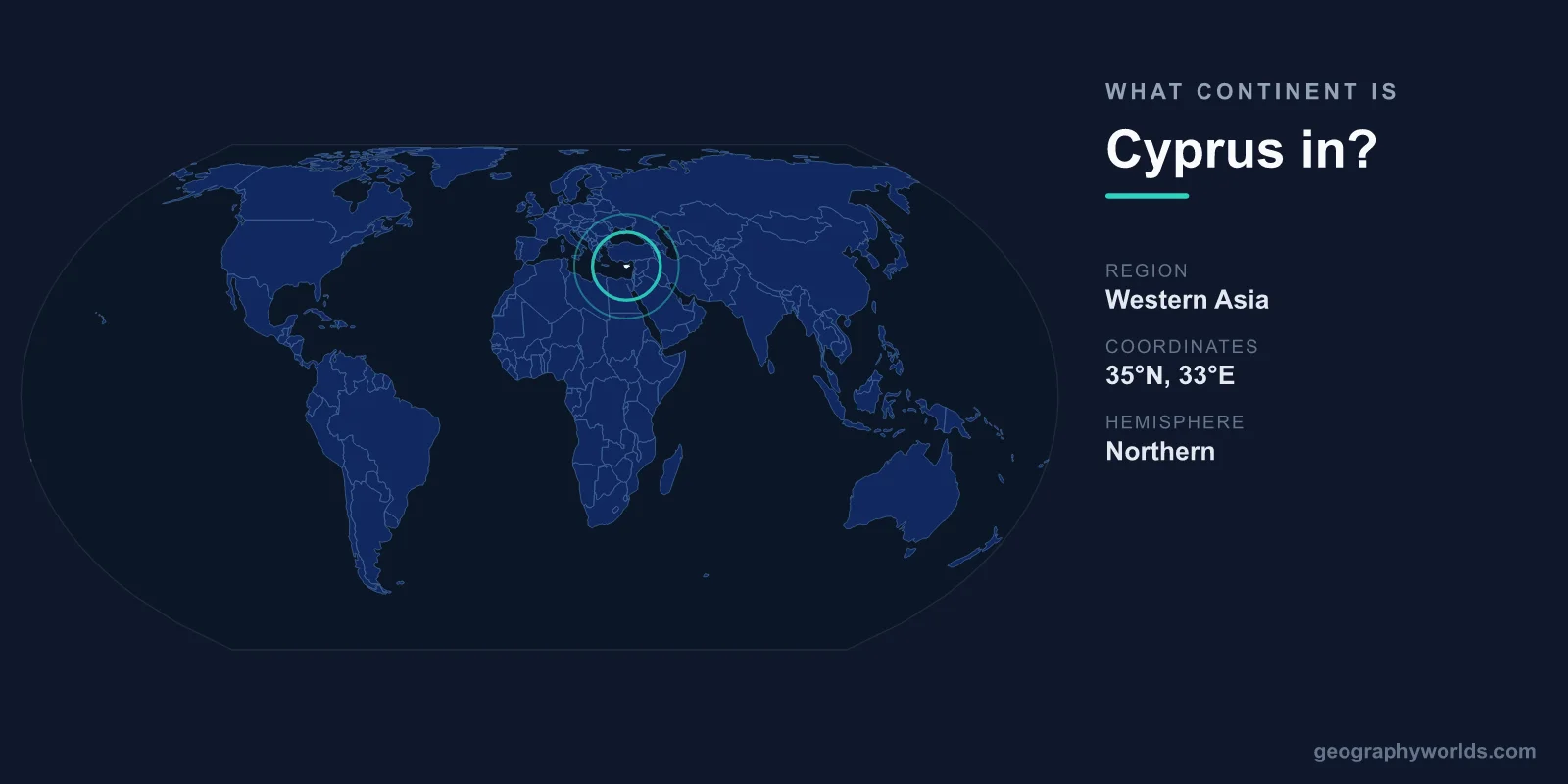
Cyprus lies geographically in Asia, sitting on the Asian continental shelf in the far eastern corner of the Mediterranean Sea — yet it is universally treated as part of Europe in political, economic, and cultural terms. The island is closer to Turkey, Syria, and Lebanon than to any European mainland, but it has been a member of the European Union since 2004, which is why most people simply call it European.
This split between physical and political geography makes Cyprus one of the most genuinely interesting "which continent" questions in the world. The short answer depends entirely on which kind of map you are reading.
Geographically Asian, Politically European
If you classify continents purely by tectonics and physical landmass, Cyprus belongs to Asia. The island rests roughly 75 km (47 miles) south of the Turkish coast, about 100 km (62 miles) west of Syria, and a similar distance northwest of Lebanon. By contrast, the nearest Greek territory — the island of Kastellorizo — lies well over 300 km away, and mainland Greece is more than 800 km distant. In raw geographic terms, Cyprus is firmly in Western Asia, often grouped with the Middle East or the Levant.
Politically and culturally, however, the picture flips. Cyprus joined the European Union on 1 May 2004 and adopted the euro in 2008. It belongs to the Council of Europe, competes in European sporting competitions such as UEFA football and Eurovision, and its Greek Cypriot majority shares deep linguistic, religious, and historical ties with Greece stretching back over three millennia. For everyday purposes — atlases, encyclopedias, and news reports — Cyprus is listed as European.
Where Exactly Is Cyprus?
Cyprus is the third-largest island in the Mediterranean, after Sicily and Sardinia, covering about 9,251 km² (3,572 sq mi). Its location places it at a crossroads between Europe, Asia, and Africa, which has shaped its history for thousands of years. Key location facts include:
- Capital: Nicosia (Lefkosia), located inland in the center of the island
- Nearest neighbors: Turkey to the north, Syria and Lebanon to the east
- Coastline: roughly 648 km (403 miles)
- Highest point: Mount Olympus in the Troodos range, at 1,952 m (6,404 ft)
The island's interior is defined by the Troodos Mountains in the south-center and the long, narrow Kyrenia (Pentadaktylos) range along the north coast. Between them stretches the flat, fertile Mesaoria plain, where Nicosia sits. The climate is classically Mediterranean: hot, dry summers and mild, rainy winters that keep the coastlines popular with visitors for much of the year.
Why People Find Cyprus So Confusing
The confusion is entirely reasonable, because Cyprus genuinely behaves like a European country while sitting on Asian soil. It uses the euro, follows EU law, issues EU passports, and its citizens can travel and work freely across the bloc. A traveler flying from Larnaca to Athens or Frankfurt feels they are moving within Europe.
Yet a glance at a physical map tells a different story. Cyprus is closer to Beirut than to any Greek island, and its position east of the 30th meridian places it well inside the conventional boundary of Asia. This is a textbook example of how political and cultural geography can override physical geography in everyday classification — much like how Armenia and Georgia are often considered European despite lying largely in Asia.
A Divided Island
Cyprus has been politically divided since 1974, following intercommunal conflict and a Turkish military intervention. The internationally recognized Republic of Cyprus governs the southern roughly two-thirds of the island, while the north is administered by the self-declared Turkish Republic of Northern Cyprus, which is recognized only by Turkey. A UN-patrolled buffer zone, the "Green Line," separates the two.
This division runs straight through Nicosia, making it the world's last divided capital city. The split adds another layer to Cyprus's identity: the south is integrated into the European Union, while the north looks toward Turkey — reinforcing how this single Asian island straddles two cultural and political worlds. To explore more about the country's history, geography, and travel, see our cyprus country guide.
Frequently Asked Questions
Is Cyprus in Europe or Asia?
Both answers are defensible. Geographically, Cyprus sits on the Asian continental shelf in the Eastern Mediterranean. Politically and culturally, it is European and has been a full European Union member since 2004. Most atlases and organizations list it under Europe.
Is Cyprus part of the European Union?
Yes. The Republic of Cyprus joined the EU in 2004 and adopted the euro as its currency in 2008. EU law applies fully in the government-controlled south, but its application is suspended in the Turkish-administered north.
What countries are closest to Cyprus?
Turkey lies about 75 km to the north, with Syria roughly 100 km to the east and Lebanon a short distance beyond. All three are Asian nations, which is why Cyprus is geographically counted as part of Western Asia.
Is Cyprus considered part of the Middle East?
Geographically it can be, since it lies in the Eastern Mediterranean alongside Levantine countries. However, because of its EU membership and Greek cultural heritage, Cyprus is far more often grouped with Europe than with the Middle East.