
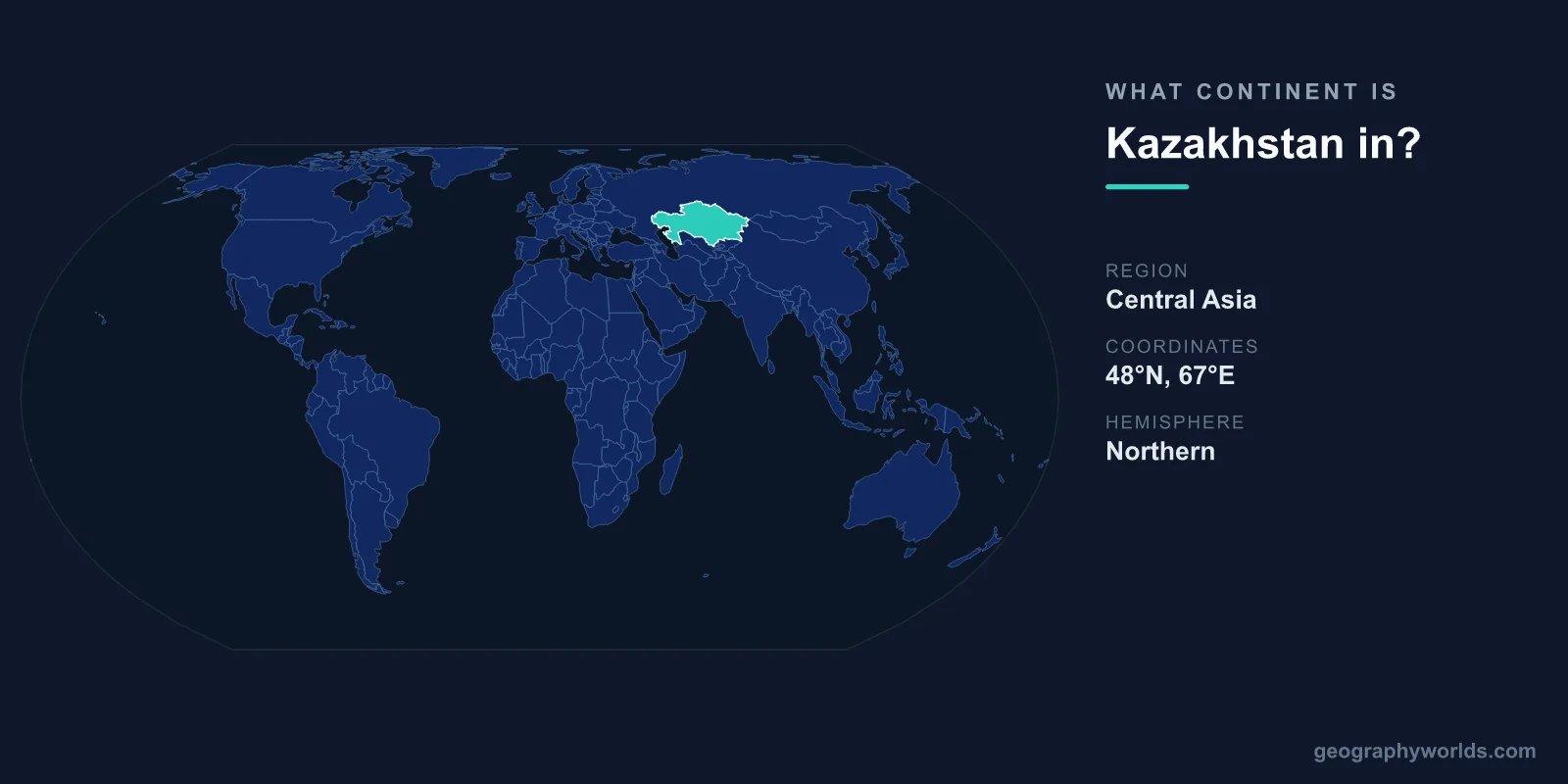
Kazakhstan is in Asia — specifically Central Asia — and it is the largest landlocked country on Earth as well as the ninth-largest country overall by total area. Although a small slice of its territory west of the Ural River is sometimes counted as European, making the country technically transcontinental, Kazakhstan is overwhelmingly Asian in land, population, and identity. The United Nations and most geographers place it firmly within Central Asia.
Which Continent Kazakhstan Belongs To
The clearest answer is Asia. Of Kazakhstan's roughly 2,724,900 square kilometres, more than 95 percent sits east of the conventional Europe–Asia dividing line, and its capital, major cities, mountains, steppes, and economic centres are all on the Asian side. The country anchors the region known as Central Asia, sharing that grouping with Kyrgyzstan, Uzbekistan, Turkmenistan, and Tajikistan.
Kazakhstan is the giant of this region. It is larger than all four of its Central Asian neighbours combined and is bigger than all of Western Europe. Among the world's countries it ranks ninth in size, surpassing nations such as Argentina and India in total land area while having a comparatively modest population of around 20 million.
Why Some Maps Call It Transcontinental
The reason Kazakhstan occasionally appears in discussions of Europe comes down to one river. The traditional boundary between Europe and Asia runs along the Ural Mountains and then south down the Ural River. Because that river flows through western Kazakhstan before reaching the Caspian Sea, a thin strip of Kazakh land technically lies on the European side of the line.
This makes Kazakhstan a transcontinental country, similar in concept to Russia or Turkey. In practice, though, the European portion is a geographic footnote — a sparsely populated sliver representing only a small fraction of the nation. No major city, and certainly none of the country's political or cultural heart, sits in that European zone. For nearly all purposes, including UN regional classification, Kazakhstan is treated as wholly Asian.
Where Kazakhstan Sits on the Map
Kazakhstan is a vast, landlocked expanse in the heart of Eurasia. Its neighbours and key borders include:
- North: Russia, along the world's second-longest continuous international border.
- East: China, across the rugged Tian Shan and Altai frontier.
- South: Kyrgyzstan, Uzbekistan, and Turkmenistan.
- West: The Caspian Sea, the largest enclosed body of water on Earth.
Because it has no access to the open ocean, Kazakhstan holds the title of the world's largest landlocked country. Its sheer width is striking: the country stretches across enough longitude to span multiple time zones, comparable to the breadth of the contiguous United States. The capital, Astana (known for a period as Nur-Sultan), sits in the northern steppe, while Almaty, the former capital and largest city, lies in the mountainous southeast.
The Landscapes That Define It
Kazakhstan's terrain reflects its position deep inside the Asian landmass, far from any moderating ocean. The result is a strongly continental and largely arid climate, with hot summers and bitterly cold winters. Its landscapes range dramatically from west to east:
- The Kazakh Steppe: One of the largest dry grassland regions on the planet, dominating the country's centre and north.
- The Tian Shan mountains: Towering peaks in the southeast, home to the highest point, Khan Tengri, at roughly 7,010 metres.
- The Caspian Depression: A low-lying western basin that includes the country's lowest point, around 132 metres below sea level.
- Major lakes: Lake Balkhash, unusual for being half freshwater and half saline, plus the Caspian shoreline.
This Asian heartland is also home to the Baikonur Cosmodrome, the world's first and largest space launch facility. Leased to Russia, it is the site from which Yuri Gagarin became the first human in space in 1961 — a reminder of the country's deep Soviet-era ties, which sometimes add to the confusion about whether it is European or Asian. If you want a fuller overview of the nation's history, regions, and travel highlights, see our kazakhstan country guide.
Frequently Asked Questions
Is Kazakhstan in Europe or Asia?
Kazakhstan is in Asia. It is classified as a Central Asian country, and the vast majority of its land and people are on the Asian side of the Europe–Asia boundary. Only a small western strip near the Ural River is technically European.
Is Kazakhstan part of Central Asia?
Yes. Kazakhstan is the largest of the five Central Asian republics and dominates the region in both area and economy. The other four are Kyrgyzstan, Uzbekistan, Turkmenistan, and Tajikistan.
Why is Kazakhstan sometimes called transcontinental?
Because the traditional Europe–Asia border follows the Ural River, which runs through western Kazakhstan, a small portion of the country falls on the European side. This makes it transcontinental in the same technical sense as Russia and Turkey, even though it is overwhelmingly Asian.
Is Kazakhstan the largest landlocked country?
Yes. With no coastline on any open ocean, Kazakhstan is the largest landlocked country in the world and the ninth-largest country of any kind, covering about 2.72 million square kilometres.
