
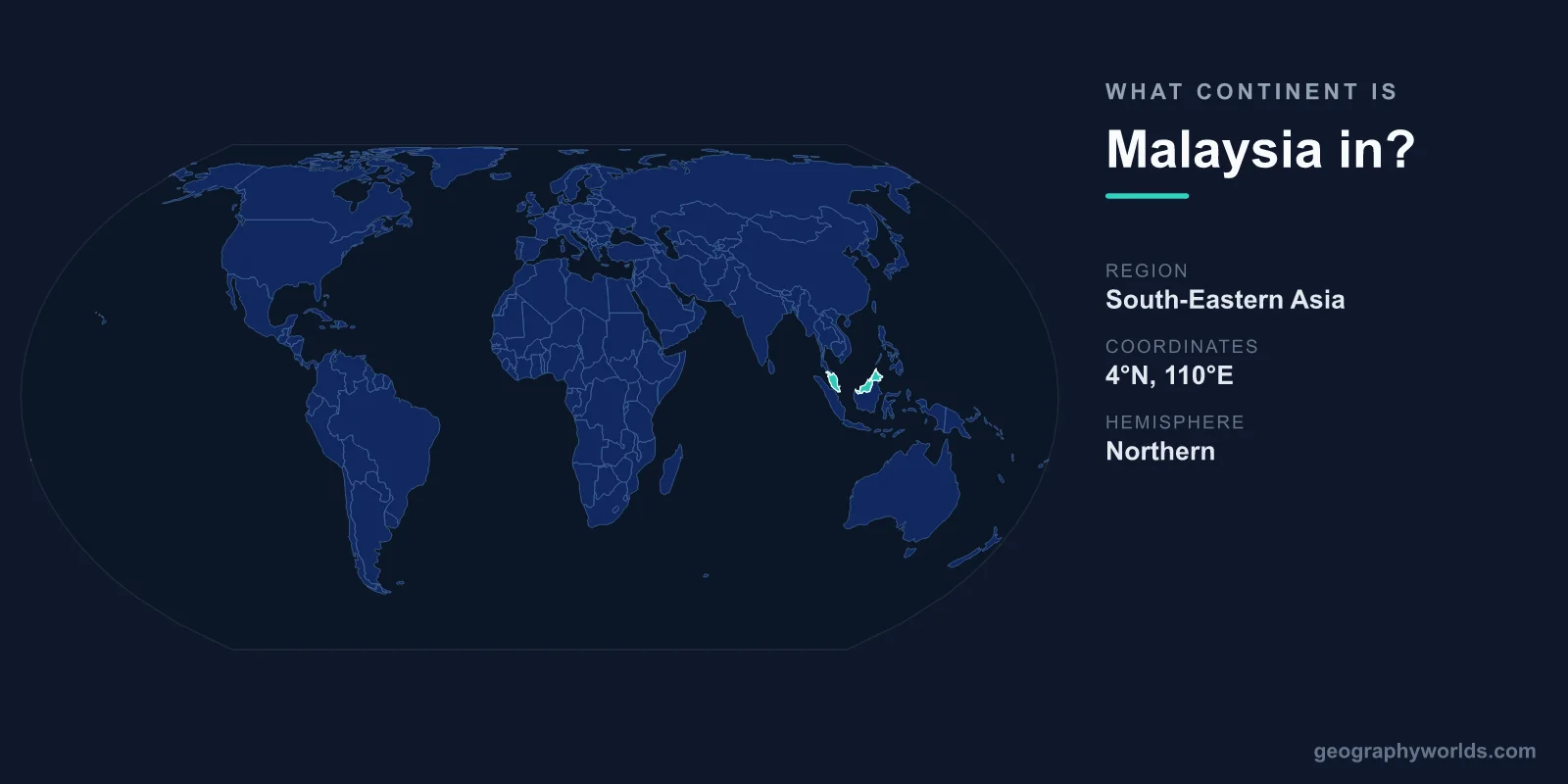
Malaysia is in Asia, more precisely in the southeastern corner of the continent known as Southeast Asia. What makes Malaysia geographically unusual is that it is not one connected landmass: the country is split into two halves separated by roughly 640 kilometres of the South China Sea. Peninsular Malaysia sits on the southern tip of the Malay Peninsula in mainland Asia, while East Malaysia occupies the northern third of Borneo, the third-largest island on Earth. Both halves lie firmly within Asia, and both belong to the Southeast Asian sub-region.
Asia and the Southeast Asian Region
Asia is the largest and most populous continent, and Southeast Asia is the tropical zone that stretches from Myanmar in the west to the Philippines in the east. This region is conventionally divided into a mainland portion and a maritime portion, and Malaysia is one of the few countries that straddles both. Peninsular Malaysia belongs to mainland Southeast Asia, sharing the peninsula with Thailand. East Malaysia, on Borneo, belongs to maritime Southeast Asia, the world of islands and archipelagos.
This dual identity reflects Malaysia's role as a crossroads. Sitting astride the Strait of Malacca — one of the busiest shipping lanes on the planet — the country has been a meeting point for Malay, Chinese, Indian, Arab, and European cultures for centuries. Today Malaysia is a founding-era member of ASEAN, the Association of Southeast Asian Nations, reinforcing its central place in the regional bloc.
Two Halves Across the South China Sea
Peninsular Malaysia, sometimes called West Malaysia, contains the capital, Kuala Lumpur, and the bulk of the population. It shares a land border with Thailand to the north and is linked to the island city-state of Singapore by causeways to the south. East Malaysia consists of the two large states of Sabah and Sarawak on Borneo, where Malaysia shares the island with Indonesia and the tiny sultanate of Brunei.
Altogether Malaysia covers about 330,803 square kilometres, with a long coastline of roughly 4,675 kilometres washed by the South China Sea, the Strait of Malacca, and the Sulu and Celebes seas. The South China Sea is the body of water that physically divides the country, which is why a domestic flight between Kuala Lumpur and the Bornean cities of Kota Kinabalu or Kuching crosses open ocean.
The Physical Geography of a Tropical Country
Malaysia lies just north of the Equator, giving it a hot, humid tropical climate with heavy rainfall and no real winter or summer — only wetter and drier seasons shaped by the monsoons. Dense rainforest still blankets a large share of the land, and these forests on Borneo are among the oldest on Earth, estimated at around 130 million years old, far predating the Amazon.
The highest point in the country is Mount Kinabalu in Sabah, rising to 4,095 metres. It is one of the tallest peaks in Southeast Asia and a magnet for climbers and biologists alike. Beyond Borneo, Malaysia includes well-known islands such as Penang and Langkawi off the western coast of the peninsula. This blend of mountains, coral reefs, and ancient jungle makes Malaysia one of the most biodiverse nations in Asia, home to orangutans, the endangered Malayan tiger, and thousands of unique plant species.
Neighbouring Countries and Maritime Borders
Every country that touches Malaysia is itself in Asia, which underlines how thoroughly the nation belongs to the continent. Its land neighbours are:
- Thailand — to the north of Peninsular Malaysia.
- Indonesia — sharing the island of Borneo to the south of Sabah and Sarawak.
- Brunei — a small sultanate enclosed within Sarawak on Borneo.
- Singapore — connected to the peninsula by causeway, just across the Strait of Johor.
Malaysia also shares maritime boundaries with the Philippines and Vietnam across surrounding seas. For a deeper look at the country's regions, culture, and travel highlights, see our malaysia country guide.
Why the Split Geography Matters
Because Malaysia spans both the mainland and an island, it sometimes confuses people trying to place it on a map. The simplest answer is that the whole country — both the peninsular half and the Bornean half — is in Asia. There is no part of Malaysia in Australia, Oceania, or any other continent, even though Borneo lies close to the maritime boundary of Southeast Asia. The island of Borneo as a whole is considered part of Asia, shared between three Asian states.
Frequently Asked Questions
Is Malaysia in Asia or Oceania?
Malaysia is in Asia, specifically Southeast Asia. While it is close to maritime regions sometimes grouped with Oceania, all of Malaysia — including the states of Sabah and Sarawak on Borneo — is firmly within the Asian continent.
Is Malaysia part of mainland Asia or an island?
Both. Peninsular Malaysia is attached to mainland Asia via the Malay Peninsula, while East Malaysia sits on the island of Borneo. The two halves are separated by the South China Sea.
What countries border Malaysia?
Malaysia shares land borders with Thailand, Indonesia, and Brunei, and is linked to Singapore by causeway. It also has maritime borders with the Philippines and Vietnam — all Asian nations.
What is the capital of Malaysia and where is it?
The capital is Kuala Lumpur, located in Peninsular Malaysia. The federal administrative centre, Putrajaya, lies just to its south, while the main legislative seat remains in Kuala Lumpur.