
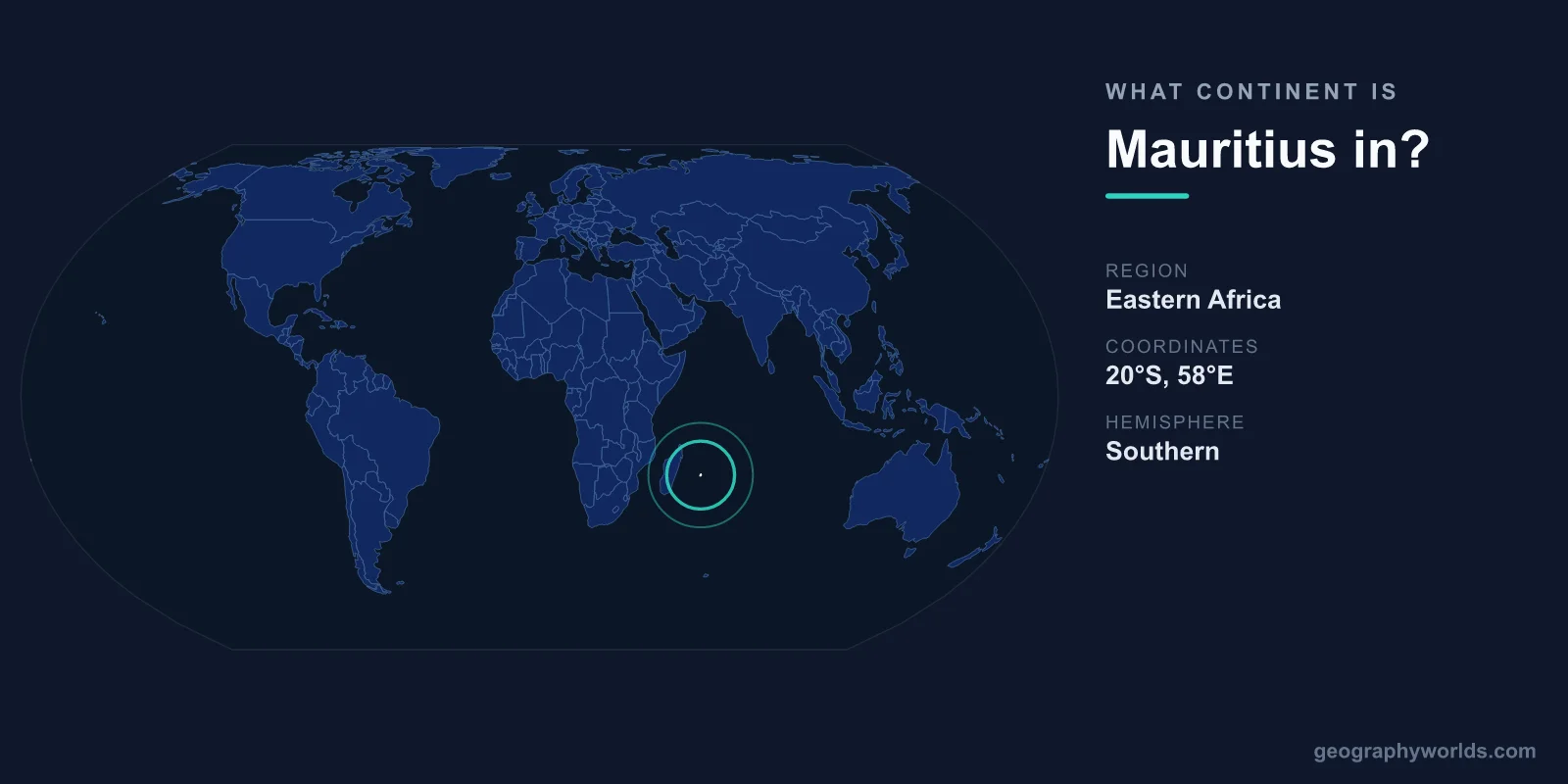
Mauritius is in Africa. Although it is an island nation set roughly 2,000 km off the southeastern coast of the African mainland in the Indian Ocean, Mauritius is internationally classified as an African country. The United Nations places it within the Eastern Africa subregion, and the country is a full member of the African Union. Its remote, mid-ocean position sometimes leads people to assume it belongs to Asia or sits in a category of its own, but geographically and politically it is firmly part of Africa.
Why Mauritius Counts as African
Continental classification is partly about physical geography and partly about political and historical ties. Mauritius lies closer to Africa than to any other landmass: the African coast and the large island of Madagascar are its nearest continental references, while Asia is far to the northeast and Australia even farther east. Because the African continent is the closest major landmass and Mauritius shares deep regional links with it, the UN, the African Union, and most atlases group the island with Africa rather than treating it as oceanic limbo.
Beyond proximity, Mauritius belongs to a web of African and Indian Ocean institutions. It is a member of the African Union, the Southern African Development Community (SADC), and the Indian Ocean Commission. These memberships reinforce its standing as an African state with strong cross-ocean trading relationships.
Where Exactly Is Mauritius?
Mauritius is a volcanic island that forms part of the Mascarene Islands, a small archipelago that also includes the French overseas department of Réunion and Rodrigues, which is itself part of the Republic of Mauritius. The main island sits about 900 km east of Madagascar, with Réunion roughly 200 km to its southwest.
- Continent: Africa
- Region: Eastern Africa (Indian Ocean)
- Capital: Port Louis
- Area: about 2,040 km²
- Highest point: Piton de la Petite Rivière Noire (828 m)
The island's compact size means you can drive from coast to coast in a matter of hours, yet it packs in a surprising range of landscapes, from sugar-cane plains to a hilly central plateau that hints at its volcanic birth. You can explore more about the nation in our mauritius country guide.
A Landscape Shaped by Volcanoes and Reefs
Mauritius rose from the sea through volcanic activity millions of years ago, and that origin still defines its terrain. The interior climbs to a central plateau ringed by mountain ranges and isolated peaks, the tallest being the 828-metre Piton de la Petite Rivière Noire. Although the volcanoes are long extinct, craters, lava flows, and basalt outcrops remain visible across the island.
Almost the entire 177-km coastline is fringed by coral reefs, which shelter shallow, turquoise lagoons and give Mauritius its postcard reputation. One of the island's most photographed features is the so-called "underwater waterfall" off the southwestern coast near Le Morne. It is actually an optical illusion: deposits of sand and silt sliding down a steep underwater shelf create the appearance of water cascading beneath the ocean surface.
Neighbours and Indian Ocean Setting
Because it is an island, Mauritius shares no land borders. Its closest neighbours are all reached across open water: Réunion (France) about 200 km to the southwest, and Madagascar around 900 km to the west. All three lie within the African sphere of the Indian Ocean, and together with the Seychelles and the Comoros they form a cluster of island territories that the world groups with Africa.
This mid-ocean crossroads location shaped the country's remarkably diverse population. People of Indian, African, Chinese, and European descent live side by side, a legacy of the island's centuries as a colonial outpost and trading hub for the French, Dutch, and British. That blend makes Mauritius one of the most culturally mixed nations on the African continent.
Climate and Natural Heritage
Mauritius has a tropical maritime climate, with a warm, humid summer from roughly November to April and a cooler, drier winter from June to September. Trade winds moderate the heat, and the surrounding reefs keep coastal waters calm for much of the year.
The island is also famous as the only home of the dodo, the flightless bird that became extinct in the late 1600s after human settlement and introduced animals wiped it out. Today the dodo is a national symbol and a global emblem of human-caused extinction. Mauritius has since become a conservation focus and was the first African country to be rated as having "high human development" by the UN.
Frequently Asked Questions
Is Mauritius in Africa or Asia?
Mauritius is in Africa. Despite its Indian Ocean location and large population of Indian descent, it is classified as part of Eastern Africa by the United Nations and is a member of the African Union, not any Asian bloc.
What ocean is Mauritius in?
Mauritius lies in the Indian Ocean, east of Madagascar and the African mainland. It is part of the Mascarene Islands, alongside Réunion and Rodrigues.
How far is Mauritius from mainland Africa?
The island sits roughly 2,000 km off the southeastern coast of the African mainland, and about 900 km east of Madagascar, the nearest large landmass.
What is the capital of Mauritius?
The capital is Port Louis, located on the island's northwestern coast. It serves as the country's main port, commercial centre, and seat of government.