
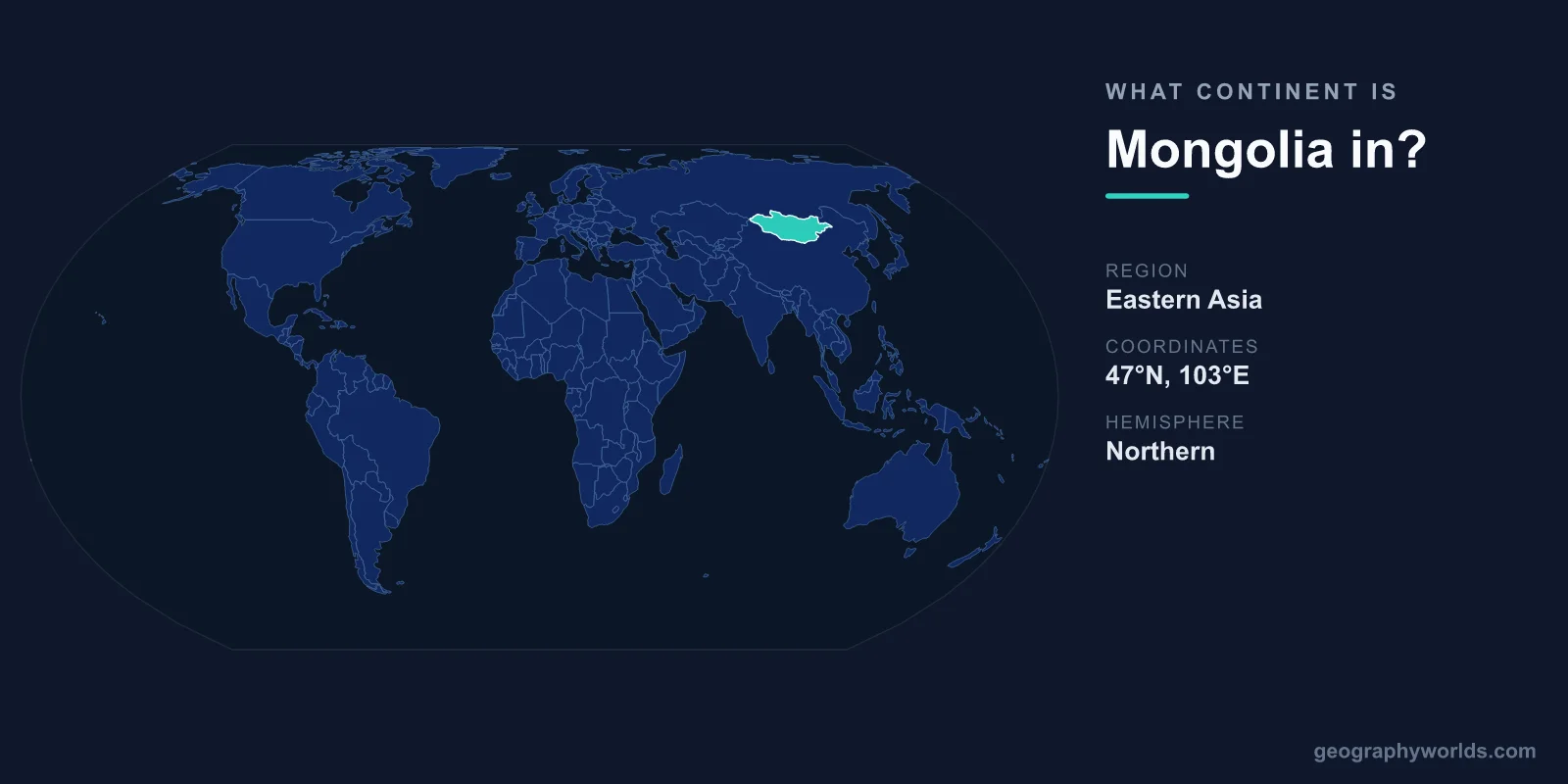
Mongolia is in Asia, specifically in the heart of East-Central Asia, landlocked between Russia to the north and China to the south. It sits on the high interior plateau of the continent, far from any ocean, and is one of the most remote and sparsely populated nations on Earth. While it belongs unambiguously to the Asian continent, Mongolia straddles a cultural and geographic boundary that makes its exact regional classification a surprisingly interesting question.
Which Part of Asia Is Mongolia In?
The United Nations classifies Mongolia as part of Eastern Asia, the same subregion as China, Japan, and the Koreas. Geographically, however, the country occupies a central position on the continent, deep in the interior away from any coastline. Because of this inland location and its historical ties to Turkic and Central Asian peoples, Mongolia is sometimes grouped with Central Asia in cultural or political discussions.
The capital, Ulaanbaatar, lies at roughly 47.9° North and 106.9° East. From there it is more than 1,500 kilometers in any direction to reach the sea, underscoring just how landlocked the country is. Mongolia is, in fact, the second-largest landlocked country in the world, surpassed only by Kazakhstan.
Mongolia's Borders and Neighbors
Mongolia shares its borders with only two countries, both of them giants:
- Russia to the north, including the regions of Siberia and the Russian Far East.
- China to the south, east, and west, wrapping around most of the country.
Despite having just two neighbors, Mongolia's total land border stretches well over 8,000 kilometers. This sandwiched position between two of the world's most powerful nations has shaped Mongolian history, trade, and foreign policy for centuries. Both neighbors are firmly part of the Asian continent, which reinforces Mongolia's placement at the continent's core.
The Landscape of an Asian Heartland
Mongolia covers an area of about 1,564,116 km², making it the 18th-largest country on the planet and larger than Iran, Mexico, or Alaska. Yet it is home to only around 3.4 million people, which makes it the least densely populated sovereign nation on Earth. The land itself is defined by dramatic variety:
- Steppes: Vast rolling grasslands cover much of the central and eastern country, supporting nomadic herding.
- The Gobi Desert: This famous arid expanse blankets the southern third of Mongolia, reaching into northern China.
- Mountains: The Altai range rises in the west, where Khüiten Peak reaches 4,374 meters, the country's highest point.
The average elevation across Mongolia is about 1,580 meters above sea level, giving it one of the highest mean altitudes of any country. This elevated, interior position is a key reason the nation experiences such an extreme continental climate.
A Climate Shaped by Continental Position
Sitting deep inside Asia and cut off from any moderating ocean, Mongolia endures one of the most severe continental climates in the world. Winter temperatures regularly plunge below -40°C, while summer days can exceed 40°C, a swing of more than 80 degrees over the year. Ulaanbaatar holds the title of the coldest national capital on Earth, with an average annual temperature of roughly -1.3°C.
This harsh environment has profoundly influenced how Mongolians live. Roughly 45% of the population is concentrated in Ulaanbaatar, while much of the rest follow a nomadic or semi-nomadic lifestyle, moving herds of livestock across the steppe and living in portable felt tents called gers (yurts). For more on the country's culture, economy, and travel highlights, see our mongolia country guide.
Mongolia's Place in History and the Map
Mongolia's central Asian location was once the launchpad for the largest contiguous land empire in history. In the 13th century, Genghis Khan united the nomadic tribes of the steppe and forged the Mongol Empire, which at its height stretched from the Pacific coast of Asia all the way to Eastern Europe. That legacy still anchors Mongolia firmly within the Asian story.
Today the country is also famous for an unusual statistic: it is home to more horses than people, with an estimated 4 million horses for its 3.4 million residents. The horse remains a symbol of Mongolian identity, a living link to the mounted warriors who reshaped the Asian continent eight centuries ago.
Frequently Asked Questions
Is Mongolia in Asia or Europe?
Mongolia is entirely in Asia. Unlike Russia, which spans both continents, Mongolia lies wholly within the Asian landmass, with no European territory at all.
Is Mongolia part of Central Asia or East Asia?
The United Nations officially places Mongolia in Eastern Asia. However, because of its inland geography and historical and cultural ties, it is sometimes informally grouped with Central Asia.
Is Mongolia the same as Inner Mongolia in China?
No. Mongolia is an independent sovereign country, often called Outer Mongolia. Inner Mongolia is a separate autonomous region within China, located to the south across the border.
Does Mongolia have a coastline?
No. Mongolia is landlocked, with no access to the sea. It is the second-largest landlocked country in the world after Kazakhstan, bordered only by Russia and China.