
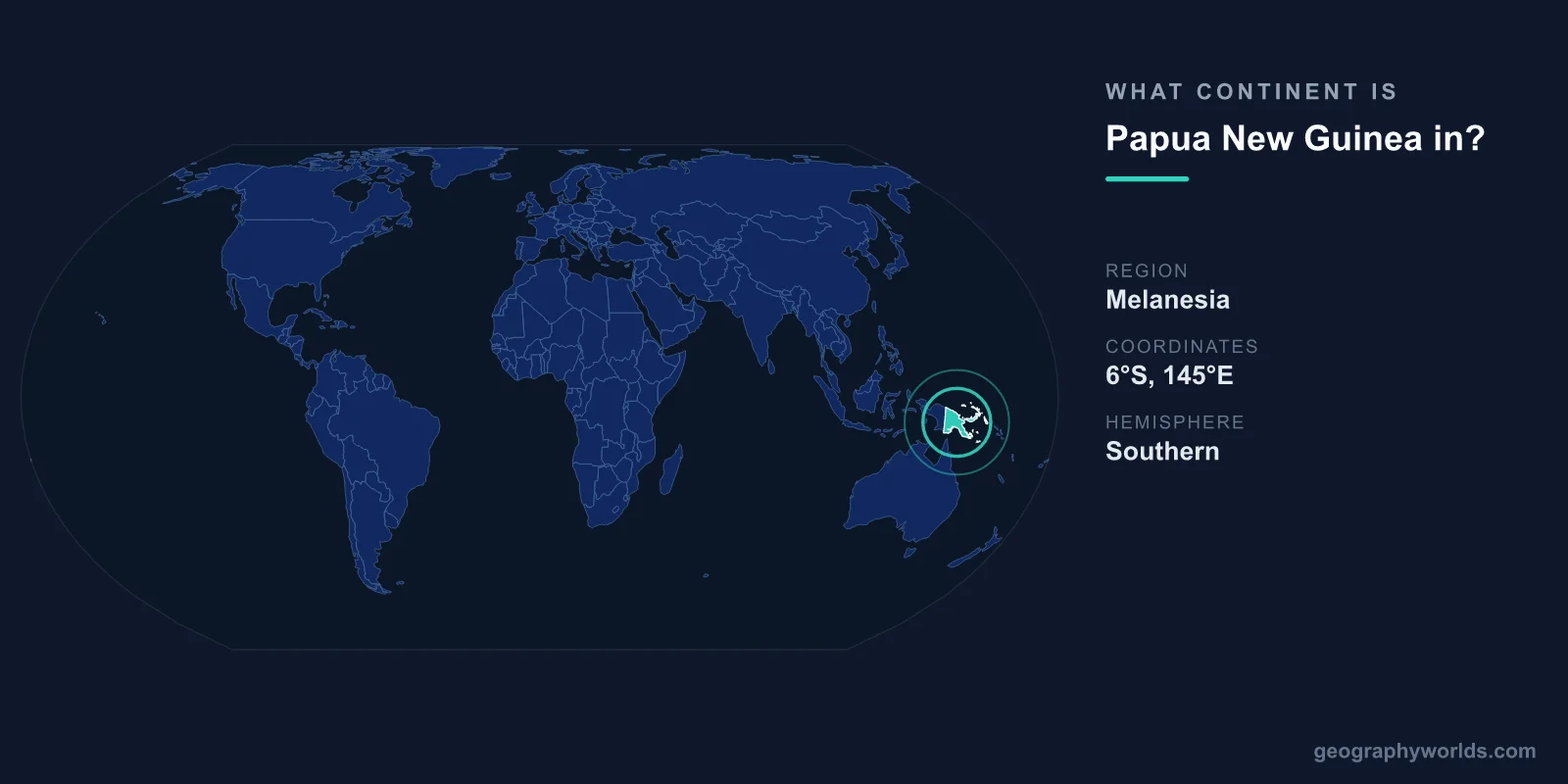
Papua New Guinea is located in Oceania, within the Melanesia subregion of the southwestern Pacific Ocean. It occupies the eastern half of New Guinea — the world's second-largest island — along with more than 600 surrounding islands. While the island of New Guinea sits at the meeting point of Asia and the Pacific, every major geographic authority, including the United Nations, classifies Papua New Guinea as an Oceanian nation rather than an Asian one.
Why Oceania and Not Asia?
The confusion is understandable. New Guinea lies just south of the equator and directly east of the Indonesian archipelago, which is part of Southeast Asia. The western half of the island, known as Western New Guinea or Indonesian Papua, belongs to Indonesia — an Asian country. Yet Papua New Guinea, which controls the eastern half, is grouped with the Pacific island nations.
The distinction comes down to cultural geography and tectonics rather than pure proximity. Papua New Guinea sits on the boundary between the Australian and Pacific tectonic plates, well to the east of the Sunda Shelf that connects mainland Southeast Asia. Its peoples are predominantly Melanesian, sharing ancestry, languages, and traditions with the Solomon Islands, Vanuatu, and Fiji rather than with Asian populations. For these reasons, the UN places Papua New Guinea firmly in Oceania, specifically the Melanesian cultural sphere.
Where Exactly Is Papua New Guinea?
Papua New Guinea covers roughly 462,840 square kilometers, making it the largest country in Oceania after Australia. Its capital, Port Moresby, sits on the southern coast facing the Coral Sea. The country's position can be pinned down by the seas and lands that surround it:
- To the west: a land border with Indonesia along the spine of New Guinea island.
- To the south: Australia, only about 150 kilometers away across the narrow Torres Strait.
- To the north: the Bismarck Sea and the open Pacific Ocean.
- To the east and southeast: the Solomon Sea and the neighboring Solomon Islands.
This places the country at a crossroads — close enough to Australia and Asia to feel the influence of both, but woven into the chain of Pacific islands that defines Melanesia. You can explore its position further in our papua new guinea country guide.
A Land of Mountains, Rainforest, and Islands
Papua New Guinea is one of the most rugged countries on Earth. A massive central cordillera runs the length of the mainland, crowned by Mount Wilhelm at 4,509 meters — high enough to see occasional frost despite the tropical latitude. Below the highlands, the land falls away into dense lowland rainforest, broad river valleys, and coastal mangrove swamps. The country's coastline stretches more than 5,000 kilometers, fringed by coral reefs and dotted with volcanic islands such as New Britain, New Ireland, and Bougainville.
This dramatic terrain helps explain why the nation belongs culturally to the Pacific world. The mountains divided communities so completely that distinct societies developed in neighboring valleys, many of them isolated until the twentieth century. The result is a biological and human landscape unlike anywhere in Asia.
The World's Most Diverse Nation
Papua New Guinea is home to roughly 10 million people who speak more than 840 living languages — by far the most of any country, and about 12 percent of all the languages spoken on the planet. This extraordinary diversity is a direct product of the country's geography: rugged terrain and scattered islands kept communities apart for thousands of years, allowing separate tongues and customs to flourish.
The natural world is equally rich. Papua New Guinea shelters birds of paradise, tree kangaroos, and one of the highest concentrations of orchid species anywhere on Earth. Some interior regions remain among the least-explored places on the globe, and a handful of highland tribes had no contact with the outside world until the 1930s. This isolation, characteristic of the Melanesian islands, reinforces the country's identity as part of Oceania.
Frequently Asked Questions
Is Papua New Guinea in Asia or Oceania?
Papua New Guinea is in Oceania, not Asia. Although it shares the island of New Guinea with Indonesia (an Asian country) and lies close to Southeast Asia, its Melanesian culture, tectonic setting, and UN classification all place it firmly in Oceania.
What region of Oceania is Papua New Guinea in?
It belongs to Melanesia, the subregion of the southwestern Pacific that also includes the Solomon Islands, Vanuatu, Fiji, and New Caledonia. Melanesians share common ancestry and cultural traits across these island groups.
What countries border Papua New Guinea?
Papua New Guinea shares a single land border, with Indonesia, running down the middle of New Guinea island. Its nearest maritime neighbors are Australia to the south and the Solomon Islands to the southeast.
Is Papua New Guinea the same as Indonesian Papua?
No. Papua New Guinea is an independent country occupying the eastern half of New Guinea, while the western half — Indonesian Papua — is part of Indonesia. They share an island but are different nations on different continents in terms of UN grouping.