
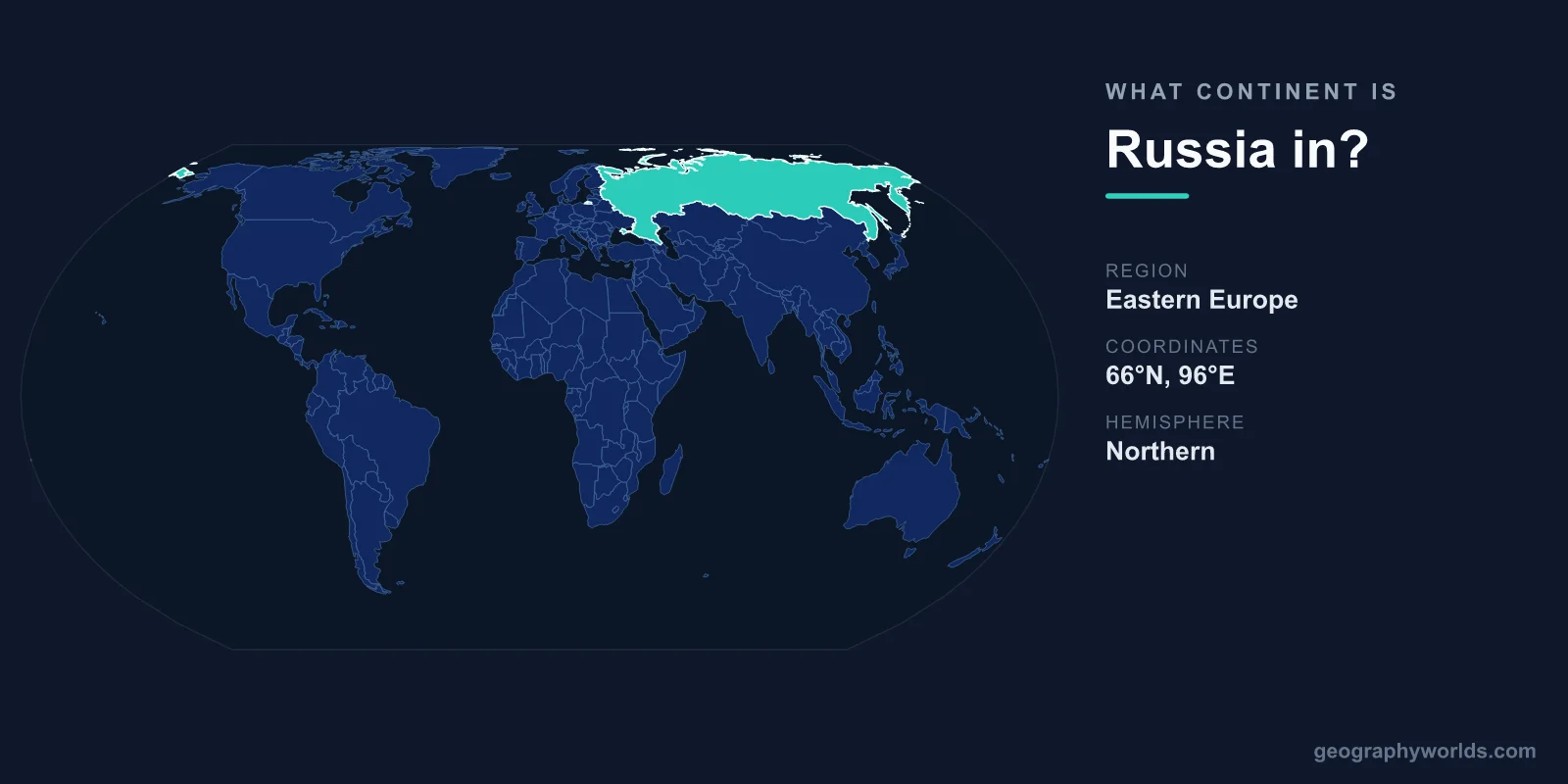
Russia is located on two continents at once: it sits in both Europe and Asia, making it a transcontinental country. Roughly 77% of its enormous landmass lies in Asia, in the region known as Siberia, while the western quarter belongs to Europe. Yet the balance of people is reversed — around 77% of Russians live in the European part, west of the Ural Mountains, where the capital and largest cities are found.
Europe and Asia, Divided by the Urals
The line that traditionally separates European Russia from Asian Russia is the Ural Mountains, a low, weathered range that runs roughly north to south for about 2,500 kilometres. West of the Urals stretches European Russia, bordered by Finland, the Baltic states, Belarus, and Ukraine. East of the range lies Asian Russia, an immense expanse reaching all the way to the Pacific Ocean.
In raw numbers, the European portion covers about 3.97 million km², while the Asian portion accounts for roughly 13.1 million km². Together they make Russia the largest country on Earth, with a total area of 17,098,242 km² — bigger than Pluto's surface and larger than the combined area of Canada and India.
Why Russia Is Usually Called European
Despite having most of its territory in Asia, Russia is generally treated as a European nation in politics, culture, and history. The reason is simple: that is where the country lives and works. Moscow, the capital, and Saint Petersburg, the historic imperial capital, are both firmly in the European part, as are the bulk of the population centres. About 110 million of Russia's roughly 144 million people reside west of the Urals.
Russia's identity has been shaped by European events — the Byzantine Christianity that arrived in the 10th century, the reforms of Peter the Great, the Napoleonic Wars, and the upheavals of the 20th century. International bodies and sporting federations have long classed Russia as European, which is why its teams compete in European competitions rather than Asian ones.
Siberia: The Vast Asian Half
The Asian side of Russia, broadly called Siberia and the Russian Far East, is one of the least densely populated regions on the planet. It contains endless taiga forests, frozen tundra, and Lake Baikal — the deepest and oldest freshwater lake in the world, holding about a fifth of all unfrozen fresh water on Earth.
To grasp the scale, consider that Asian Russia alone is larger than any other single country on the planet. If Siberia were independent, it would still be the biggest nation by far. Cities such as Novosibirsk, Yekaterinburg (right at the Ural divide), and Vladivostok on the Pacific coast anchor this thinly settled, resource-rich territory.
Eleven Time Zones and a Continental Span
- Total area: 17,098,242 km² (largest in the world)
- Capital: Moscow, in European Russia
- Continental boundary: the Ural Mountains
- Time zones: 11, from Kaliningrad in the west to Kamchatka in the east
- Highest point: Mount Elbrus (5,642 m), in the European Caucasus
Because Russia stretches so far from west to east, it spans 11 time zones. When it is midnight in the Baltic exclave of Kaliningrad, it is already mid-morning on the Kamchatka Peninsula. This sheer breadth is the simplest explanation for why a single country can sit comfortably in two continents at the same time. For a deeper look at the nation's geography, history, and travel highlights, see our russia country guide.
The "Eurasia" Shortcut
Because the boundary between Europe and Asia is a human convention rather than an ocean, geographers sometimes sidestep the question entirely by using the term Eurasia — the single continuous landmass that the two continents share. Russia dominates Eurasia more than any other country, which is part of why the where-does-it-belong debate never fully settles. Both answers are correct depending on whether you are asking about land or people.
Frequently Asked Questions
Is Russia in Europe or Asia?
Both. Russia is a transcontinental country. The smaller western portion is in Europe, and the much larger eastern portion (Siberia) is in Asia. Culturally and politically it is usually considered European because that is where most people and the capital are located.
What divides European Russia from Asian Russia?
The Ural Mountains form the traditional dividing line, supported in the south by the Ural River and the Caucasus region. Everything west of the Urals is counted as Europe; everything east is counted as Asia.
Is Moscow in Europe or Asia?
Moscow is in Europe. It lies well to the west of the Ural Mountains, in the European part of Russia, along with Saint Petersburg and most of the country's major cities.
How much of Russia is in Asia?
About 77% of Russia's land area is in Asia, covering roughly 13.1 million km² of Siberia and the Far East. However, only around 23% of the population lives there, as the region is sparsely settled.
