
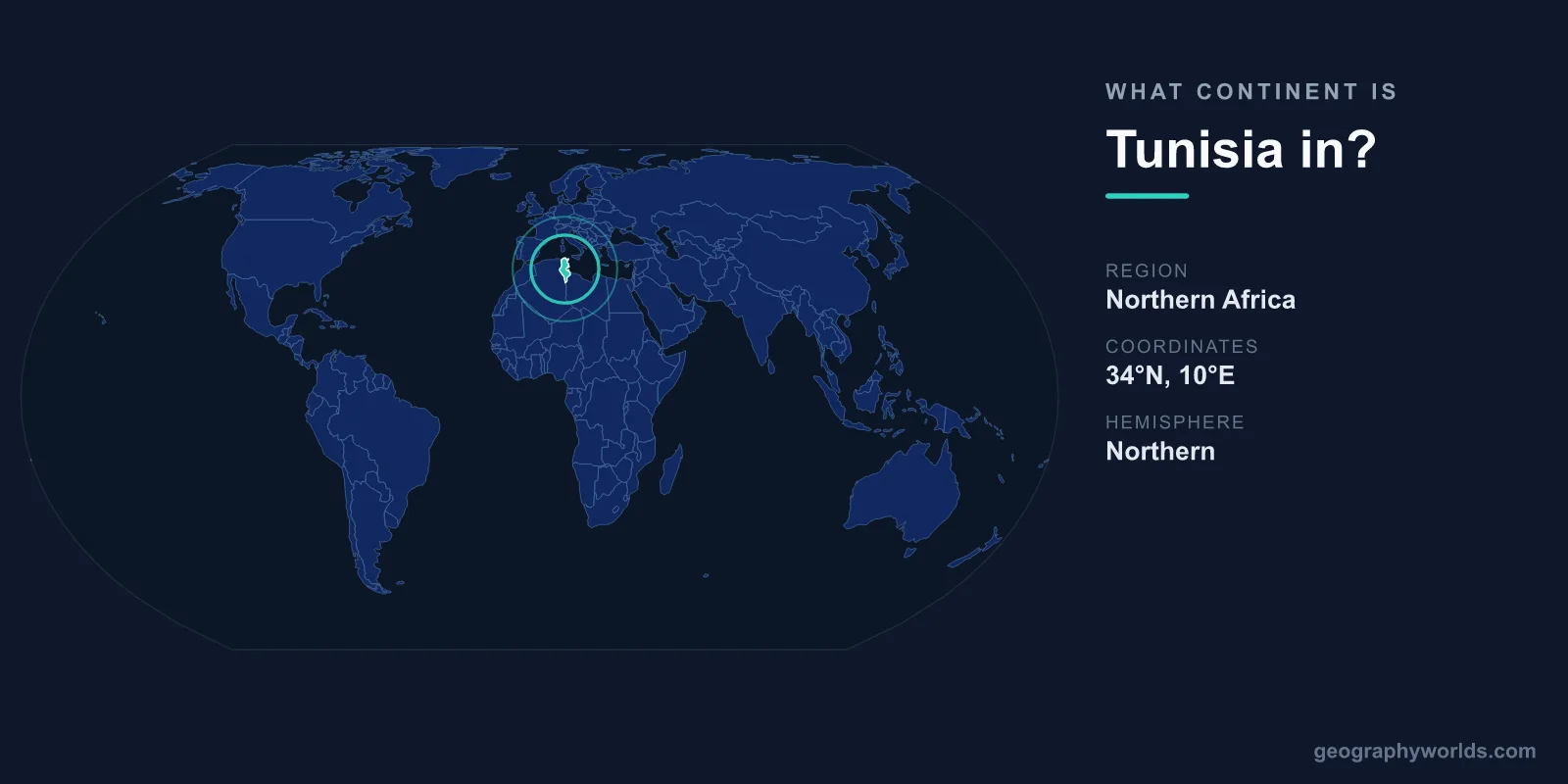
Tunisia is located in Africa, on the northern edge of the continent in the region known as North Africa or the Maghreb. It is, in fact, the northernmost country on the entire African continent, with its tip reaching closer to Europe than almost any other point in Africa. Tunisia stretches along the Mediterranean coast, wedged between Algeria to the west and Libya to the southeast.
Africa, and Specifically North Africa
There is no ambiguity about which continent Tunisia belongs to: it is firmly part of Africa. The United Nations classifies it under Northern Africa, alongside neighbours such as Algeria, Libya, Morocco, and Egypt. Tunisia is also a founding member of regional and continental bodies including the African Union and the Arab League, reflecting both its African geography and its Arab cultural identity.
Within North Africa, Tunisia forms the eastern anchor of the Maghreb, a band of countries running across the continent's northwest. Covering roughly 163,610 square kilometres, it is the smallest of the Maghreb states, yet its position at the top of Africa has made it one of the most strategically important. The capital, Tunis, sits on the northern coast and has served as a crossroads of Mediterranean trade for thousands of years. Although Africa is the world's second-largest continent and contains 54 fully recognised countries, only a handful of them touch the Mediterranean, and Tunisia is among them.
Where Exactly Is Tunisia?
Tunisia lies roughly between 30 and 37 degrees north latitude and 7 and 12 degrees east longitude. That places it in the temperate-to-subtropical band of the Northern Hemisphere, directly south of Italy and the central Mediterranean. The country is shaped a little like a wedge, narrow and mountainous in the north where it meets the sea, and broadening into desert plateaus as it extends southward toward the Sahara.
Because Tunisia sits at the pivot point of the Mediterranean basin, it has historically linked three worlds: the rest of Africa to the south, the Arab Middle East to the east, and Europe across the water to the north. Few countries occupy such a genuine geographic crossroads, and that location explains much about Tunisia's layered history and culture.
The Northernmost Point in Africa
Tunisia holds a remarkable geographic distinction: Cape Angela (Ras al-Abyad), just north of the city of Bizerte, is the northernmost point of the entire African continent. From here, mainland Africa reaches its closest approach to Europe along this stretch of the Mediterranean.
This northern thrust explains why Tunisia feels so deeply connected to the Mediterranean world. The Italian island of Sicily lies only about 140 kilometres across the water, and Tunisia's northern tip is actually closer to Rome than it is to many sub-Saharan African capitals such as Lagos. This proximity has shaped Tunisian history, cuisine, and culture, blending African, Arab, Berber, and European influences into a distinctive identity. The narrow waters between Tunisia and Sicily, known as the Strait of Sicily, divide the Mediterranean into its western and eastern basins, making the country a natural gatekeeper of one of the sea's busiest maritime corridors.
From Mediterranean Coast to Sahara Desert
Although it is a relatively compact country, Tunisia packs in dramatic geographic variety as you travel from north to south. Its landscapes change character almost completely across its length:
- The north: Fertile coastal plains and the foothills of the Atlas Mountains, watered by enough Mediterranean rainfall to support farming, vineyards, and olive groves.
- The centre: A transitional zone of drier steppe and semi-arid plateaus, where rainfall thins and the land gives way to grazing country.
- The south: The northern reaches of the Sahara Desert, with sand seas, oases, and vast salt flats.
Tunisia's highest point is Jebel ech Chambi, rising to 1,544 metres in the western interior. In the south lies Chott el Jerid, a huge endorheic salt lake and one of the largest salt flats in the Sahara, shimmering white and pink under the desert sun. With a coastline stretching about 1,148 kilometres, Tunisia balances arid interior terrain against a long, productive Mediterranean shore. The country's climate follows the same north-to-south gradient: a mild, rainy Mediterranean climate along the coast gives way to hot, dry desert conditions in the deep south, where summer temperatures regularly soar past 40 degrees Celsius.
Neighbours and a Crossroads Location
Tunisia shares land borders with just two countries: Algeria to the west, with which it has its longest frontier, and Libya to the southeast. To the north and east stretches the Mediterranean Sea, opening Tunisia directly toward southern Europe.
This position has made the territory a meeting point of civilisations for millennia. The ancient city of Carthage, founded by Phoenician settlers and later Rome's most formidable rival, stood in what is today a coastal suburb of Tunis. Across the centuries, Romans, Vandals, Byzantines, Arabs, Ottomans, and the French all left their mark, layering Tunisia's African foundations with Mediterranean and Middle Eastern heritage. You can explore more about the country's full geography and history in our tunisia country guide.
Key Facts
- Continent: Africa (North Africa / the Maghreb)
- UN region: Northern Africa
- Capital: Tunis, on the northern Mediterranean coast
- Area: About 163,610 square kilometres, the smallest Maghreb state
- Land neighbours: Algeria (west) and Libya (southeast)
- Northernmost point in Africa: Cape Angela (Ras al-Abyad), near Bizerte
- Highest point: Jebel ech Chambi, 1,544 metres
A Country of Surprising Fame
Tunisia's desert south has a claim to global pop-culture fame: it provided the otherworldly backdrop for the planet Tatooine in the Star Wars films. The fictional planet's name was borrowed directly from the real Tunisian town of Tataouine, and several iconic film sets still stand in the surrounding dunes and rock formations. It is a reminder that this small North African nation, perched at the very top of the continent, has long captured imaginations far beyond its borders.
Frequently Asked Questions
Is Tunisia in Africa or the Middle East?
Tunisia is geographically in Africa, specifically North Africa. However, because it is an Arabic-speaking, predominantly Muslim country and a member of the Arab League, it is sometimes grouped culturally with the Middle East and North Africa (MENA) region. Geographically, it is unambiguously African.
What region of Africa is Tunisia in?
Tunisia is in North Africa, and more specifically it forms part of the Maghreb, the northwestern region of the continent that also includes Algeria, Morocco, and Libya. The UN places it within Northern Africa.
Is Tunisia in Europe because it is so close?
No. Although Tunisia is only about 140 kilometres from Sicily and its northern tip is closer to Rome than to much of Africa, it lies entirely on the African continent. Its closeness to Europe has influenced its culture but does not change its location.
What continent borders Tunisia?
Tunisia is bordered on land only by African nations, Algeria and Libya. Across the Mediterranean Sea to the north lies the continent of Europe, with Italy being the nearest country.