
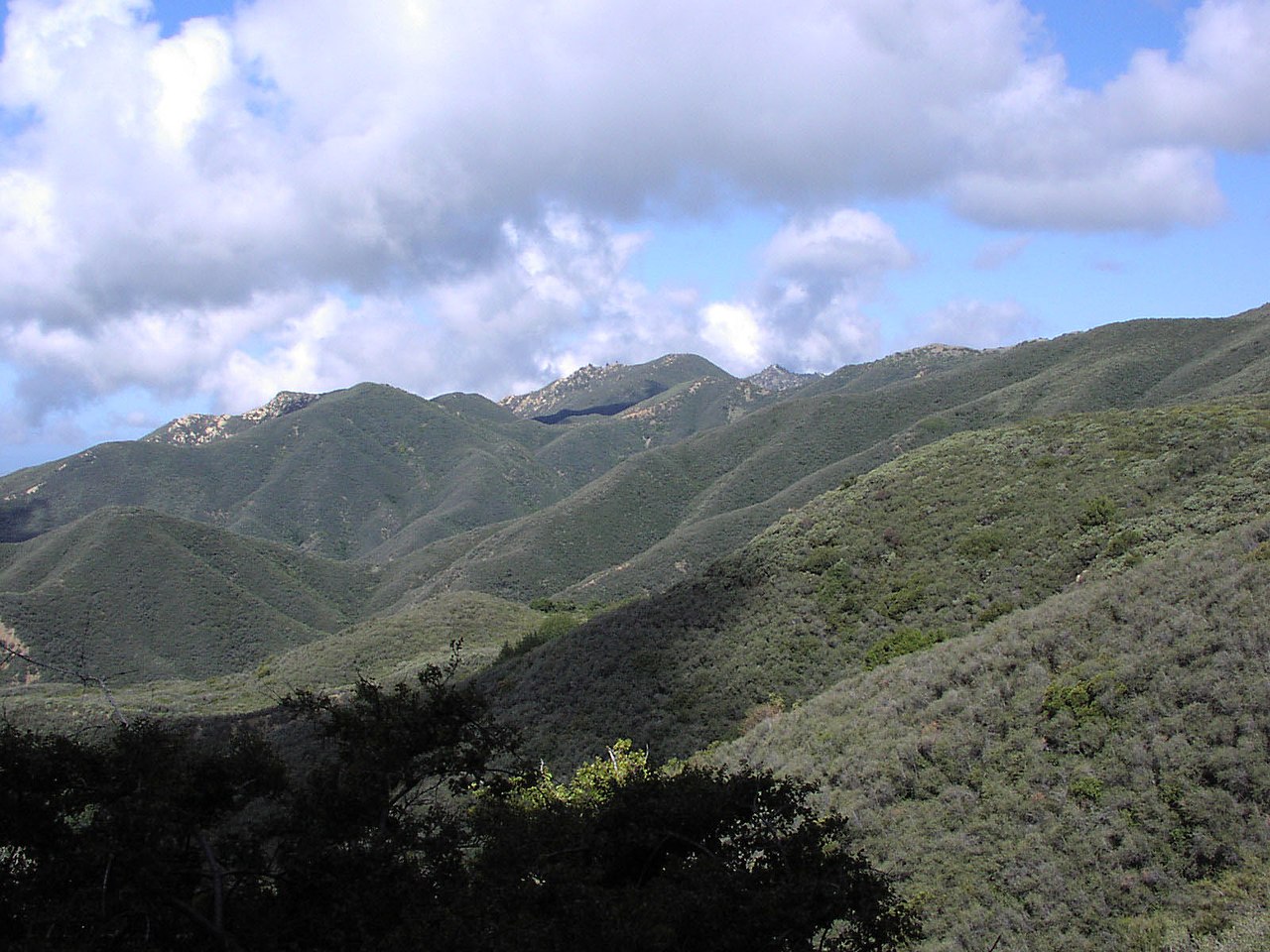
Drive through the hills of southern California in late summer and you see a particular vegetation: dense, dark green shrubs covering the hillsides, often 1-3 metres tall, with small thick leaves that look almost waxy. The plants are spaced just close enough that walking through them is difficult — they grab clothing, scratch skin, sometimes have thorns. The plants are largely the same species across many kilometres: chamise, manzanita, ceanothus, scrub oak, toyon. By late summer, the leaves often look dusty and stressed, and many of the plants have shed leaves to conserve water. This is chaparral — the fire-adapted shrubland of Mediterranean climates, and the defining vegetation of much of California. Similar shrublands exist in the other Mediterranean climate regions of the world — the Mediterranean basin itself, central Chile, southwestern Australia, and the southwestern Cape region of South Africa. Each region has its own distinctive shrubland with somewhat different plant species, but the basic ecology and adaptation to seasonal drought and fire is similar across all of them.
The Climate That Produces Chaparral
Chaparral occurs in Mediterranean climate regions — regions with hot, dry summers and mild, wet winters. The seasonal pattern is the opposite of what is typical in most temperate climates: rainfall is concentrated in winter rather than summer, and the summers are essentially rainless. Mean annual temperatures are typically 12-18°C; annual rainfall is 300-800 mm, with essentially all of it falling between November and March. The summer drought period typically extends from May to October, with months of zero rainfall. The combination — adequate but seasonal rainfall, hot dry summers, mild winters — produces a particular pattern of vegetation stress and adaptation. Plants must grow during the wet winter and spring, then survive the dry summer. The result is the distinctive chaparral vegetation: hardy evergreen shrubs with adaptations to drought, fire, and the irregular timing of rainfall.
The Five Mediterranean Climate Regions
Mediterranean climates are restricted to specific regions of the world, all on the western coasts of continents between approximately 30 and 45 degrees latitude. The five Mediterranean climate regions are: the Mediterranean basin itself (Spain, Portugal, southern France, Italy, Greece, the Levant, parts of North Africa); California and the adjacent Mexican Baja peninsula; central Chile (between approximately Coquimbo and Concepción); southwestern Australia (including Perth and the surrounding region); and the Cape Floristic Region of South Africa (the southwestern tip of the continent including Cape Town). Each region has its own version of the chaparral biome with different specific plant species. In California it is called chaparral. In the Mediterranean basin it is called "maquis" or "garrigue" depending on the density and structure. In Chile it is called "matorral." In Australia it is called "kwongan" in the southwest and "mallee" in some other regions. In South Africa it is called "fynbos."
The California Chaparral
California chaparral occupies approximately 9 percent of the state — about 35,000 square kilometres of shrubland across the coastal mountains and inland foothills. The plant community includes chamise (Adenostoma fasciculatum, the most abundant species), manzanita (various Arctostaphylos species), ceanothus (various species), toyon (Heteromeles arbutifolia), scrub oak (Quercus berberidifolia and others), and many subordinate species. Mature chaparral can have 50+ percent vegetation cover, with closely-spaced shrubs creating dense thickets. The total chaparral plant diversity in California is several hundred species. The plants typically have small, thick, sclerophyllous (hard, leathery) leaves that minimise water loss. Many have deep root systems that can reach water tables several metres below the surface. Some have specialised storage organs (lignotubers) that allow them to resprout after fire.
Fire Ecology
Fire is the defining ecological factor in chaparral. The vegetation is adapted to repeated burning. Native fire frequencies in California chaparral are approximately every 30-130 years — frequent enough to maintain the shrubland, not so frequent that the plants can't recover between fires. Many chaparral species are obligate seeders — they are killed by fire but their seeds (which are stored in the soil or on the plants) germinate vigorously after fire. Some species are obligate resprouters — they survive fire and resprout from underground burls or lignotubers. Both strategies are common in different species. Some species require fire-induced chemical cues from charcoal or smoke to germinate — their seeds will remain dormant for decades until a fire passes through. The result is a community that depends on fire for its long-term maintenance — fire-suppression policies that try to eliminate fires from chaparral ecosystems lead to vegetation succession changes, loss of species, and eventually catastrophic fires when conditions finally allow ignition.
The California Fire Problem
California's wildfire problem has multiple causes, but chaparral ecology is central to several of them. The combination of fire-adapted (and fire-dependent) vegetation, the seasonal drought that produces flammable conditions every year, the strong Santa Ana winds that drive major fires, and the expanding population of communities in fire-prone areas creates a difficult management problem. Major fires in chaparral can burn intensely, travel rapidly, and produce dangerous fire behaviour. The 2017 Thomas Fire, the 2018 Carr Fire, the 2018 Camp Fire, the 2019 Kincade Fire, and many others have been devastating events. The combination of climate change (longer fire seasons, drier vegetation, higher temperatures), accumulated fuel from decades of fire suppression, expanded human development into fire-prone areas, and the natural fire-adapted nature of the chaparral has produced an increasingly difficult management situation.
The Mediterranean Maquis
The "maquis" of the Mediterranean basin is the European analogue of California chaparral. The vegetation is similar in structure — dense evergreen shrubs with sclerophyllous leaves — but composed of different species. Olive (wild form), holm oak, carob, juniper, rosemary, oleander, mastic, myrtle, and many others dominate maquis communities. "Garrigue" is the lower, more open form of maquis. The maquis of Corsica gave the word "maquis" its other famous meaning — the resistance fighters during World War II were called "maquisards" because they hid in the impassable maquis vegetation. Mediterranean basin maquis communities are older than California chaparral in the sense that they have been heavily modified by human use over thousands of years — grazing, charcoal production, agricultural conversion. Much of what is now maquis was originally evergreen oak forest.
Cape Floristic Region and Beyond
The Cape Floristic Region of South Africa is the smallest of the five Mediterranean climate regions but one of the most biologically remarkable. The dominant vegetation type is fynbos — a fire-adapted shrubland with extraordinary biological diversity. The Cape Floristic Region contains approximately 9,000 plant species in an area of just 90,000 square kilometres — more plant species than the entire continent of Europe. Many of the species are endemic to the region. The southwestern Australian Mediterranean climate region contains the kwongan shrublands and the more open mallee woodlands. The kwongan is similarly biodiverse to the South African fynbos, containing perhaps 5,000 plant species. Chile's Mediterranean climate region is geographically isolated from other Mediterranean regions and has its own distinctive matorral shrubland with fewer total species but high endemism.
Plant Adaptations in Detail
Chaparral plants have evolved a remarkable set of adaptations to their seasonal climate and fire regime. Sclerophyllous leaves — small, thick, evergreen, with waxy coatings and reduced surface area — minimise water loss during the dry summer. Deep tap roots reach water tables that may be 5-10 metres below the surface, allowing the plants to access moisture long after surface soils have dried. Some species have specialised "drought-deciduous" strategies — they shed leaves during severe summer drought to reduce water demand, then re-leaf when winter rains return. Several species have aromatic oils in their leaves (chamise, sage, ceanothus) — the oils discourage herbivores and may also play a role in fire dynamics, increasing flammability when the dry summer arrives. Many chaparral species are nitrogen-fixers (particularly in the Ceanothus genus), helping the community persist on the relatively nutrient-poor soils typical of chaparral regions.
Animal Communities
Chaparral supports distinctive animal communities adapted to the dense vegetation and seasonal climate. Mule deer, mountain lions, coyotes, bobcats, gray foxes, and various smaller mammals occupy California chaparral. The California gnatcatcher, the wrentit, the California thrasher, and various other birds are chaparral specialists. Various lizards, snakes, and amphibians depend on the chaparral environment. The fire-adapted nature of chaparral extends to its animals — some species have evolved life cycles that take advantage of the fire-recovery cycle, with rapid colonisation of recently burned areas. The animal communities have been substantially affected by the conversion of natural chaparral to housing developments, with some chaparral specialists now listed as threatened or endangered.
The Mediterranean Climate Future
Climate change is affecting all five Mediterranean climate regions. The basic Mediterranean climate pattern — hot dry summers, mild wet winters — is being intensified in many cases. Summer drought is becoming longer and more severe in many regions. Annual rainfall is decreasing in some Mediterranean regions and shifting in timing in others. Fire activity is increasing — the lengthening fire season, drier vegetation, and changing wind patterns are all contributing. The challenges to chaparral and analogous ecosystems include: changes in plant species composition as some species cannot tolerate the changing conditions; increased fire frequency that exceeds the recovery capacity of even fire-adapted species; reduced winter rain that affects the seasonal water balance; increased pressure from invasive species; and continued human encroachment that reduces total habitat area. The continued integrity of the world's Mediterranean climate biomes — among the most biologically remarkable ecosystems on Earth — is one of the major conservation challenges of the coming decades.