
A continental shelf is the gently sloping, shallow underwater extension of a continent that stretches from the shoreline out to the "shelf break," where the seabed drops steeply into the deep ocean. Continental shelves average about 80 kilometers in width but can extend over 1,500 kilometers in some areas, and they rarely exceed 200 meters in depth. Though they make up only about 8% of the ocean's total area, continental shelves are among the most biologically productive and economically valuable regions on Earth.
Definition and Structure
A continental shelf is geologically part of the continent, not the ocean floor. It is composed of continental crust — the same rock that makes up the land — temporarily submerged by seawater. During the last Ice Age, when sea levels were roughly 120 meters lower than today, most continental shelves were dry land. The English Channel, the North Sea, and the Persian Gulf were all exposed land that humans walked across.
How Continental Shelves Form
- Sediment Accumulation: Rivers deposit sediment at the continental margin over millions of years
- Tectonic Extension: As continents rift apart, the thinning edge subsides below sea level
- Sea Level Changes: Rising seas flood the low-lying continental margins
- Glacial Erosion: Ice sheets can widen shelves by grinding down the continental edge
Continental shelves form where the edge of a continent meets the ocean. Over millions of years, rivers carry sediment from the interior of the continent to the coast, where it accumulates in layers on the shallow seabed. This process gradually extends the shelf outward. Tectonic activity also plays a role: when continents rift apart, the stretched and thinned continental crust at the margins subsides below sea level, creating a broad, gently sloping platform.
The width of a continental shelf depends on the tectonic setting. Passive continental margins (those without nearby plate boundaries), like the east coast of North America or the coast of western Africa, tend to have wide shelves because sediment has been accumulating undisturbed for tens of millions of years. Active continental margins (those with subduction zones or transform faults), like the west coast of South America, tend to have very narrow shelves because the tectonic activity prevents sediment buildup.
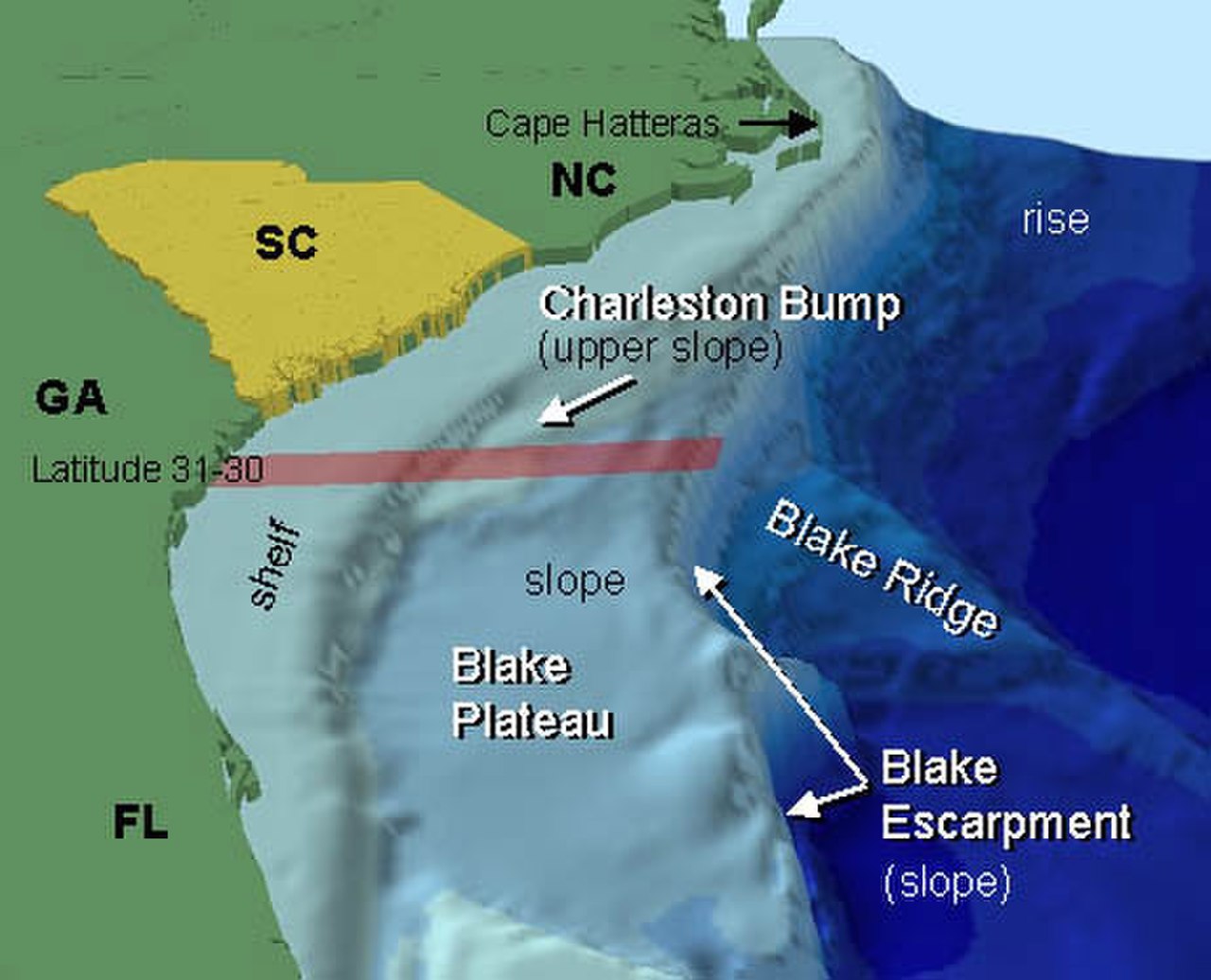
The Three Zones of a Continental Margin
- Continental Shelf: The shallow, flat or gently sloping zone from shore to the shelf break (0-200 m depth)
- Continental Slope: The steep drop-off from the shelf break to the deep ocean floor (200-3,000 m)
- Continental Rise: A gentler slope of accumulated sediment at the base (3,000-5,000 m)
The shelf break — where the gentle shelf gives way to the steep continental slope — is one of the most important boundaries in oceanography. It marks the transition from shallow, sunlit, nutrient-rich waters to the dark, cold deep ocean. Many marine species concentrate near the shelf break, and major ocean currents are deflected by it. Fishermen have known for centuries that the best fishing grounds often lie along or near the shelf break.
Why Continental Shelves Matter
- Fisheries: 90% of the world's fish catch comes from continental shelf waters
- Oil and Gas: Major deposits are trapped in sedimentary layers beneath the shelf
- Minerals: Sand, gravel, and mineral deposits are mined from shelf sediments
- Biodiversity: Shallow, sunlit shelf waters support most marine productivity
- Territorial Claims: Under UNCLOS, nations have sovereign rights over their continental shelf resources
Continental shelves are extraordinarily productive because sunlight penetrates the shallow water all the way to the seabed, allowing photosynthesis throughout the water column. Nutrients from river runoff and upwelling from the deep ocean further fuel productivity. As a result, roughly 90% of the world's commercial fish catch comes from continental shelf waters, even though shelves make up only about 8% of ocean area.
The sedimentary layers beneath continental shelves trap enormous reserves of oil and natural gas. Offshore drilling on continental shelves produces about 30% of the world's oil supply. Major oil-producing shelves include the Gulf of Mexico, the North Sea, the Persian Gulf, and offshore Brazil. These reserves are the product of millions of years of organic material accumulating in shelf sediments and being slowly transformed into hydrocarbons by heat and pressure.
Continental Shelves and International Law
- Exclusive Economic Zone (EEZ): Nations control resources out to 200 nautical miles from shore
- Extended Continental Shelf: If the geological shelf extends beyond 200 nm, nations can claim rights up to 350 nm
- UNCLOS: The UN Convention on the Law of the Sea governs continental shelf claims
- Disputes: Overlapping shelf claims are a major source of international tension
Under the United Nations Convention on the Law of the Sea (UNCLOS), every coastal nation has sovereign rights over the natural resources of its continental shelf out to 200 nautical miles from shore. If a nation can demonstrate that its geological continental shelf extends beyond 200 nautical miles, it can claim rights up to 350 nautical miles. Russia, Canada, Denmark, and Norway have all submitted claims over the extended continental shelf beneath the Arctic Ocean, where vast untapped oil and gas reserves are believed to exist.
These shelf claims have become a major source of geopolitical tension. The South China Sea dispute involves overlapping continental shelf claims by China, Vietnam, the Philippines, Malaysia, Brunei, and Taiwan. The Arctic continental shelf is contested by five nations as melting sea ice makes resource extraction increasingly feasible.
Key Facts
- A continental shelf is the shallow, submerged extension of a continent, averaging 80 km wide.
- Continental shelves are geologically part of the continent, not the ocean floor.
- About 90% of the world's fish catch comes from continental shelf waters.
- During the last Ice Age, most continental shelves were dry land.
- Nations have sovereign rights over continental shelf resources under international law.
Fun Facts
- During the Ice Age, humans walked from France to England, from Alaska to Russia, and from Australia to Papua New Guinea across exposed continental shelves.
- The Siberian Shelf in the Arctic is the widest continental shelf on Earth, extending over 1,500 km from the Russian coast.
- Fishermen discovered the Grand Banks of Newfoundland in the 1400s — this broad continental shelf was once the richest fishing ground in the world.
- Doggerland, the continental shelf between Britain and continental Europe, was a populated landscape with rivers, lakes, and settlements before it was flooded about 8,000 years ago.
Final Thoughts
Continental shelves are where the land meets the sea in the most consequential way. These submerged platforms support the vast majority of the world's fisheries, harbor enormous energy reserves, shelter critical marine ecosystems, and are at the center of some of the most contentious geopolitical disputes of our time. Understanding continental shelves is essential for managing ocean resources sustainably and navigating the complex intersection of geology, biology, economics, and international law.
Test Your Knowledge!
Think you know your geographic features? Try our interactive quiz!
Play Geography Games →