
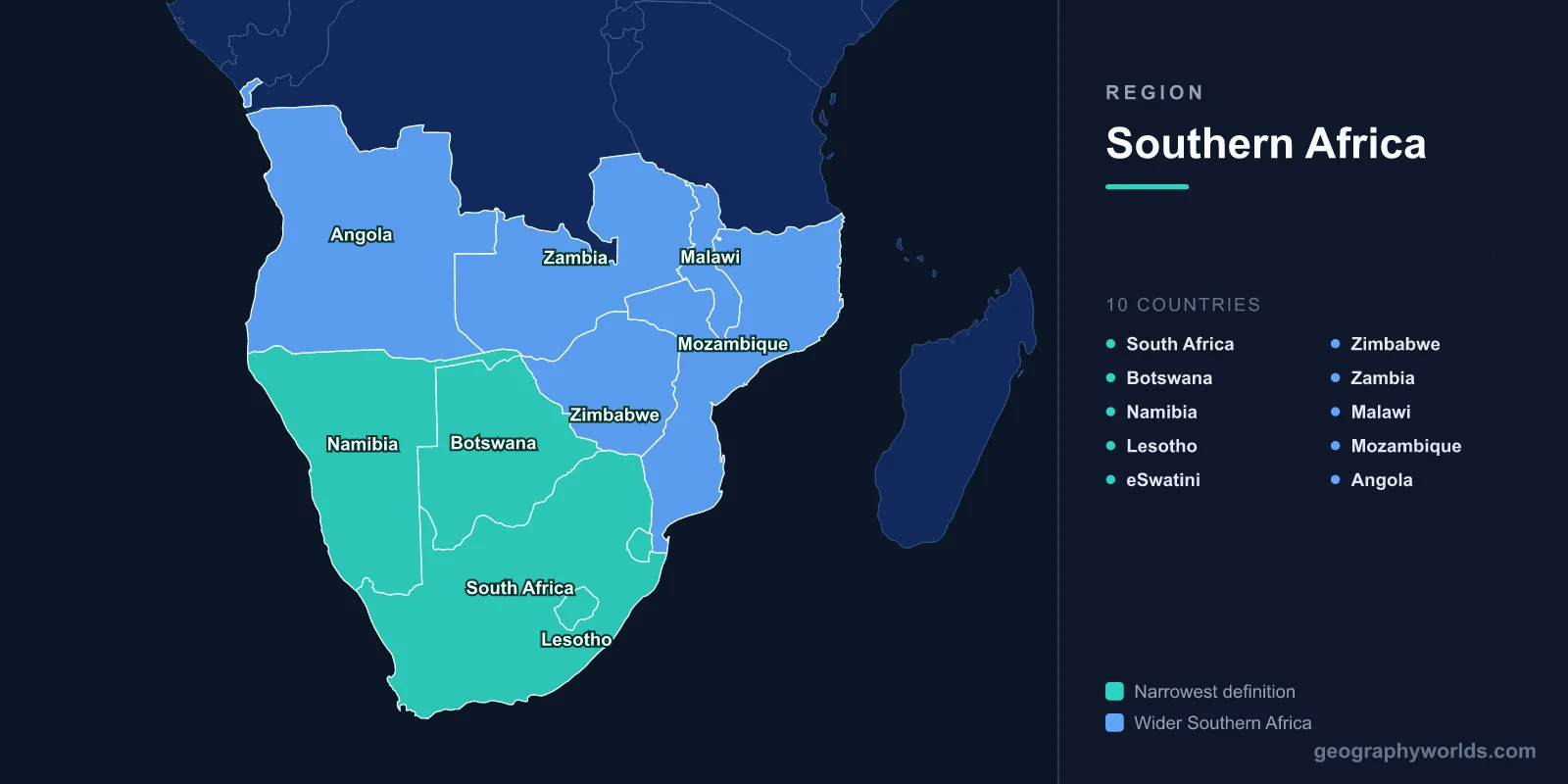
Southern Africa is the southernmost region of the African continent, occupying the broad southern bulge of the landmass between the South Atlantic and Indian Oceans. The region is dominated geographically and economically by South Africa, the largest country in the region and one of the most developed economies on the continent. The other countries of Southern Africa — Botswana, Namibia, Lesotho, Eswatini (formerly Swaziland), Zimbabwe, Zambia, Malawi, Mozambique, and Angola — together with South Africa form a region of approximately 200 million people spread across 5 million square kilometres. The region contains the Kalahari Desert, the Cape Floristic Region (one of the world's most botanically diverse), the Drakensberg mountains, Victoria Falls (one of the world's largest waterfalls), the Okavango Delta, and a long history of human civilisation. Southern Africa is a distinct subregion of sub-Saharan Africa, with its own political institutions, economic patterns, and cultural identities that have evolved over millennia.
What Counts as Southern Africa
The exact definition of "Southern Africa" varies depending on context. The most common political definition is the membership of the Southern African Development Community (SADC), which currently includes 16 member states — but only about 10 of these are clearly geographically "southern" rather than central African. The narrowest geographic definition includes only South Africa, Botswana, Namibia, Lesotho, and Eswatini — the southernmost cluster of countries below approximately 20 degrees south latitude. A broader definition adds Zimbabwe, Zambia, Malawi, and Mozambique. The broadest definition includes Angola and parts of Madagascar and the Indian Ocean islands. The 10-country cluster is the most common working definition. The combined area is approximately 5 million square kilometres; the combined population is around 200 million.
South Africa as the Hub
South Africa dominates the region in essentially every dimension. Its GDP is approximately one-third of the entire continent's GDP. Its industrial economy is the most developed in sub-Saharan Africa. Its population of 62 million is the largest of the regional countries. Its infrastructure (roads, ports, railways, telecommunications, electricity) is by far the most extensive in the region. Johannesburg is the largest city, with a metropolitan population of approximately 15 million; Cape Town and Durban are also major cities. The country has three capital cities — Pretoria (executive), Cape Town (legislative), and Bloemfontein (judicial) — reflecting its complex political history. South Africa's historical role in the region has been complex; the country was a regional hegemon during the apartheid era, often involved in destabilising neighbouring countries, and has continued as a regional leader though in different ways since the 1994 democratic transition.
The Geological Setting
Southern Africa sits on the southern portion of the African plate, with a geological history that spans much of Earth's history. The region contains some of the oldest rocks on the planet — the Barberton Greenstone Belt in northeastern South Africa includes rocks dated to approximately 3.5 billion years old, among the oldest preserved rocks on Earth. The Kaapvaal Craton — an ancient block of continental crust underlying much of the eastern half of southern Africa — has been geologically stable for over 3 billion years. The region is mineral-rich, with substantial deposits of gold (the world's largest gold deposits, particularly the Witwatersrand Basin), diamonds (the Kimberley diamond fields and various offshore deposits), platinum (the world's largest platinum deposits in the Bushveld Igneous Complex), and many other commodities. Mining has been the foundation of South Africa's economic development since the 19th century and continues to be a major economic sector.
The Kalahari
The Kalahari Desert covers approximately 900,000 square kilometres across Botswana, Namibia, and South Africa. Despite its name, the Kalahari is not a true desert in the strictest sense — it receives more rainfall than the Sahara or other extreme deserts, and it supports more vegetation. The Kalahari is technically a "semi-arid sandveld" — a vast sandy plain with seasonal grasses and shrubs, dotted with occasional waterholes. It is home to substantial wildlife including African elephants, lions, leopards, cheetahs, giraffes, zebras, and many antelope species. The Central Kalahari Game Reserve in Botswana is one of the largest protected areas in Africa. The Kalahari has been the historical homeland of the San peoples (the "Bushmen") for tens of thousands of years; their distinctive hunting and gathering culture has been substantially studied as one of the oldest continuous human cultures on Earth.
The Cape
The Cape Floristic Region is the southwestern tip of the African continent — the area around Cape Town and the Western Cape province of South Africa. This relatively small region (approximately 90,000 square kilometres) is one of the world's six floral kingdoms and one of the most botanically diverse places on Earth. The region contains approximately 9,000 plant species — more than the entire continent of Europe — in an area smaller than Hungary. About 70 percent of the species are endemic to the region. The dominant vegetation is fynbos — a fire-adapted shrubland with extraordinary species diversity. The Cape Floristic Region is a UNESCO World Heritage Site and is one of the world's most important biodiversity hotspots. The Mediterranean climate of the region (hot dry summers, mild wet winters) is one of only five such climates worldwide.
Victoria Falls and the Zambezi
The Zambezi River, the fourth-longest in Africa at approximately 2,700 kilometres, flows through the central Southern African region. About midway along its course, between Zambia and Zimbabwe, the river plunges over Victoria Falls — one of the largest and most spectacular waterfalls in the world. The Falls are approximately 1,700 metres wide and 108 metres tall — wider than Iguazu and Niagara though not as tall. During the wet season (February-May), the Falls produce a vast spray cloud visible from kilometres away, giving the local Kololo name "Mosi-oa-Tunya" — "the smoke that thunders." The Falls have been a UNESCO World Heritage Site since 1989 and are one of the major tourist attractions in southern Africa. The town of Victoria Falls (Zimbabwe) and Livingstone (Zambia) are the main tourism hubs serving the Falls area.
The Apartheid Legacy
South Africa's apartheid era (1948-1994) cast a long shadow over the whole region. Apartheid policies enforced racial segregation in South Africa and produced substantial regional consequences — destabilising operations in neighbouring countries, supporting proxy wars in Angola and Mozambique, and reinforcing patterns of regional economic dependence on the apartheid state. The democratic transition in 1994, led by Nelson Mandela and the African National Congress, was one of the most significant political events in modern African history. The transition was followed by the establishment of the Truth and Reconciliation Commission, which produced a substantial documentary record of apartheid-era abuses. South Africa's post-apartheid governments have substantially altered the country's domestic and foreign policy, though many of the underlying social and economic inequalities of the apartheid era continue to shape the country today.
Regional Institutions
The Southern African Development Community (SADC) is the primary regional political and economic institution. SADC has 16 member states, including the Southern African countries plus several Central African and Indian Ocean states. SADC promotes regional economic integration, political coordination, security cooperation, and various other goals. The Southern African Customs Union (SACU), one of the oldest customs unions in the world (founded in 1910), links South Africa, Botswana, Lesotho, Eswatini, and Namibia in a unified customs area. The Common Monetary Area (CMA) similarly links the four smaller countries to the South African rand, with their currencies pegged 1:1 to the rand. These institutions have facilitated regional trade and economic coordination, though the practical level of integration varies substantially across the different agreements.
Cultural Diversity
Southern Africa contains substantial cultural and linguistic diversity. South Africa alone has 12 official languages (English, Afrikaans, Zulu, Xhosa, Sotho, Tswana, Pedi, Tsonga, Swati, Ndebele, Venda, and SA Sign Language). Other Southern African countries have their own languages and language groups. The major language families include Bantu languages (Zulu, Xhosa, Shona, Tswana, and others), Khoisan languages (the click languages of the San and Khoekhoe peoples), Afrikaans (the most-spoken language in southwestern South Africa), and English and Portuguese (the colonial-era languages). The cultural diversity is reflected in music (the various musical traditions of southern Africa have produced internationally famous artists like Hugh Masekela, Miriam Makeba, Ladysmith Black Mambazo), art, dance, literature, and many other dimensions of expression.
The Economic Patterns
The regional economy is dominated by South Africa but includes substantial activity in mining, agriculture, tourism, and manufacturing across the region. Botswana has the second-highest per capita income in mainland sub-Saharan Africa (after Equatorial Guinea), based primarily on diamond mining and beef exports. Namibia and Zambia are similarly mineral-rich (uranium and copper, respectively) but with different economic structures. Zimbabwe, once one of the more prosperous countries in the region, has experienced substantial economic decline since the 2000s. Malawi and Mozambique are among the poorest countries in the region. Lesotho and Eswatini have particularly limited economies and are highly dependent on South African remittances and trade. The mining-and-agriculture economic base, the dependence on South Africa, the inequality both within countries and between them, and the legacy of colonial and apartheid-era patterns continue to shape Southern African economic life.
The Continued Trajectory
Southern Africa's trajectory is being shaped by several major forces. Climate change is producing increasing drought and water stress, particularly in the southwestern arid regions. Migration from rural to urban areas continues, with major implications for cities like Johannesburg, Cape Town, Luanda (Angola), Maputo (Mozambique), and others. Youth unemployment is a major challenge across the region — South Africa's youth unemployment rate is among the highest in the world. The Chinese presence in the region has grown substantially, with substantial Chinese investments in mining, infrastructure, and various other sectors. The region's 200 million people face substantial development challenges but also have substantial natural and human resources to work with. The continued evolution of Southern Africa — politically, economically, and culturally — will be one of the major regional stories of the coming decades, shaping not just the southern tip of Africa but the broader trajectory of the continent.