
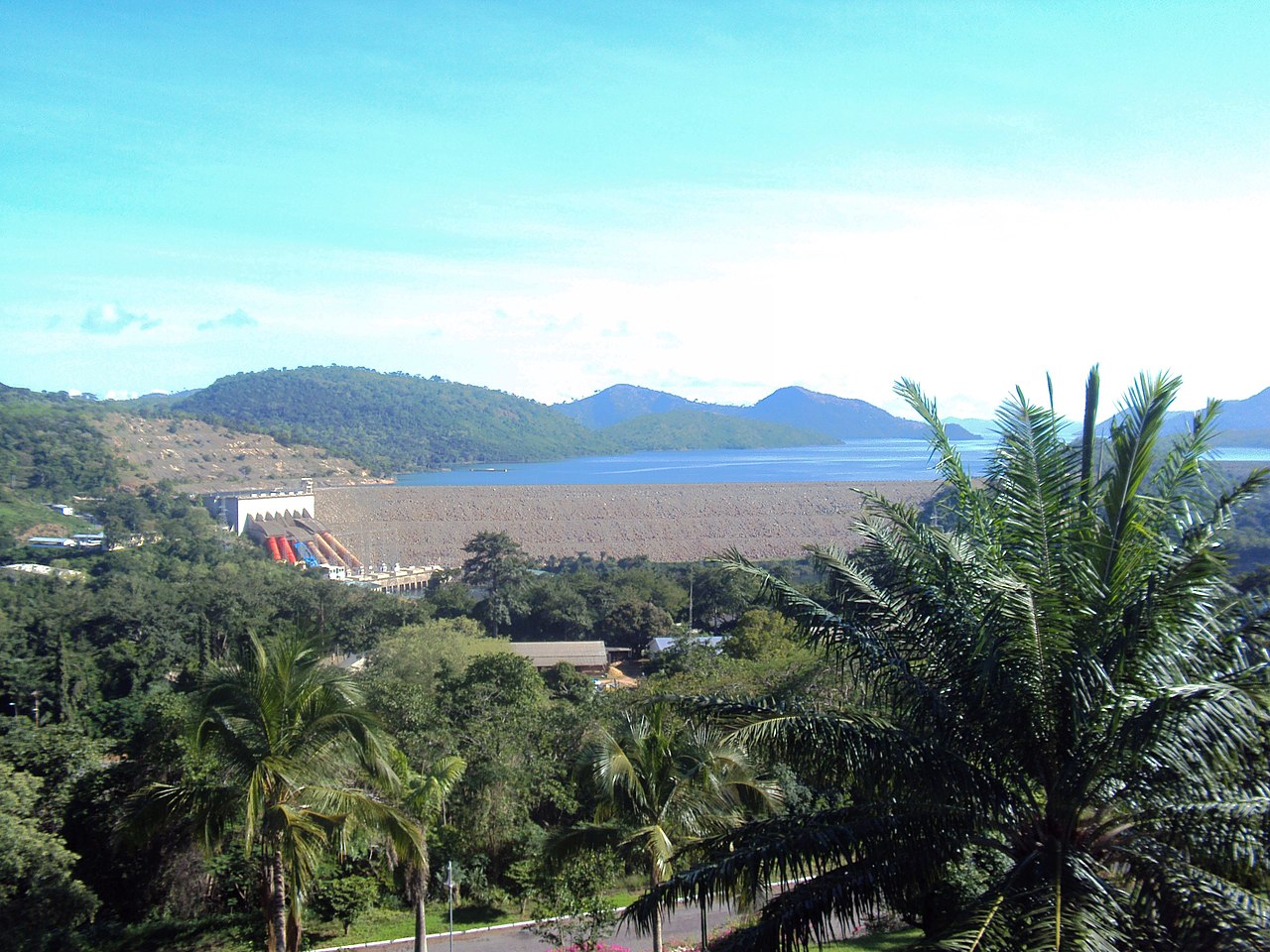
The Akosombo Dam is a rock-fill embankment dam on the Volta River in south-eastern Ghana, completed in 1965. Its reservoir, Lake Volta, covers roughly 8,500 square kilometres — the largest artificial lake in the world by surface area — and its power station generates around 1,020 megawatts, for decades the backbone of Ghana's electricity supply.

Few infrastructure projects have reshaped a country's physical geography as thoroughly as Akosombo reshaped Ghana's. The dam did not merely generate power; it redrew the map, created an inland sea, displaced tens of thousands of people, and tied the national economy to a single aluminium smelter for a generation. It is simultaneously one of post-independence Africa's landmark achievements and one of its most instructive cautionary tales.
Where the Akosombo Dam Is and What It Does
The dam sits in the Akosombo gorge in Ghana's Eastern Region, roughly 100 kilometres upstream from where the Volta River meets the Gulf of Guinea. The gorge was chosen for straightforward engineering reasons: the river narrows sharply between hard quartzite ridges, meaning a relatively modest structure could impound an enormous volume of water. The site's potential was identified as early as 1915 by the geologist Albert Ernest Kitson, decades before anyone could finance building on it.
The dam performs three functions:
- Hydroelectric generation — its primary purpose, feeding Ghana's national grid and exporting to neighbouring countries.
- Water storage — the reservoir buffers the Volta's strongly seasonal flow, though it cannot fully insulate the system from multi-year drought.
- Inland navigation — Lake Volta provides a north–south water route through a country whose transport links otherwise run awkwardly against the grain of its geography.
It is operated by the Volta River Authority, the state utility created specifically to build and run it.
Building the Dam: Nkrumah, Aluminium and Cold War Finance
Akosombo was Kwame Nkrumah's signature project, and it was explicitly political. Ghana became independent in 1957, and Nkrumah wanted an industrial base rather than an economy exporting raw cocoa and unprocessed bauxite. The plan was integrated: dam the Volta, use the power to smelt Ghanaian bauxite into aluminium domestically, and capture the value added at home.
Construction ran from 1961 to 1965, and the dam was formally inaugurated in January 1966 — just weeks before Nkrumah was deposed in a military coup. Financing came from the World Bank, the United States and the United Kingdom, and the American involvement was entangled with Cold War calculations about keeping a prominent non-aligned African leader from turning further toward the Soviet bloc.
The VALCO Bargain
The critical condition was a guaranteed customer. The Volta Aluminium Company smelter at Tema, controlled by American aluminium interests, contracted to buy a very large share of Akosombo's output at a rate fixed far below what other consumers paid — a deal locked in for decades.
The integration Nkrumah intended never fully materialised. VALCO largely imported alumina rather than processing Ghanaian bauxite, so the country supplied cheap electricity without capturing the upstream value. For years a single smelter consumed a substantial fraction of national generation on preferential terms while Ghanaian households and businesses faced shortages. The contract was renegotiated repeatedly, and the smelter has operated intermittently since. It remains the standard example of how a well-built dam can still yield a poor bargain.
Engineering and Structure
Akosombo is a rock-fill embankment dam with a clay core — a design that uses locally quarried material rather than the vast volumes of concrete a gravity dam requires, which suited both the site and the budget.
- Height — roughly 114 metres above the foundation.
- Crest length — approximately 660 metres across the gorge.
- Installed capacity — originally 912 megawatts from six turbines, raised to about 1,020 megawatts following a retrofit programme completed in the early 2000s.
- Spillway — a gated spillway on the eastern side, used sparingly. Spilling is significant news in Ghana, because releases flood downstream communities in the Volta delta.
A second, smaller dam was later built at Kpong, about 25 kilometres downstream, commissioned in 1982 with around 160 megawatts of capacity. It functions as a re-regulating dam, smoothing the flow Akosombo releases. Much later, the Bui Dam on the Black Volta added roughly 400 megawatts in 2013.
Lake Volta: The World's Largest Reservoir by Area
Filling the reservoir took several years, and the result is one of the most conspicuous human alterations to any national landscape.
- Surface area — roughly 8,500 square kilometres, larger than any other artificial lake on Earth by area, and equivalent to about 3.6% of Ghana's total territory.
- Length — around 400 kilometres from the dam northward, reaching well into the country's interior.
- Volume — approximately 148 cubic kilometres. This is large but not a world record: Lake Kariba on the Zambezi holds substantially more water in a smaller footprint, because Lake Volta is broad and comparatively shallow.
That shape — wide and shallow — has consequences. High surface area means high evaporation losses in a hot climate. It also means an immense shoreline, which is where most of the dam's social and health effects concentrated. In area terms Lake Volta now ranks among Africa's biggest lakes overall, though the great tectonic lakes still dwarf it in depth and volume, as our guide to the largest lakes in Africa sets out.
The Lake as Transport — and as Hazard
Ferries and cargo boats run the length of the lake, linking the north of the country to the industrial south. The route matters economically, but it is dangerous. Much of the forest drowned during filling was never cleared, leaving submerged tree stumps that hole boats decades later, and overloaded vessels contribute to a persistent record of fatal accidents.
The lake also supports a large inland fishery, which has become notorious for a serious problem: documented use of trafficked child labour in fishing operations, with children employed to dive and free nets snagged on those same submerged stumps. Ghanaian authorities and international organisations have run repeated interventions, but enforcement across a 400-kilometre lake with thousands of small landing sites remains extremely difficult.
Power: What Akosombo Delivers and Why It's No Longer Enough
For decades Akosombo supplied the overwhelming majority of Ghana's electricity, and it enabled early exports to Togo and Benin — a rare case of an African country being a net power exporter. Our Ghana country guide covers the wider economy.
But dependence on a single hydro source proved fragile in a country with a strongly seasonal, drought-prone climate:
- 1983–84 — severe drought across West Africa dropped lake levels far enough to force drastic load shedding and curtail smelter operations.
- 1998 — another drought produced a comparable crisis.
- 2006–07 — low inflows again triggered rolling blackouts.
- 2012 onward — the sustained power crisis Ghanaians call dumsor ("off-on"), driven by a mix of low water, generation shortfalls, fuel supply problems and utility debt.
The structural lesson was learned. Ghana has since built substantial thermal capacity, running on domestic gas from offshore fields and on the West African Gas Pipeline, and has begun adding solar. Hydro's share of generation has fallen from near-total to roughly a third or less. Akosombo remains vital — and it remains the cheapest power on the system — but it is no longer the whole system, which is a considerably safer position.
Akosombo vs Aswan and Kariba: Africa's Great Dams Compared
Akosombo belongs to a small cohort of mid-twentieth-century African megadams, and comparing them clarifies what is distinctive about it.
- Reservoir area — Lake Volta leads at roughly 8,500 km², ahead of Lake Kariba at around 5,600 km² and Lake Nasser behind the Aswan High Dam at around 5,250 km².
- Reservoir volume — the ranking inverts. Kariba holds roughly 180 km³ and Lake Nasser roughly 132 to 157 km³ depending on level, against Lake Volta's roughly 148 km³ spread far more thinly.
- Generating capacity — Aswan leads at about 2,100 MW, then Kariba at roughly 1,600 MW across its Zambian and Zimbabwean stations, then Akosombo at about 1,020 MW.
- Displacement — Akosombo resettled around 80,000 people. Aswan displaced a comparable or larger number of Nubians in Egypt and Sudan, and flooded archaeological sites that required the relocation of temples including Abu Simbel.
- Downstream sediment — all three trap sediment and starve their deltas. Aswan's effect on the Nile Delta is the most studied case globally; Akosombo produced the same pattern of coastal erosion on a smaller scale.
- Purpose — Aswan was built primarily for irrigation and flood control, with power as a major secondary benefit. Akosombo and Kariba were built essentially for electricity alone.
Against the modern generation of megaprojects, all three are modest. The Three Gorges Dam in China has more than twenty times Akosombo's generating capacity. And compared with the Hoover Dam, which inspired much of this era's dam-building, Akosombo's reservoir is far larger while its power output is broadly comparable — the difference being that Hoover is a tall concrete arch in a deep canyon, while Akosombo is an embankment closing a gorge above a broad, shallow basin.
The Human and Environmental Ledger
Akosombo's costs were substantial, and they were distributed very unevenly.
Resettlement
Around 80,000 people from more than 700 villages were relocated into 52 planned resettlement townships. The programme was ambitious for its era and, by the standards of comparable projects, not unusually badly run — but it went wrong in familiar ways. Resettled farmers received plots that were often smaller and less fertile than what they had lost, the new towns concentrated populations beyond what surrounding land could support, promised infrastructure arrived late or never, and many people eventually drifted away from the townships entirely. Compensation disputes persisted for decades.
Downstream and Coastal Effects
- Delta erosion — with sediment trapped behind the dam, the Volta delta no longer receives the material that maintained its shoreline. Coastal erosion around Ada and the Keta area has been severe, in places removing land at rates measured in metres per year and requiring expensive sea defences.
- Fishery collapse — the downstream clam fishery, which depended on the river's natural flood and sediment regime, largely failed.
- Flooding from spills — because communities settled the downstream floodplain during decades of regulated flow, controlled spillway releases during high-water years now displace thousands of people, most recently and severely in 2023.
Disease
The health record cuts both ways, which is unusual and worth stating plainly. The vast new shoreline created ideal habitat for the snails that host Schistosoma, and schistosomiasis (bilharzia) prevalence rose sharply in lakeside communities, particularly among children. At the same time, drowning the fast-flowing rapids downstream destroyed the breeding sites of the blackflies that transmit onchocerciasis, and river blindness declined markedly in those areas. One disease was created by the reservoir; another was suppressed by it.
Sixty years on, the fairest assessment is that Akosombo delivered exactly the engineering it promised and roughly half the development it was sold on. The dam works, the power is cheap, and the lake is a permanent feature of Ghanaian geography. What failed was the surrounding bargain — the smelter deal, the resettlement follow-through, and the assumption that a single reservoir in a drought-prone basin could carry a national grid indefinitely.
Test Your Knowledge!
Can you locate the world's greatest dams and reservoirs on the map?
Play Geography Games →