
Introduction
Colombia 🇨🇴 and Venezuela 🇻🇪 share a long border across the north of South America, along with the Andes, a Caribbean coastline, and a common Spanish-speaking heritage. Yet the two neighbours differ in size, population, and the natural wonders each is known for. This comparison sets them against one another across area, demographics, capitals, climate, and landscape.
Whether you are studying South America, planning a journey through the region, or simply curious how these two countries compare, the tables and figures below lay out the key facts.
Size & Geography
| Feature | Colombia 🇨🇴 | Venezuela 🇻🇪 |
|---|---|---|
| Area | 1,141,748 km² | 912,050 km² |
| Continent | South America | South America |
| Region | South America | South America |
| Land Borders | Venezuela, Brazil, Peru, Ecuador, Panama | Colombia, Brazil, Guyana |
| Landscape | Andes mountains, Caribbean and Pacific coasts, Amazon basin | Andes Mountains, Lake Maracaibo, Llanos plains, Guiana Highlands |
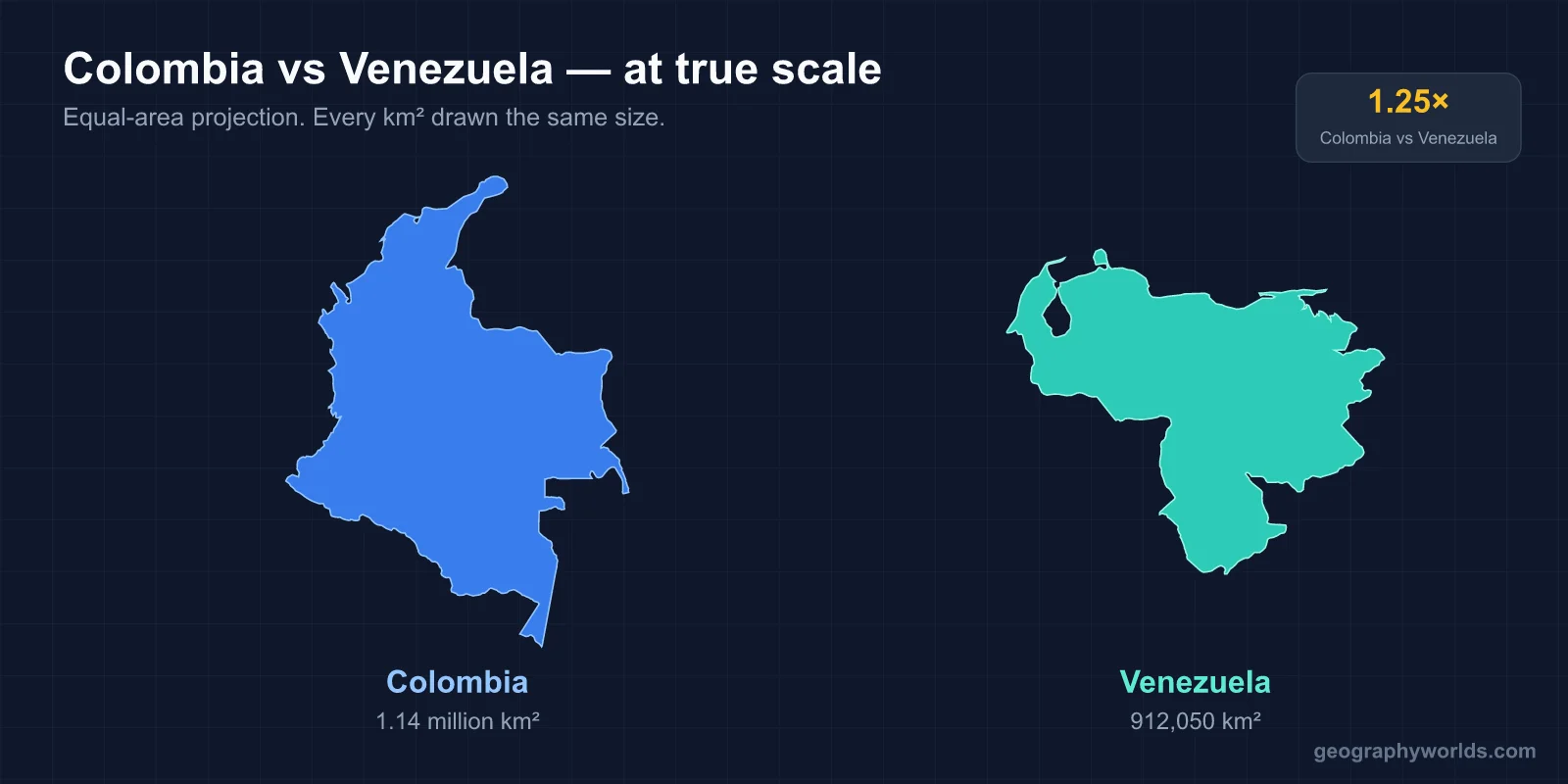
Colombia is the larger of the two, covering 1,141,748 km² against Venezuela's 912,050 km², roughly 1.3 times the area. Both straddle dramatic terrain: the Andes run through each, and both reach the Caribbean. Colombia, however, is the only South American country with coastlines on both the Caribbean and the Pacific, and it stretches from those shores into the Amazon basin. Venezuela's geography centres on the Andes, the oil-rich Lake Maracaibo, the vast Llanos plains, and the ancient Guiana Highlands. The two share a border directly, and Colombia's five land neighbours outnumber Venezuela's three.
Population & Demographics
| Metric | Colombia 🇨🇴 | Venezuela 🇻🇪 |
|---|---|---|
| Population | 53.9 million | 28.6 million |
| Population Density | 47.2 per km² | 31.4 per km² |
Colombia's population lead is wider than its lead in land. It is home to about 53.9 million people, roughly 1.9 times Venezuela's 28.6 million. With more people on a larger territory, Colombia is also the more densely settled, at 47.2 people per square kilometre versus Venezuela's 31.4 — a difference of about 15.8 per km². Both figures remain modest by global standards, a reflection of the rainforest, mountains, and plains that leave large swathes of each country sparsely populated.
Capital Cities
Bogotá is the capital of Colombia and Caracas the capital of Venezuela. Both are South American capitals set in mountainous surroundings; Bogotá sits high on a plateau in the Andes, while Caracas lies in a valley near the Caribbean coast. Each is the largest city and political heart of its nation.
Language, Currency & Culture
| Aspect | Colombia 🇨🇴 | Venezuela 🇻🇪 |
|---|---|---|
| Languages | Spanish (official) | Spanish (official) |
| Currency | Colombian Peso (COP) | Venezuelan Bolívar (VES) |
Here the two countries are alike where many neighbours differ. Both have Spanish as their official language, a shared legacy of Spanish colonial rule, which makes communication across the border seamless. Their currencies, though, are separate: Colombia uses the Colombian Peso, while Venezuela uses the Venezuelan Bolívar.
Climate & Natural Features
| Aspect | Colombia 🇨🇴 | Venezuela 🇻🇪 |
|---|---|---|
| Climate | tropical along coast and plains; cooler in highlands | tropical; hot, humid |
| Key Features | Andes Mountains, Amazon basin, Caribbean coast, Caño Cristales | Angel Falls (world's highest waterfall), Orinoco River, Los Roques |
| Economy | oil, coffee, flowers, mining, tourism | oil (largest reserves in the world), mining, agriculture |
Both countries lie in the tropics, but Colombia's range of elevations gives it a more varied climate, hot along the coasts and plains yet cool in the Andean highlands, while Venezuela is generally hot and humid. Their standout natural features sit at opposite poles of scale: Colombia offers the Andes, the Amazon basin, its Caribbean coast, and the rainbow-hued river of Caño Cristales, while Venezuela holds Angel Falls, the Orinoco River, and the archipelago of Los Roques. Oil features heavily in both economies, but Colombia diversifies into coffee, cut flowers, mining, and tourism, whereas Venezuela's economy rests far more squarely on its oil and mining wealth.
What Makes Each Country Unique
Colombia is renowned for its coffee, ranking among the world's leading producers, along with its emeralds, Caribbean coastline, and salsa dancing. It is the world's foremost source of emeralds, supplying an estimated 70 to 90 percent of the global market.
Venezuela is best known for Angel Falls, the highest uninterrupted waterfall on Earth, as well as its enormous oil reserves and Caribbean shoreline. Water plunges 979 metres at Angel Falls — roughly 15 times the height of Niagara Falls — and the country holds the largest proven oil reserves in the world.
Key Differences at a Glance
- Area: Colombia (1,141,748 km²) vs Venezuela (912,050 km²) — Colombia is 1.3x larger
- Population: Colombia (53.9 million) vs Venezuela (28.6 million) — Colombia is 1.9x more populous
- Capitals: Bogotá vs Caracas
- Currency: Colombian Peso (COP) vs Venezuelan Bolívar (VES)
- Continents: South America vs South America
- Density: Colombia is more densely populated (difference of ~15.8 people per km²)
- Languages: Spanish (official) vs Spanish (official) — both Spanish-speaking
Verdict
Colombia and Venezuela are northern South American neighbours that share a language, a border, and a stretch of the Andes, yet differ in scale. Colombia is the larger country by about 1.3 times, the more populous by roughly 1.9 times, and the more densely settled of the two, though both remain relatively open countries thanks to their forests, mountains, and plains.
Colombia's variety is its hallmark, from two ocean coasts to Andean highlands, the Amazon, and the striking Caño Cristales, supporting an economy that spreads across oil, coffee, flowers, and tourism. Venezuela's identity is anchored by superlatives, the world's highest waterfall at Angel Falls and the planet's largest oil reserves, with an economy weighted heavily toward those resources.
Placed side by side, the two countries reveal how much two close neighbours can diverge while sharing so much. Whether you are planning a visit, studying South America, or simply curious, comparing them deepens the picture of this richly varied corner of the continent.
Test Your Knowledge!
Think you know your countries? Try our interactive geography quiz!
Play Geography Games →