
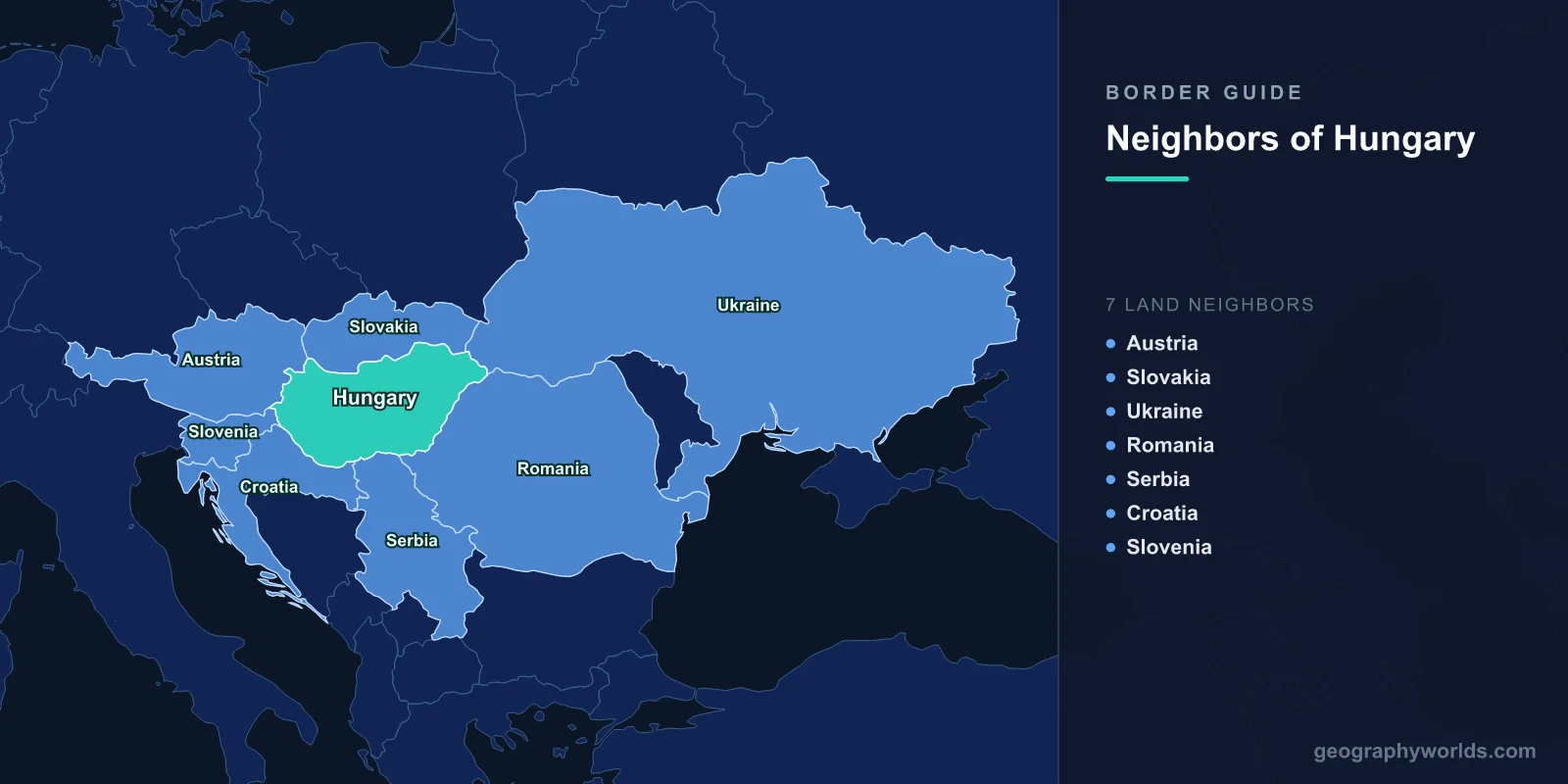
Hungary shares land borders with seven countries: Austria to the west, Slovakia to the north, Ukraine to the northeast, Romania to the east, Serbia to the south, Croatia to the southwest, and Slovenia to the west.
Introduction
Hungary's borders are a product of the Treaty of Trianon (1920), which reduced historic Hungary by two-thirds after World War I. The current borders cut through the flat Pannonian (Carpathian) Basin, often dividing communities that had been united for centuries. This legacy means that millions of ethnic Hungarians live in neighboring countries, a fact that profoundly shapes Hungary's foreign policy.
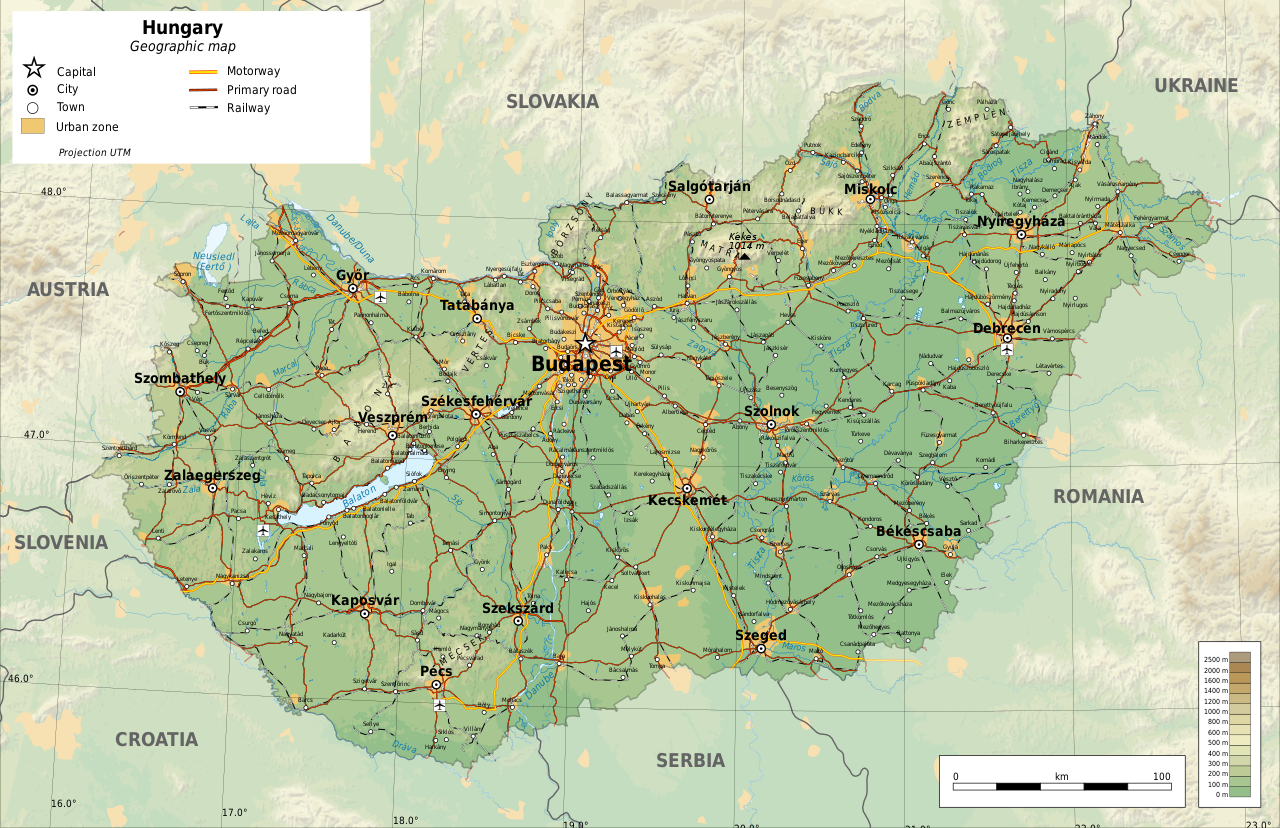
Overview of Hungary's Borders
- Total Land Borders: 2,106 km
- Number of Neighbors: 7 countries
- Longest Border: Slovakia (627 km)
- Shortest Border: Slovenia (102 km)
Hungary's borders largely follow the Pannonian Basin, crossing relatively flat terrain of plains and gentle hills. Unlike most European countries, Hungary's borders are not defined by major natural barriers. The Danube and its tributaries form parts of the borders with Slovakia and Croatia, but much of the frontier is simply a line on the map dictated by the post-World War I settlement.
The Treaty of Trianon left approximately 3 million ethnic Hungarians outside Hungary's borders, primarily in Romania (Transylvania), Slovakia (southern regions), Serbia (Vojvodina), and Ukraine (Transcarpathia). This ethnic Hungarian diaspora remains a central issue in Hungarian politics and bilateral relations with all eastern and southern neighbors.
Western Neighbors: Austria and Slovenia
- Austria Border: 321 km
- Slovenia Border: 102 km
- Key Features: Lake Neusiedl, Raba River
The Austrian border at 321 km crosses the flat western edge of the Pannonian Basin around Lake Neusiedl (Ferto), a UNESCO World Heritage cultural landscape. This border was part of the Iron Curtain from 1948 to 1989. The famous Pan-European Picnic of August 1989 on this border was one of the first breaches of the Iron Curtain, when hundreds of East Germans crossed into Austria.
Slovenia's 102 km border is Hungary's shortest, running through the hilly Prekmurje/Orseg region. This border was created when the Kingdom of Serbs, Croats, and Slovenes (later Yugoslavia) received the territory after World War I. A small Hungarian-speaking community (the Prekmurje Hungarians) remains on the Slovenian side.
Northern Neighbor: Slovakia
- Border Length: 627 km
- Key Feature: Danube River forms central section
- Major Crossing: Budapest to Bratislava corridor
Slovakia is Hungary's longest border at 627 km, running from Austria in the west to Ukraine in the east. The Danube forms the central section, with the twin cities of Komarno (Slovakia) and Komarom (Hungary) facing each other across the river. Southern Slovakia has a significant ethnic Hungarian population of about 460,000, roughly 8% of Slovakia's total population.
The Hungarian minority in Slovakia has been a persistent source of bilateral tension, with disputes over language rights, education, and political representation. The Gabcikovo-Nagymaros Dam dispute on the Danube was one of the first cases brought to the International Court of Justice after the fall of communism. Despite these issues, both countries cooperate within the EU and Schengen.
Eastern and Southern Neighbors: Ukraine, Romania, Serbia, and Croatia
- Ukraine Border: 137 km
- Romania Border: 424 km
- Serbia Border: 164 km
- Croatia Border: 329 km
Hungary's eastern borders reflect the Trianon legacy most acutely. The short Ukrainian border (137 km) connects to Transcarpathia, home to about 150,000 ethnic Hungarians. The Romanian border (424 km) leads to Transylvania, where 1.2 million ethnic Hungarians live. Hungary's relationship with Romania is shaped by this large diaspora, with Hungary providing citizenship and voting rights.
The Serbian border at 164 km leads to Vojvodina, where about 250,000 ethnic Hungarians reside. This border gained international attention in 2015-2016 when Hungary built a fence to stop migration flows through the Western Balkans. The Croatian border at 329 km follows the Drava River for part of its length and connects to the Baranya region, another historically multiethnic area.
Cross-Border Relations and Trade
- EU/Schengen: Open borders with Austria, Slovakia, Slovenia, Croatia
- EU External: Ukraine border; Serbia not in EU
- Trade: Germany is top partner; strong ties with Austria, Slovakia
Hungary's western and northern borders with Austria, Slovakia, and Slovenia are open under Schengen. Croatia joined Schengen in 2023. The border with Serbia requires passport control, and the Ukrainian border is an EU external frontier. Hungary's central position on the Danube makes it a key logistics hub for Central European trade.
Hungary's policy of offering citizenship to ethnic Hungarians in neighboring countries has created a unique cross-border dynamic. Dual citizenship allows hundreds of thousands to move freely across borders for work, education, and family connections. However, this policy has also created tensions, particularly with Slovakia and Ukraine, which view it as interference in their internal affairs.
Key Facts
- Hungary borders 7 countries: Austria, Slovakia, Ukraine, Romania, Serbia, Croatia, and Slovenia.
- Hungary's longest border is with Slovakia at 627 km, partly defined by the Danube.
- The Treaty of Trianon (1920) left approximately 3 million ethnic Hungarians outside Hungary's borders.
- The 1989 Pan-European Picnic on the Austrian border helped trigger the fall of the Iron Curtain.
- Hungary built a border fence on the Serbian border in 2015 during the European migration crisis.
Fun Facts
- Historic Hungary before 1920 was three times larger than today's Hungary.
- The Danube flows through Budapest, making it one of few European capitals on a major river border.
- Lake Neusiedl on the Austrian border is the largest lake in Central Europe that cannot be seen across due to its extreme shallowness.
- The twin cities of Komarom (Hungary) and Komarno (Slovakia) share a name but are in different countries since 1920.
Final Thoughts
Hungary's seven borders are a living map of Central European history, drawn by treaties that dismembered a once-vast kingdom. Today, these borders divide and connect in equal measure, with open Schengen frontiers to the west and more contentious boundaries to the east and south. The ethnic Hungarian diaspora in neighboring countries ensures that Hungary's borders remain among the most politically significant in Europe.
Test Your Knowledge!
Think you know which countries share borders? Try our geography games!
Play Geography Games →