
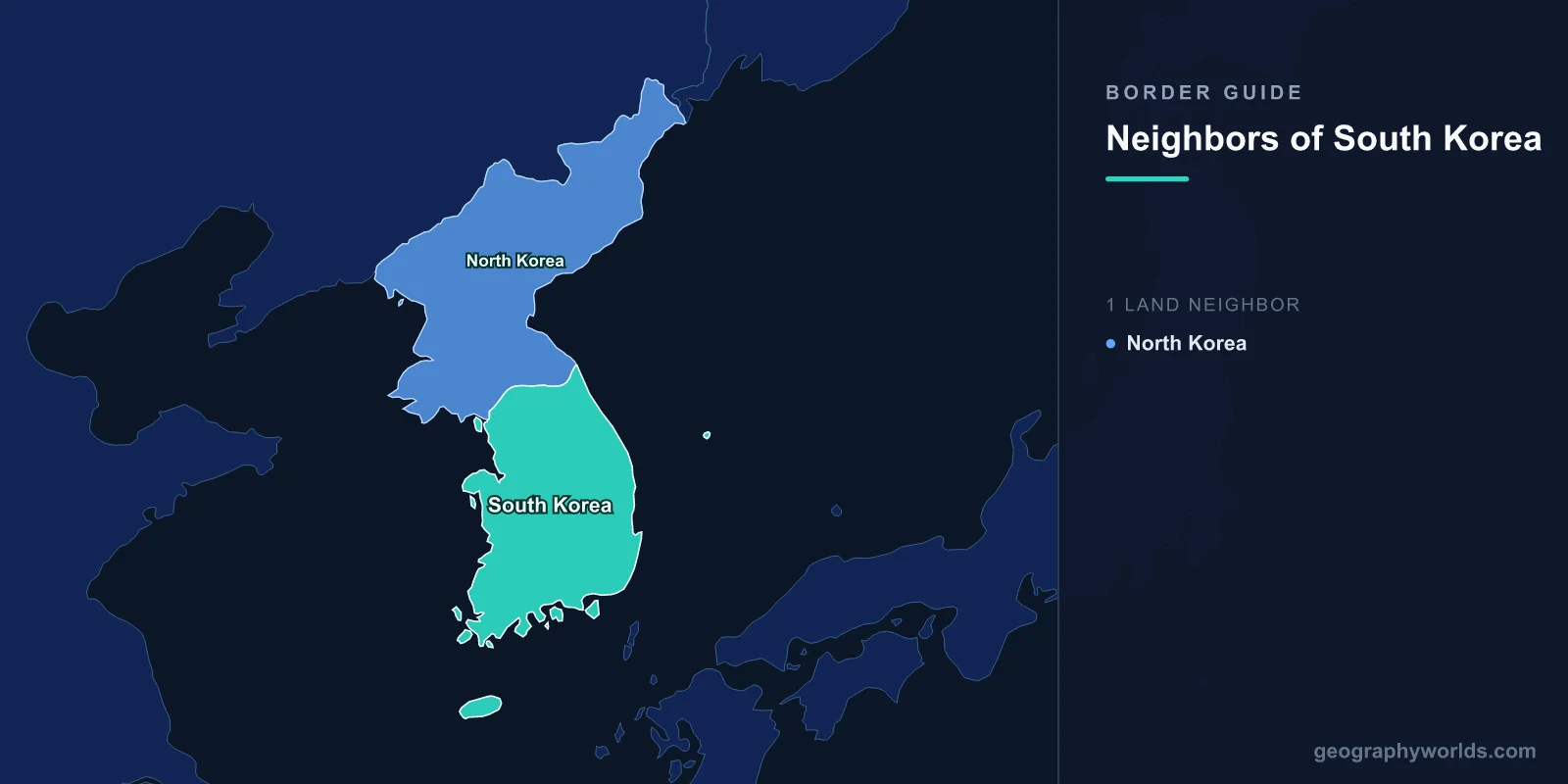
South Korea (Republic of Korea) has only one land neighbor: North Korea, separated by the Korean Demilitarized Zone (DMZ). South Korea also has significant maritime boundaries with Japan and China.
Introduction
South Korea is effectively an island nation, surrounded by water on three sides and cut off from the Asian mainland by the world's most impenetrable border. The DMZ, established after the 1950-1953 Korean War, has turned South Korea into a geopolitical island despite being on a peninsula. This unique situation has profoundly shaped South Korea's economy, military posture, and national psyche.

Overview of South Korea's Borders
- Land Border: 238 km (DMZ with North Korea)
- Land Neighbors: 1 (North Korea)
- Maritime Neighbors: Japan, China
- Coastline: 2,413 km
South Korea's sole land border runs along the DMZ at roughly the 38th parallel, stretching 238 km from the Yellow Sea to the Sea of Japan (East Sea). This border has been essentially sealed since the Korean War armistice in 1953, with virtually no civilian traffic. South Korea has no land connections to any other country.
Maritime boundaries are therefore critical for South Korea. The Korea Strait separates South Korea from Japan (approximately 200 km at its narrowest), while the Yellow Sea separates it from China. The island of Jeju, South Korea's largest, sits in the Korea Strait. Maritime boundary agreements with both Japan and China define fishing rights and economic zones.
The DMZ: World's Most Fortified Border
- DMZ Width: 4 km (2 km on each side)
- Military Personnel: ~600,000 South Korean troops + 28,500 US troops
- Minefields: Over 1 million landmines
The DMZ is a 250 km long, 4 km wide strip running across the Korean Peninsula. Despite its name, it is the most heavily militarized border zone in the world. South Korea maintains approximately 600,000 active-duty troops, supplemented by 28,500 US military personnel. The border includes concrete barriers, razor wire, guard towers, and over a million landmines.
The Joint Security Area (JSA) at Panmunjom is the only point of contact between the two Koreas. Historic moments have occurred here, including the 2018 inter-Korean summit when North Korean leader Kim Jong Un stepped across the border into South Korean territory. The Military Demarcation Line (MDL) running through the JSA's conference rooms is the actual border.
Maritime Neighbor: Japan
- Strait Width: ~200 km at narrowest
- Disputed Territory: Dokdo/Takeshima Islands
- Economic Ties: Major trading partner
Japan lies across the Korea Strait, approximately 200 km from South Korea's southeastern coast. The two countries have a complex relationship shaped by Japan's colonial rule of Korea (1910-1945), but are major economic partners and security allies under the US alliance system. Regular ferry services connect Busan to Fukuoka and other Japanese cities.
The Dokdo/Takeshima islets, tiny rocky formations in the Sea of Japan (East Sea), are a persistent source of diplomatic friction. South Korea controls the islands and maintains a small police garrison, but Japan also claims sovereignty. Despite this dispute, people-to-people exchanges are significant, with millions of tourists traveling between the two countries annually.
Maritime Neighbor: China
- Yellow Sea: Separates South Korea from China
- Economic Ties: China is South Korea's largest trading partner
- Military Concern: Chinese military expansion in the region
China lies across the Yellow Sea, with the Shandong Peninsula roughly 330 km from South Korea's west coast. China is South Korea's largest trading partner, with bilateral trade exceeding $300 billion annually. The deployment of the US THAAD missile defense system in South Korea in 2017 caused a significant diplomatic rift with China, which imposed economic retaliation.
The Yellow Sea is a vital shipping lane and fishing ground shared by both countries. Illegal Chinese fishing in South Korean waters is a persistent issue. The Jeju Strait between Jeju Island and mainland South Korea is a key maritime chokepoint. South Korea's Incheon port faces China and is one of the busiest ports on the Yellow Sea.
Living as a Geopolitical Island
- No Land Access: South Korea cannot access the Asian continent by land
- Air/Sea Dependent: 100% of international travel by air or sea
- Reunification: Would reconnect South Korea to the mainland
South Korea's sole, sealed land border makes it functionally an island. All international trade must go by sea or air, which has driven the development of world-class ports (Busan is one of the world's busiest container ports) and airports (Incheon is a major global hub). South Korea cannot access the Trans-Siberian Railway or Asian highway networks that connect the continent.
The dream of Korean reunification or at least normalization would transform South Korea's geographic situation overnight. Plans exist for a Trans-Korean Railway connecting Seoul to the Trans-Siberian and Trans-China railways, which would turn South Korea into a continental trade hub. The Kaesong Industrial Complex, a joint North-South economic zone, operated from 2004 to 2016 as a brief experiment in cross-border cooperation.
Key Facts
- South Korea has only one land neighbor: North Korea, separated by the DMZ.
- The DMZ is the most heavily fortified border in the world, with over 1 million landmines.
- South Korea functions as a geopolitical island, with all international trade by sea or air.
- China is South Korea's largest trading partner; Japan is a key economic and security partner.
- The Dokdo/Takeshima Islands are disputed between South Korea and Japan.
Fun Facts
- South Korea's Busan port is the 7th busiest container port in the world, partly because the country has no land trade routes.
- Incheon Airport has been rated the world's best airport multiple times.
- The Kaesong Industrial Complex employed 55,000 North Korean workers making South Korean products.
- If reunified, a Trans-Korean Railway could connect Seoul to London via the Trans-Siberian.
Final Thoughts
South Korea's unique position as a country with only one land neighbor, separated by the world's most fortified border, has shaped its development in profound ways. Functioning as a geopolitical island, South Korea has built one of the world's most dynamic economies through maritime and air trade, while the sealed DMZ remains a daily reminder of the peninsula's division.
Test Your Knowledge!
Think you know which countries share borders? Try our geography games!
Play Geography Games →